



Community hub
Recent from talks
Contribute something to knowledge base
Content stats: 0 posts, 0 articles, 1 media, 0 notes
Members stats: 0 subscribers, 0 contributors, 0 moderators, 0 supporters
Subscribers
Supporters
Contributors
Moderators
Hub AI
W. M. Keck Observatory AI simulator
(@W. M. Keck Observatory_simulator)
Hub AI
W. M. Keck Observatory AI simulator
(@W. M. Keck Observatory_simulator)
W. M. Keck Observatory
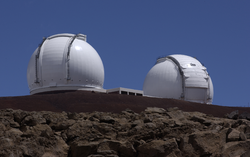
The W. M. Keck Observatory is an astronomical observatory with two telescopes at an elevation of 4,145 meters (13,600 ft) near the summit of Mauna Kea in the U.S. state of Hawaii. Both telescopes have 10 m (33 ft) aperture primary mirrors, and, when completed in 1993 (Keck I) and 1996 (Keck II), they were the largest optical reflecting telescopes in the world. They have been the third and fourth largest since 2006.
With a concept first proposed in 1977, telescope designers Terry Mast, of the University of California, Berkeley, and Jerry Nelson of Lawrence Berkeley Laboratory had been developing the technology necessary to build a large, ground-based telescope. In 1985, Howard B. Keck of the W. M. Keck Foundation gave $70 million to fund the construction of the Keck I telescope, which began in September 1985. First light occurred on November 24, 1990, using 9 of the eventual 36 segments. When construction of the first telescope was well advanced, further donations allowed the construction of a second telescope starting in 1991. The Keck I telescope began science observations in May 1993, while first light for Keck II occurred on April 27, 1996.
The key advance that allowed the construction of the Keck telescopes was the use of active optics to operate smaller mirror segments as a single, contiguous mirror. A mirror of similar size cast of a single piece of glass could not be made rigid enough to hold its shape precisely; it would sag microscopically under its own weight as it was turned to different positions, causing aberrations in the optical path. In the Keck telescopes, each primary mirror is made of 36 hexagonal segments that work together as a unit. Each segment is 1.8 meters wide and 7.5 centimeters thick and weighs half a ton. The mirrors were made in Lexington, Massachusetts by Itek Optical Systems from Zerodur glass-ceramic by the German company Schott AG. On the telescope, each segment is kept stable by a system of active optics, which uses extremely rigid support structures in combination with three actuators under each segment. During observation, the computer-controlled system of sensors and actuators dynamically adjusts each segment's position relative to its neighbors, keeping a surface shape accuracy of four nanometers. As the telescope moves, this twice-per-second adjustment counters the effects of gravity and other environmental and structural effects that can affect mirror shape.
Each Keck telescope sits on an altazimuth mount. Most current 8–10 m class telescopes use altazimuth designs for their reduced structural requirements compared to older equatorial designs. Altazimuth mounting provides the greatest strength and stiffness with the least amount of steel, which, for Keck Observatory, totals about 270 tons per telescope, bringing each telescope's total weight to more than 300 tons. Two proposed designs for the next generation 30 and 40 m telescopes use the same basic technology pioneered at Keck Observatory: a hexagonal mirror array coupled with an altazimuth mounting.
Each of the two telescopes has a primary mirror with an equivalent diameter of 10 meters (32.8 ft or 394 in), slightly smaller than the Gran Telescopio Canarias whose primary mirror has an equivalent diameter of 10.4 meters.
The telescopes are equipped with a suite of cameras and spectrometers that allow observations across much of the visible and near-infrared spectrum.
The Keck Observatory is managed by the California Association for Research in Astronomy, a non-profit 501(c)(3) organization whose board of directors includes representatives from Caltech and the University of California. Construction of the telescopes was made possible through private grants of over $140 million from the W.M. Keck Foundation. The National Aeronautics and Space Administration (NASA) joined the partnership in October 1996 when Keck II commenced observations.
Telescope time is allocated by the partner institutions. Caltech, the University of Hawaii System, and the University of California accept proposals from their own researchers; NASA accepts proposals from researchers based in the United States.
W. M. Keck Observatory
The W. M. Keck Observatory is an astronomical observatory with two telescopes at an elevation of 4,145 meters (13,600 ft) near the summit of Mauna Kea in the U.S. state of Hawaii. Both telescopes have 10 m (33 ft) aperture primary mirrors, and, when completed in 1993 (Keck I) and 1996 (Keck II), they were the largest optical reflecting telescopes in the world. They have been the third and fourth largest since 2006.
With a concept first proposed in 1977, telescope designers Terry Mast, of the University of California, Berkeley, and Jerry Nelson of Lawrence Berkeley Laboratory had been developing the technology necessary to build a large, ground-based telescope. In 1985, Howard B. Keck of the W. M. Keck Foundation gave $70 million to fund the construction of the Keck I telescope, which began in September 1985. First light occurred on November 24, 1990, using 9 of the eventual 36 segments. When construction of the first telescope was well advanced, further donations allowed the construction of a second telescope starting in 1991. The Keck I telescope began science observations in May 1993, while first light for Keck II occurred on April 27, 1996.
The key advance that allowed the construction of the Keck telescopes was the use of active optics to operate smaller mirror segments as a single, contiguous mirror. A mirror of similar size cast of a single piece of glass could not be made rigid enough to hold its shape precisely; it would sag microscopically under its own weight as it was turned to different positions, causing aberrations in the optical path. In the Keck telescopes, each primary mirror is made of 36 hexagonal segments that work together as a unit. Each segment is 1.8 meters wide and 7.5 centimeters thick and weighs half a ton. The mirrors were made in Lexington, Massachusetts by Itek Optical Systems from Zerodur glass-ceramic by the German company Schott AG. On the telescope, each segment is kept stable by a system of active optics, which uses extremely rigid support structures in combination with three actuators under each segment. During observation, the computer-controlled system of sensors and actuators dynamically adjusts each segment's position relative to its neighbors, keeping a surface shape accuracy of four nanometers. As the telescope moves, this twice-per-second adjustment counters the effects of gravity and other environmental and structural effects that can affect mirror shape.
Each Keck telescope sits on an altazimuth mount. Most current 8–10 m class telescopes use altazimuth designs for their reduced structural requirements compared to older equatorial designs. Altazimuth mounting provides the greatest strength and stiffness with the least amount of steel, which, for Keck Observatory, totals about 270 tons per telescope, bringing each telescope's total weight to more than 300 tons. Two proposed designs for the next generation 30 and 40 m telescopes use the same basic technology pioneered at Keck Observatory: a hexagonal mirror array coupled with an altazimuth mounting.
Each of the two telescopes has a primary mirror with an equivalent diameter of 10 meters (32.8 ft or 394 in), slightly smaller than the Gran Telescopio Canarias whose primary mirror has an equivalent diameter of 10.4 meters.
The telescopes are equipped with a suite of cameras and spectrometers that allow observations across much of the visible and near-infrared spectrum.
The Keck Observatory is managed by the California Association for Research in Astronomy, a non-profit 501(c)(3) organization whose board of directors includes representatives from Caltech and the University of California. Construction of the telescopes was made possible through private grants of over $140 million from the W.M. Keck Foundation. The National Aeronautics and Space Administration (NASA) joined the partnership in October 1996 when Keck II commenced observations.
Telescope time is allocated by the partner institutions. Caltech, the University of Hawaii System, and the University of California accept proposals from their own researchers; NASA accepts proposals from researchers based in the United States.
Recent media
Recent media