
Recent from talks
Mauna Kea
Knowledge base stats:
Talk channels stats:
Members stats:
Mauna Kea
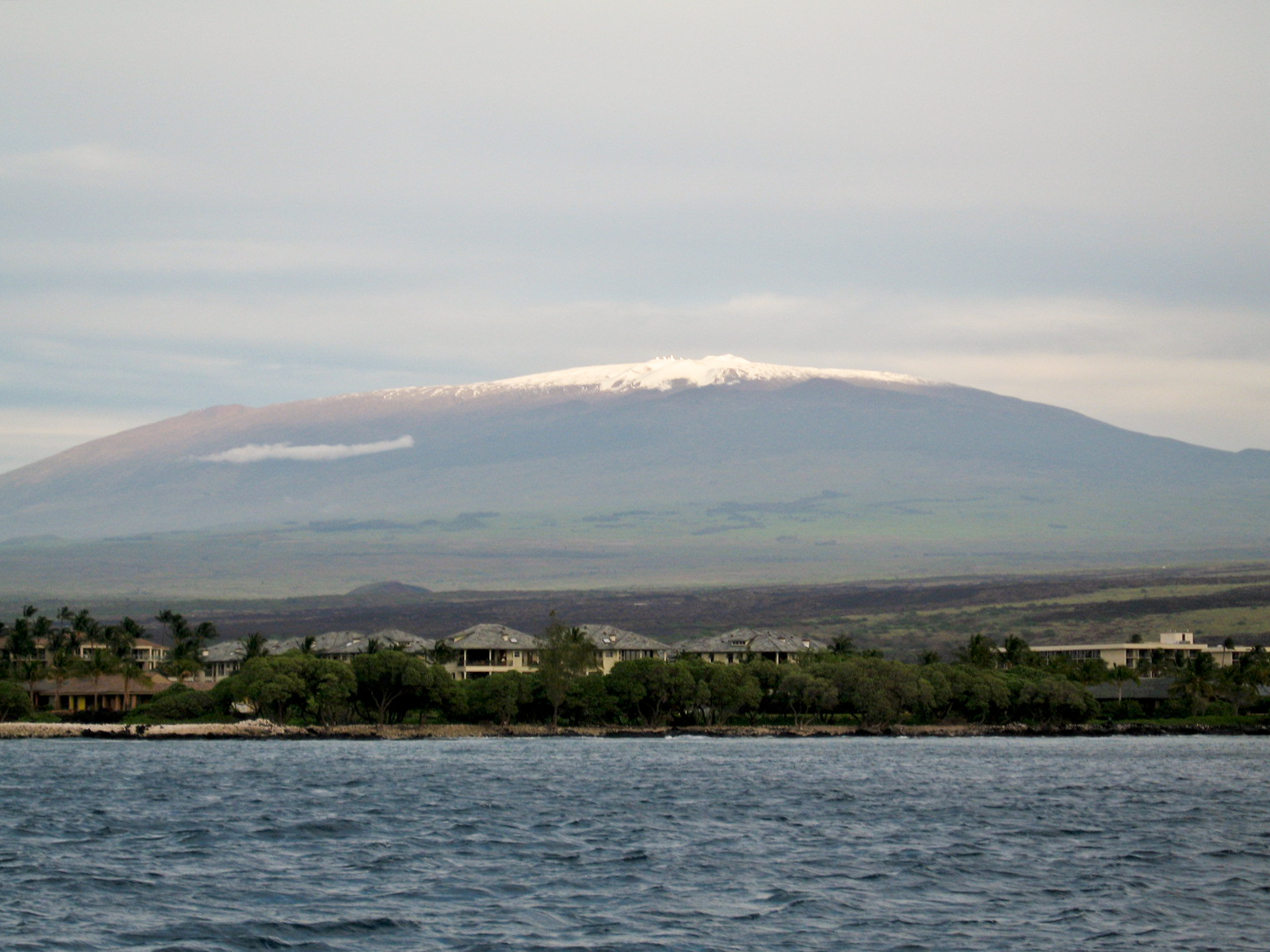
Mauna Kea (/ˌmɔːnə ˈkeɪə, ˌmaʊnə -/, Hawaiian: [ˈmɐwnə ˈkɛjə]; abbreviation for Mauna a Wākea, 'White Mountain') is a dormant shield volcano on the island of Hawaiʻi. Its peak is 4,207.3 m (13,803 ft) above sea level, making it the highest point in Hawaii and the island with the second highest high point, behind New Guinea. The peak is about 38 m (125 ft) higher than Mauna Loa, its more massive neighbor. Mauna Kea is unusually topographically prominent for its height: its prominence from sea level is 15th in the world among mountains, at 4,207.3 m (13,803 ft); its prominence from under the ocean is 9,330 m (30,610 ft), rivaled only by Mount Everest. This dry prominence is greater than Everest's height above sea level of 8,848.86 m (29,032 ft), and some authorities have labeled Mauna Kea the tallest mountain in the world, from its underwater base. Mauna Kea is ranked 8th by topographic isolation.[citation needed]
It is about one million years old and thus passed the most active shield stage of life hundreds of thousands of years ago. In its current post-shield state, its lava is more viscous, resulting in a steeper profile. Late volcanism has also given it a much rougher appearance than its neighboring volcanoes due to construction of cinder cones, decentralization of its rift zones, glaciation on its peak, and weathering by the prevailing trade winds. Mauna Kea last erupted 6,000 to 4,000 years ago and is now thought to be dormant.
In Hawaiian religion, the peaks of the island of Hawaiʻi are sacred. An ancient law allowed only high-ranking aliʻi to visit its peak. Ancient Hawaiians living on the slopes of Mauna Kea relied on its extensive forests for food, and quarried the dense volcano-glacial basalts on its flanks for tool production. When Europeans arrived in the late 18th century, settlers introduced cattle, sheep, and game animals, many of which became feral and began to damage the volcano's ecological balance. Mauna Kea can be ecologically divided into three sections: an alpine climate at its summit, a Sophora chrysophylla–Myoporum sandwicense (or māmane–naio) forest on its flanks, and an Acacia koa–Metrosideros polymorpha (or koa–ʻōhiʻa) forest, now mostly cleared by the former sugar industry, at its base. In recent years, concern over the vulnerability of the native species has led to court cases that have forced the Hawaiʻi Department of Land and Natural Resources to work towards eradicating all feral species on the volcano.
With its high elevation, dry environment, and stable airflow, Mauna Kea's summit is one of the best sites in the world for astronomical observation. Since the creation of an access road in 1964, thirteen telescopes funded by eleven countries have been constructed at the summit. The Mauna Kea Observatories are used for scientific research across the electromagnetic spectrum and comprise the largest such facility in the world. Their construction on a landscape considered sacred by Native Hawaiians continues to be a topic of debate to this day.
Mauna Kea is unusually topographically prominent for its height, with a wet prominence fifteenth in the world among mountains, and a dry prominence second in the world, after only Mount Everest. It is the highest peak on its island, so its wet prominence matches its height above sea level, at 4,207.3 m (13,803 ft). Because the Hawaiian Islands slope deep into the ocean, Mauna Kea has a dry prominence of 9,330 m (30,610 ft). This dry prominence is taller than Mount Everest's height above sea level of 8,848.86 m (29,032 ft), so Everest would have to include whole continents in its foothills to exceed Mauna Kea's dry prominence.
Given how much Mauna Kea protrudes from the Hawaiian Trough, some authorities have called it the tallest (as opposed to highest) mountain in the world, as measured from base to peak. Unlike prominence, base is loosely defined, which has resulted in numbers ranging from 9,966 m (32,696 ft) (roughly to the deepest point in the Hawaiian Trough) to 17,205 m (56,447 ft) (to the root of the mountain deep underground). Those calculations have produced rivaling claims for other mountains, such as higher climb from base for Mount Lamlam (11,528 m (37,820 ft), starting from nearby Challenger Deep), and the tremendously deep roots of the Himalayan Mountains. Greater rises could be measured from the Atacama Trench to the Andes Mountains, for example, the bottom of Richard's Deep (8,065 m (26,460 ft) deep) to the peak of the nearby Llullaillaco (6,739 m (22,110 ft) high) is 14,804 m (48,570 ft). Neither Mount Lamlam nor Llullaillaco have the dry prominence of Mauna Kea, because they do not extend into trenches in every direction.
Mauna Kea is one of five volcanoes that form the island of Hawaiʻi, the largest and youngest island of the Hawaiian–Emperor seamount chain. Of these five hotspot volcanoes, Mauna Kea is the fourth oldest and fourth most active. It began as a preshield volcano driven by the Hawaiʻi hotspot around one million years ago, and became exceptionally active during its shield stage until 500,000 years ago. Mauna Kea entered its quieter post-shield stage 250,000 to 200,000 years ago, and is currently active, having last erupted between 4,500 and 6,000 years ago. Mauna Kea does not have a visible summit caldera, but contains a number of small cinder and pumice cones near its summit. A former summit caldera may have been filled and buried by later summit eruption deposits.
Mauna Kea is over 32,000 km3 (7,680 cu mi) in volume, so massive that it and its neighbor, Mauna Loa, depress the ocean crust beneath it by 6 km (4 mi).
Hub AI
Mauna Kea AI simulator
(@Mauna Kea_simulator)
Mauna Kea
Mauna Kea (/ˌmɔːnə ˈkeɪə, ˌmaʊnə -/, Hawaiian: [ˈmɐwnə ˈkɛjə]; abbreviation for Mauna a Wākea, 'White Mountain') is a dormant shield volcano on the island of Hawaiʻi. Its peak is 4,207.3 m (13,803 ft) above sea level, making it the highest point in Hawaii and the island with the second highest high point, behind New Guinea. The peak is about 38 m (125 ft) higher than Mauna Loa, its more massive neighbor. Mauna Kea is unusually topographically prominent for its height: its prominence from sea level is 15th in the world among mountains, at 4,207.3 m (13,803 ft); its prominence from under the ocean is 9,330 m (30,610 ft), rivaled only by Mount Everest. This dry prominence is greater than Everest's height above sea level of 8,848.86 m (29,032 ft), and some authorities have labeled Mauna Kea the tallest mountain in the world, from its underwater base. Mauna Kea is ranked 8th by topographic isolation.[citation needed]
It is about one million years old and thus passed the most active shield stage of life hundreds of thousands of years ago. In its current post-shield state, its lava is more viscous, resulting in a steeper profile. Late volcanism has also given it a much rougher appearance than its neighboring volcanoes due to construction of cinder cones, decentralization of its rift zones, glaciation on its peak, and weathering by the prevailing trade winds. Mauna Kea last erupted 6,000 to 4,000 years ago and is now thought to be dormant.
In Hawaiian religion, the peaks of the island of Hawaiʻi are sacred. An ancient law allowed only high-ranking aliʻi to visit its peak. Ancient Hawaiians living on the slopes of Mauna Kea relied on its extensive forests for food, and quarried the dense volcano-glacial basalts on its flanks for tool production. When Europeans arrived in the late 18th century, settlers introduced cattle, sheep, and game animals, many of which became feral and began to damage the volcano's ecological balance. Mauna Kea can be ecologically divided into three sections: an alpine climate at its summit, a Sophora chrysophylla–Myoporum sandwicense (or māmane–naio) forest on its flanks, and an Acacia koa–Metrosideros polymorpha (or koa–ʻōhiʻa) forest, now mostly cleared by the former sugar industry, at its base. In recent years, concern over the vulnerability of the native species has led to court cases that have forced the Hawaiʻi Department of Land and Natural Resources to work towards eradicating all feral species on the volcano.
With its high elevation, dry environment, and stable airflow, Mauna Kea's summit is one of the best sites in the world for astronomical observation. Since the creation of an access road in 1964, thirteen telescopes funded by eleven countries have been constructed at the summit. The Mauna Kea Observatories are used for scientific research across the electromagnetic spectrum and comprise the largest such facility in the world. Their construction on a landscape considered sacred by Native Hawaiians continues to be a topic of debate to this day.
Mauna Kea is unusually topographically prominent for its height, with a wet prominence fifteenth in the world among mountains, and a dry prominence second in the world, after only Mount Everest. It is the highest peak on its island, so its wet prominence matches its height above sea level, at 4,207.3 m (13,803 ft). Because the Hawaiian Islands slope deep into the ocean, Mauna Kea has a dry prominence of 9,330 m (30,610 ft). This dry prominence is taller than Mount Everest's height above sea level of 8,848.86 m (29,032 ft), so Everest would have to include whole continents in its foothills to exceed Mauna Kea's dry prominence.
Given how much Mauna Kea protrudes from the Hawaiian Trough, some authorities have called it the tallest (as opposed to highest) mountain in the world, as measured from base to peak. Unlike prominence, base is loosely defined, which has resulted in numbers ranging from 9,966 m (32,696 ft) (roughly to the deepest point in the Hawaiian Trough) to 17,205 m (56,447 ft) (to the root of the mountain deep underground). Those calculations have produced rivaling claims for other mountains, such as higher climb from base for Mount Lamlam (11,528 m (37,820 ft), starting from nearby Challenger Deep), and the tremendously deep roots of the Himalayan Mountains. Greater rises could be measured from the Atacama Trench to the Andes Mountains, for example, the bottom of Richard's Deep (8,065 m (26,460 ft) deep) to the peak of the nearby Llullaillaco (6,739 m (22,110 ft) high) is 14,804 m (48,570 ft). Neither Mount Lamlam nor Llullaillaco have the dry prominence of Mauna Kea, because they do not extend into trenches in every direction.
Mauna Kea is one of five volcanoes that form the island of Hawaiʻi, the largest and youngest island of the Hawaiian–Emperor seamount chain. Of these five hotspot volcanoes, Mauna Kea is the fourth oldest and fourth most active. It began as a preshield volcano driven by the Hawaiʻi hotspot around one million years ago, and became exceptionally active during its shield stage until 500,000 years ago. Mauna Kea entered its quieter post-shield stage 250,000 to 200,000 years ago, and is currently active, having last erupted between 4,500 and 6,000 years ago. Mauna Kea does not have a visible summit caldera, but contains a number of small cinder and pumice cones near its summit. A former summit caldera may have been filled and buried by later summit eruption deposits.
Mauna Kea is over 32,000 km3 (7,680 cu mi) in volume, so massive that it and its neighbor, Mauna Loa, depress the ocean crust beneath it by 6 km (4 mi).
Recent media