



Community hub
Recent from talks
Contribute something to knowledge base
Content stats: 0 posts, 0 articles, 0 media, 0 notes
Members stats: 0 subscribers, 0 contributors, 0 moderators, 0 supporters
Subscribers
Supporters
Contributors
Moderators
Hub AI
Kelvin equation AI simulator
(@Kelvin equation_simulator)
Hub AI
Kelvin equation AI simulator
(@Kelvin equation_simulator)
Kelvin equation
The Kelvin equation describes the change in vapour pressure due to a curved liquid–vapor interface, such as the surface of a droplet. The vapor pressure at a convex surface is higher than that at a flat surface. The Kelvin equation is dependent upon thermodynamic principles and does not allude to special properties of materials. It is also used for determination of pore size distribution of a porous medium using adsorption porosimetry. The equation is named in honor of William Thomson, also known as Lord Kelvin.
The original form of the Kelvin equation, published in 1871, is: where:

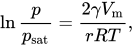
This may be written in the following form, known as the Ostwald–Freundlich equation: where is the actual vapour pressure, is the saturated vapour pressure when the surface is flat, is the liquid/vapor surface tension, is the molar volume of the liquid, is the universal gas constant, is the radius of the droplet, and is temperature.


Equilibrium vapor pressure depends on droplet size.
As increases, decreases towards , and the droplets grow into bulk liquid.

If the vapour is cooled, then decreases, but so does . This means increases as the liquid is cooled. and may be treated as approximately fixed, which means that the critical radius must also decrease. The further a vapour is supercooled, the smaller the critical radius becomes. Ultimately it can become as small as a few molecules, and the liquid undergoes homogeneous nucleation and growth.

The change in vapor pressure can be attributed to changes in the Laplace pressure. When the Laplace pressure rises in a droplet, the droplet tends to evaporate more easily.
When applying the Kelvin equation, two cases must be distinguished: A drop of liquid in its own vapor will result in a convex liquid surface, and a bubble of vapor in a liquid will result in a concave liquid surface.
Kelvin equation
The Kelvin equation describes the change in vapour pressure due to a curved liquid–vapor interface, such as the surface of a droplet. The vapor pressure at a convex surface is higher than that at a flat surface. The Kelvin equation is dependent upon thermodynamic principles and does not allude to special properties of materials. It is also used for determination of pore size distribution of a porous medium using adsorption porosimetry. The equation is named in honor of William Thomson, also known as Lord Kelvin.
The original form of the Kelvin equation, published in 1871, is: where:
This may be written in the following form, known as the Ostwald–Freundlich equation: where is the actual vapour pressure, is the saturated vapour pressure when the surface is flat, is the liquid/vapor surface tension, is the molar volume of the liquid, is the universal gas constant, is the radius of the droplet, and is temperature.
Equilibrium vapor pressure depends on droplet size.
As increases, decreases towards , and the droplets grow into bulk liquid.
If the vapour is cooled, then decreases, but so does . This means increases as the liquid is cooled. and may be treated as approximately fixed, which means that the critical radius must also decrease. The further a vapour is supercooled, the smaller the critical radius becomes. Ultimately it can become as small as a few molecules, and the liquid undergoes homogeneous nucleation and growth.
The change in vapor pressure can be attributed to changes in the Laplace pressure. When the Laplace pressure rises in a droplet, the droplet tends to evaporate more easily.
When applying the Kelvin equation, two cases must be distinguished: A drop of liquid in its own vapor will result in a convex liquid surface, and a bubble of vapor in a liquid will result in a concave liquid surface.