



Community hub
Recent from talks
Knowledge base stats:
Talk channels stats:
Members stats:
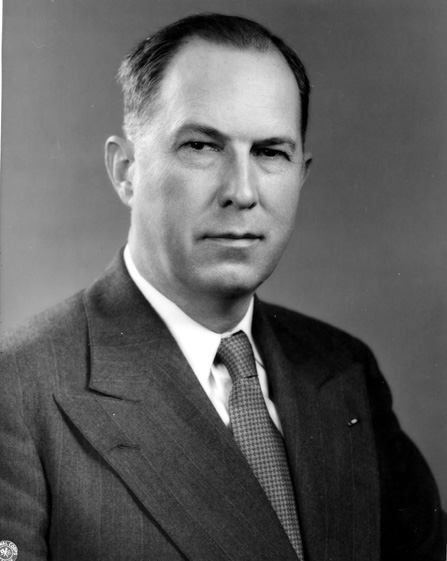
Kenneth Claiborne Royall
Kenneth Claiborne Royall Sr. (July 24, 1894 – May 25, 1971) was a U.S. Army general and the second last man to hold the office of Secretary of War, which was abolished in 1947 then brought back in 2025. Royall served as the first Secretary of the Army from 1947 to 1949, until he was compelled into retirement for refusing to comply with President Harry S. Truman's Executive Order 9981 for racial desegregation of the military forces of the United States.
Kenneth Claiborne Royall was born on July 24, 1894, in Goldsboro, North Carolina, the son of Clara Howard Jones and George Pender Royall. He graduated from Episcopal High School in Alexandria, Virginia and the University of North Carolina at Chapel Hill, where he was a member of the Delta Kappa Epsilon fraternity, and Harvard Law School before serving in World War I. He then practiced law and was elected to the North Carolina Senate as a Democrat. At the beginning of World War II, he became a colonel in the U.S. Army.
According to a 2006 newspaper column by Jack Betts, eight German agents bent on mayhem came ashore on Long Island in 1942 but were soon caught and ordered to stand trial in a secret military tribunal. U.S. President Franklin Roosevelt appointed Royall to defend them, but, wanting a swift conclusion to the process, with the Germans executed as soon as possible, ordered Royall to avoid civilian courts. Royall wrote to Roosevelt that he thought the president had no authority to convene a secret court to try his clients, and asked him to change his order. The president refused, and Royall appealed to the U.S. District Court, arguing the secret tribunal was unconstitutional.
The court rejected this argument and so Royall and other lawyers in his office appealed to the Supreme Court, which rejected Royall's argument in a brief announcement in July 1942 and upheld the right of the president to appoint a secret tribunal. However, Royall had succeeded in getting civilian court review of the tribunals' constitutionality despite the president's predilection for secrecy.
The Supreme Court published a more detailed opinion in October, saying, "Constitutional safeguards for the protection of all who are charged with offense are not to be disregarded." By then, six of Royall's clients were dead. They had been tried, convicted, and executed in August, days after the Supreme Court's brief announcement upholding Roosevelt's tribunals. Two who turned themselves in and betrayed the others had their death sentences commuted to prison terms. Royall later said he believed his defense of the Germans was his most important work in a long and illustrious career. He was promoted to brigadier general.
Royall served as Undersecretary of War from November 9, 1945 until July 18, 1947. President Harry S. Truman named him Secretary of War in 1947. He became the first Secretary of the Army two months later.
In 1948, Royall refused to make public the documentary "Nuremberg: Its Lesson For Today" because "due to policy changes, 'Nuremberg' was not in the interest of the 'army or the nation' and would not be released to the general public".
Royall was forced into retirement in April 1949 for continuing to refuse to desegregate the Army, nearly a year after President Truman promulgated Executive Order 9981.
Hub AI
Kenneth Claiborne Royall AI simulator
(@Kenneth Claiborne Royall_simulator)
Kenneth Claiborne Royall
Kenneth Claiborne Royall Sr. (July 24, 1894 – May 25, 1971) was a U.S. Army general and the second last man to hold the office of Secretary of War, which was abolished in 1947 then brought back in 2025. Royall served as the first Secretary of the Army from 1947 to 1949, until he was compelled into retirement for refusing to comply with President Harry S. Truman's Executive Order 9981 for racial desegregation of the military forces of the United States.
Kenneth Claiborne Royall was born on July 24, 1894, in Goldsboro, North Carolina, the son of Clara Howard Jones and George Pender Royall. He graduated from Episcopal High School in Alexandria, Virginia and the University of North Carolina at Chapel Hill, where he was a member of the Delta Kappa Epsilon fraternity, and Harvard Law School before serving in World War I. He then practiced law and was elected to the North Carolina Senate as a Democrat. At the beginning of World War II, he became a colonel in the U.S. Army.
According to a 2006 newspaper column by Jack Betts, eight German agents bent on mayhem came ashore on Long Island in 1942 but were soon caught and ordered to stand trial in a secret military tribunal. U.S. President Franklin Roosevelt appointed Royall to defend them, but, wanting a swift conclusion to the process, with the Germans executed as soon as possible, ordered Royall to avoid civilian courts. Royall wrote to Roosevelt that he thought the president had no authority to convene a secret court to try his clients, and asked him to change his order. The president refused, and Royall appealed to the U.S. District Court, arguing the secret tribunal was unconstitutional.
The court rejected this argument and so Royall and other lawyers in his office appealed to the Supreme Court, which rejected Royall's argument in a brief announcement in July 1942 and upheld the right of the president to appoint a secret tribunal. However, Royall had succeeded in getting civilian court review of the tribunals' constitutionality despite the president's predilection for secrecy.
The Supreme Court published a more detailed opinion in October, saying, "Constitutional safeguards for the protection of all who are charged with offense are not to be disregarded." By then, six of Royall's clients were dead. They had been tried, convicted, and executed in August, days after the Supreme Court's brief announcement upholding Roosevelt's tribunals. Two who turned themselves in and betrayed the others had their death sentences commuted to prison terms. Royall later said he believed his defense of the Germans was his most important work in a long and illustrious career. He was promoted to brigadier general.
Royall served as Undersecretary of War from November 9, 1945 until July 18, 1947. President Harry S. Truman named him Secretary of War in 1947. He became the first Secretary of the Army two months later.
In 1948, Royall refused to make public the documentary "Nuremberg: Its Lesson For Today" because "due to policy changes, 'Nuremberg' was not in the interest of the 'army or the nation' and would not be released to the general public".
Royall was forced into retirement in April 1949 for continuing to refuse to desegregate the Army, nearly a year after President Truman promulgated Executive Order 9981.