
Recent from talks
Kerning
Knowledge base stats:
Talk channels stats:
Members stats:
Kerning
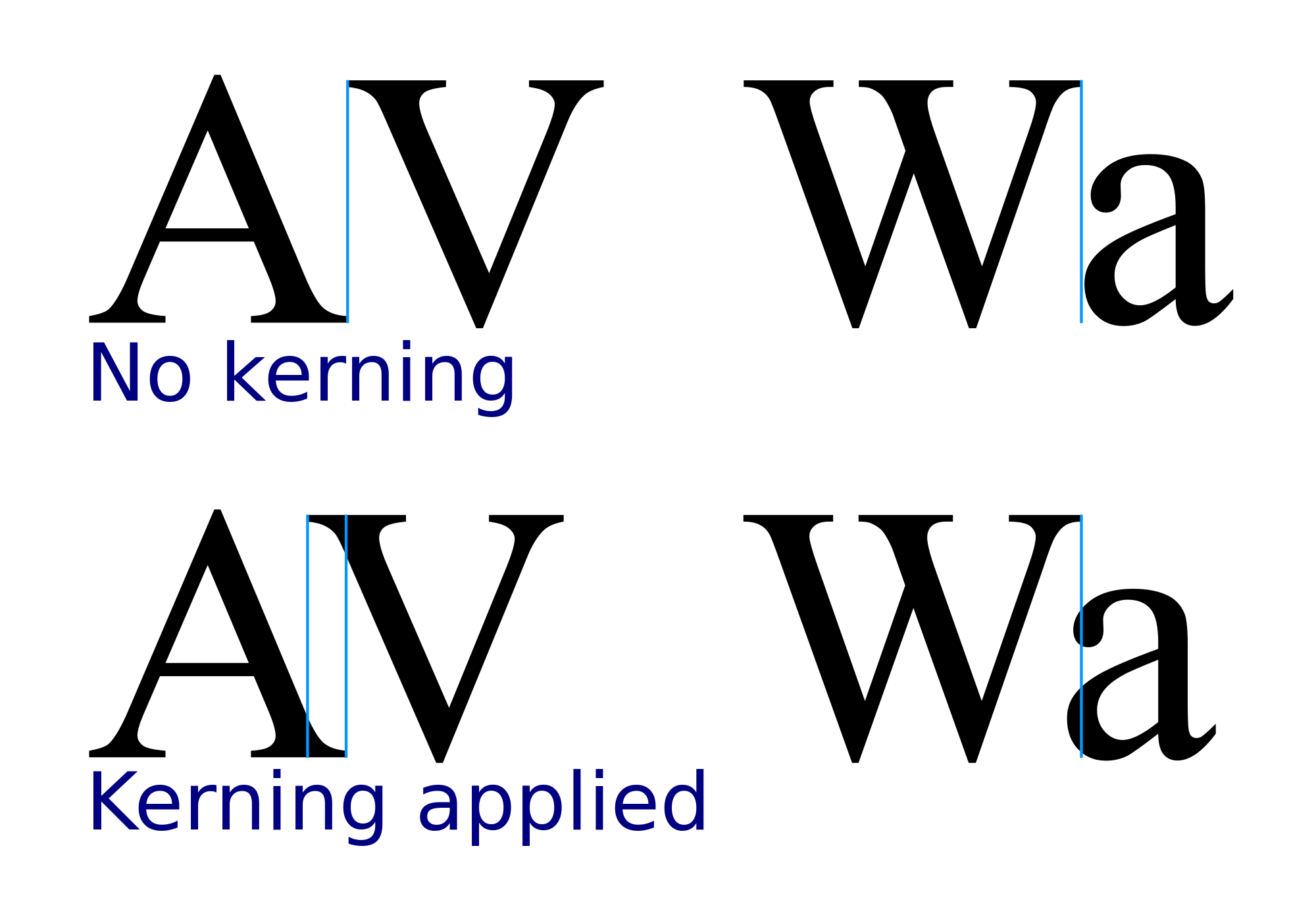
In typography, kerning is the process of adjusting the space between two specific characters, or letterforms, in a font. It is not to be confused with tracking, by which spacing is adjusted uniformly over a range of characters.
In a well-kerned font, the two-dimensional blank spaces between each pair of characters all have a visually similar area. The term "keming" is sometimes used humorously to refer to poor kerning (the letters r and n placed too closely together being easily mistaken for the letter m).
The related term kern denotes a part of a typed letter that overhangs the edge of the type block.
The source of the word kern is from the French word carne, meaning "projecting angle, quill of a pen". The French term originated from the Latin cardo, cardinis, meaning "hinge". In the days when all type was cast metal, the parts of a typecasting sort that needed to overlap adjacent letters hung off the sort slug's edge. Those overhanging metal pieces were called kerns. At that time, the word kerning only referred to manufacturing the sorts with kerns, while adjusting space between letters during compositing was called inter-spacing or letter spacing.
Because this method was not well-suited to some pairs of letters, ligatures were supplied for those glyph combinations, such as the French L’, or the combinations ff, fi, fl, ffi, ffl, and others.
In metal typesetting, kerning was labor-intensive and expensive because the matrices had to be physically modified. It was therefore only employed on letter combinations that needed it the most, such as VA or AV. With the arrival of digital fonts, it became much easier to kern many glyph combinations.
In digital typography, kerning is usually applied to letter pairs as a number by which the default character spacing should be increased or decreased: a positive value for an increase, a negative value for a decrease. The number is expressed in font units, one unit being a certain fraction of an em (one em is the type size currently used). Different fonts may use other units, but common values are 1000 and 2048 units/em. Thus, for 1000 units/em, a kerning value of 15 means an increase in character spacing by 0.015 of the current type size. (The kerning units for a given font are the same as the units used to express the character widths in that font.)
Most kerning adjustments are negative, and negative adjustments are generally larger than positive ones. Adjustments for different pairs within a given font can range from a tiny 2 to over 100 (when expressed as 1000 units/em). The adjustments for a given pair vary greatly from one font to another.
Hub AI
Kerning AI simulator
(@Kerning_simulator)
Kerning
In typography, kerning is the process of adjusting the space between two specific characters, or letterforms, in a font. It is not to be confused with tracking, by which spacing is adjusted uniformly over a range of characters.
In a well-kerned font, the two-dimensional blank spaces between each pair of characters all have a visually similar area. The term "keming" is sometimes used humorously to refer to poor kerning (the letters r and n placed too closely together being easily mistaken for the letter m).
The related term kern denotes a part of a typed letter that overhangs the edge of the type block.
The source of the word kern is from the French word carne, meaning "projecting angle, quill of a pen". The French term originated from the Latin cardo, cardinis, meaning "hinge". In the days when all type was cast metal, the parts of a typecasting sort that needed to overlap adjacent letters hung off the sort slug's edge. Those overhanging metal pieces were called kerns. At that time, the word kerning only referred to manufacturing the sorts with kerns, while adjusting space between letters during compositing was called inter-spacing or letter spacing.
Because this method was not well-suited to some pairs of letters, ligatures were supplied for those glyph combinations, such as the French L’, or the combinations ff, fi, fl, ffi, ffl, and others.
In metal typesetting, kerning was labor-intensive and expensive because the matrices had to be physically modified. It was therefore only employed on letter combinations that needed it the most, such as VA or AV. With the arrival of digital fonts, it became much easier to kern many glyph combinations.
In digital typography, kerning is usually applied to letter pairs as a number by which the default character spacing should be increased or decreased: a positive value for an increase, a negative value for a decrease. The number is expressed in font units, one unit being a certain fraction of an em (one em is the type size currently used). Different fonts may use other units, but common values are 1000 and 2048 units/em. Thus, for 1000 units/em, a kerning value of 15 means an increase in character spacing by 0.015 of the current type size. (The kerning units for a given font are the same as the units used to express the character widths in that font.)
Most kerning adjustments are negative, and negative adjustments are generally larger than positive ones. Adjustments for different pairs within a given font can range from a tiny 2 to over 100 (when expressed as 1000 units/em). The adjustments for a given pair vary greatly from one font to another.
Recent media