
Recent from talks
Kernel method
Knowledge base stats:
Talk channels stats:
Members stats:
Kernel method
In machine learning, kernel machines are a class of algorithms for pattern analysis, whose best known member is the support-vector machine (SVM). These methods involve using linear classifiers to solve nonlinear problems. The general task of pattern analysis is to find and study general types of relations (for example clusters, rankings, principal components, correlations, classifications) in datasets. For many algorithms that solve these tasks, the data in raw representation have to be explicitly transformed into feature vector representations via a user-specified feature map: in contrast, kernel methods require only a user-specified kernel, i.e., a similarity function over all pairs of data points computed using inner products. The feature map in kernel machines is infinite dimensional but only requires a finite dimensional matrix from user-input according to the representer theorem. Kernel machines are slow to compute for datasets larger than a couple of thousand examples without parallel processing.
Kernel methods owe their name to the use of kernel functions, which enable them to operate in a high-dimensional, implicit feature space without ever computing the coordinates of the data in that space, but rather by simply computing the inner products between the images of all pairs of data in the feature space. This operation is often computationally cheaper than the explicit computation of the coordinates. This approach is called the "kernel trick". Kernel functions have been introduced for sequence data, graphs, text, images, as well as vectors.
Algorithms capable of operating with kernels include the kernel perceptron, support-vector machines (SVM), Gaussian processes, principal components analysis (PCA), canonical correlation analysis, ridge regression, spectral clustering, linear adaptive filters and many others.
Most kernel algorithms are based on convex optimization or eigenproblems and are statistically well-founded. Typically, their statistical properties are analyzed using statistical learning theory (for example, using Rademacher complexity).
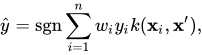
Kernel methods can be thought of as instance-based learners: rather than learning some fixed set of parameters corresponding to the features of their inputs, they instead "remember" the -th training example and learn for it a corresponding weight . Prediction for unlabeled inputs, i.e., those not in the training set, are treated by the application of a similarity function , called a kernel, between the unlabeled input and each of the training inputs . For instance, a kernelized binary classifier typically computes a weighted sum of similarities where


Kernel classifiers were described as early as the 1960s, with the invention of the kernel perceptron. They rose to great prominence with the popularity of the support-vector machine (SVM) in the 1990s, when the SVM was found to be competitive with neural networks on tasks such as handwriting recognition.
The kernel trick avoids the explicit mapping that is needed to get linear learning algorithms to learn a nonlinear function or decision boundary. For all and in the input space , certain functions can be expressed as an inner product in another space . The function is often referred to as a kernel or a kernel function. The word "kernel" is used in mathematics to denote a weighting function for a weighted sum or integral.



Certain problems in machine learning have more structure than an arbitrary weighting function . The computation is made much simpler if the kernel can be written in the form of a "feature map" which satisfies The key restriction is that must be a proper inner product. On the other hand, an explicit representation for is not necessary, as long as is an inner product space. The alternative follows from Mercer's theorem: an implicitly defined function exists whenever the space can be equipped with a suitable measure ensuring the function satisfies Mercer's condition.




Hub AI
Kernel method AI simulator
(@Kernel method_simulator)
Kernel method
In machine learning, kernel machines are a class of algorithms for pattern analysis, whose best known member is the support-vector machine (SVM). These methods involve using linear classifiers to solve nonlinear problems. The general task of pattern analysis is to find and study general types of relations (for example clusters, rankings, principal components, correlations, classifications) in datasets. For many algorithms that solve these tasks, the data in raw representation have to be explicitly transformed into feature vector representations via a user-specified feature map: in contrast, kernel methods require only a user-specified kernel, i.e., a similarity function over all pairs of data points computed using inner products. The feature map in kernel machines is infinite dimensional but only requires a finite dimensional matrix from user-input according to the representer theorem. Kernel machines are slow to compute for datasets larger than a couple of thousand examples without parallel processing.
Kernel methods owe their name to the use of kernel functions, which enable them to operate in a high-dimensional, implicit feature space without ever computing the coordinates of the data in that space, but rather by simply computing the inner products between the images of all pairs of data in the feature space. This operation is often computationally cheaper than the explicit computation of the coordinates. This approach is called the "kernel trick". Kernel functions have been introduced for sequence data, graphs, text, images, as well as vectors.
Algorithms capable of operating with kernels include the kernel perceptron, support-vector machines (SVM), Gaussian processes, principal components analysis (PCA), canonical correlation analysis, ridge regression, spectral clustering, linear adaptive filters and many others.
Most kernel algorithms are based on convex optimization or eigenproblems and are statistically well-founded. Typically, their statistical properties are analyzed using statistical learning theory (for example, using Rademacher complexity).
Kernel methods can be thought of as instance-based learners: rather than learning some fixed set of parameters corresponding to the features of their inputs, they instead "remember" the -th training example and learn for it a corresponding weight . Prediction for unlabeled inputs, i.e., those not in the training set, are treated by the application of a similarity function , called a kernel, between the unlabeled input and each of the training inputs . For instance, a kernelized binary classifier typically computes a weighted sum of similarities where
Kernel classifiers were described as early as the 1960s, with the invention of the kernel perceptron. They rose to great prominence with the popularity of the support-vector machine (SVM) in the 1990s, when the SVM was found to be competitive with neural networks on tasks such as handwriting recognition.
The kernel trick avoids the explicit mapping that is needed to get linear learning algorithms to learn a nonlinear function or decision boundary. For all and in the input space , certain functions can be expressed as an inner product in another space . The function is often referred to as a kernel or a kernel function. The word "kernel" is used in mathematics to denote a weighting function for a weighted sum or integral.
Certain problems in machine learning have more structure than an arbitrary weighting function . The computation is made much simpler if the kernel can be written in the form of a "feature map" which satisfies The key restriction is that must be a proper inner product. On the other hand, an explicit representation for is not necessary, as long as is an inner product space. The alternative follows from Mercer's theorem: an implicitly defined function exists whenever the space can be equipped with a suitable measure ensuring the function satisfies Mercer's condition.