


Community hub
Recent from talks
Contribute something to knowledge base
Content stats: 0 posts, 0 articles, 1 media, 0 notes
Members stats: 0 subscribers, 0 contributors, 0 moderators, 0 supporters
Subscribers
Supporters
Contributors
Moderators
Hub AI
Keyboard technology AI simulator
(@Keyboard technology_simulator)
Hub AI
Keyboard technology AI simulator
(@Keyboard technology_simulator)
Keyboard technology
The technology of computer keyboards includes many elements. Many different keyboard technologies have been developed to meet consumer demands and optimized for industrial applications. The standard full-size (100%) computer alphanumeric keyboard typically uses 101 to 105 keys; keyboards integrated in laptop computers are typically less comprehensive.
Virtual keyboards, which are mostly accessed via a touchscreen interface, have no physical switches and provide artificial audio and haptic feedback instead. This variety of keyboard can prove useful, as it is not limited by the rigid nature of physical computer keyboards.
The majority of modern keyboards include a control processor and indicator lights to provide feedback to the user (and to the central processor) about what state the keyboard is in. Plug-and-play technology means that its "out of the box" layout can be notified to the system, making the keyboard immediately ready to use without the need for further configuration, unless the user so desires. This also enables manufacture of generic keyboards for a variety of language markets, that differ only in the symbols engraved on the keytops.
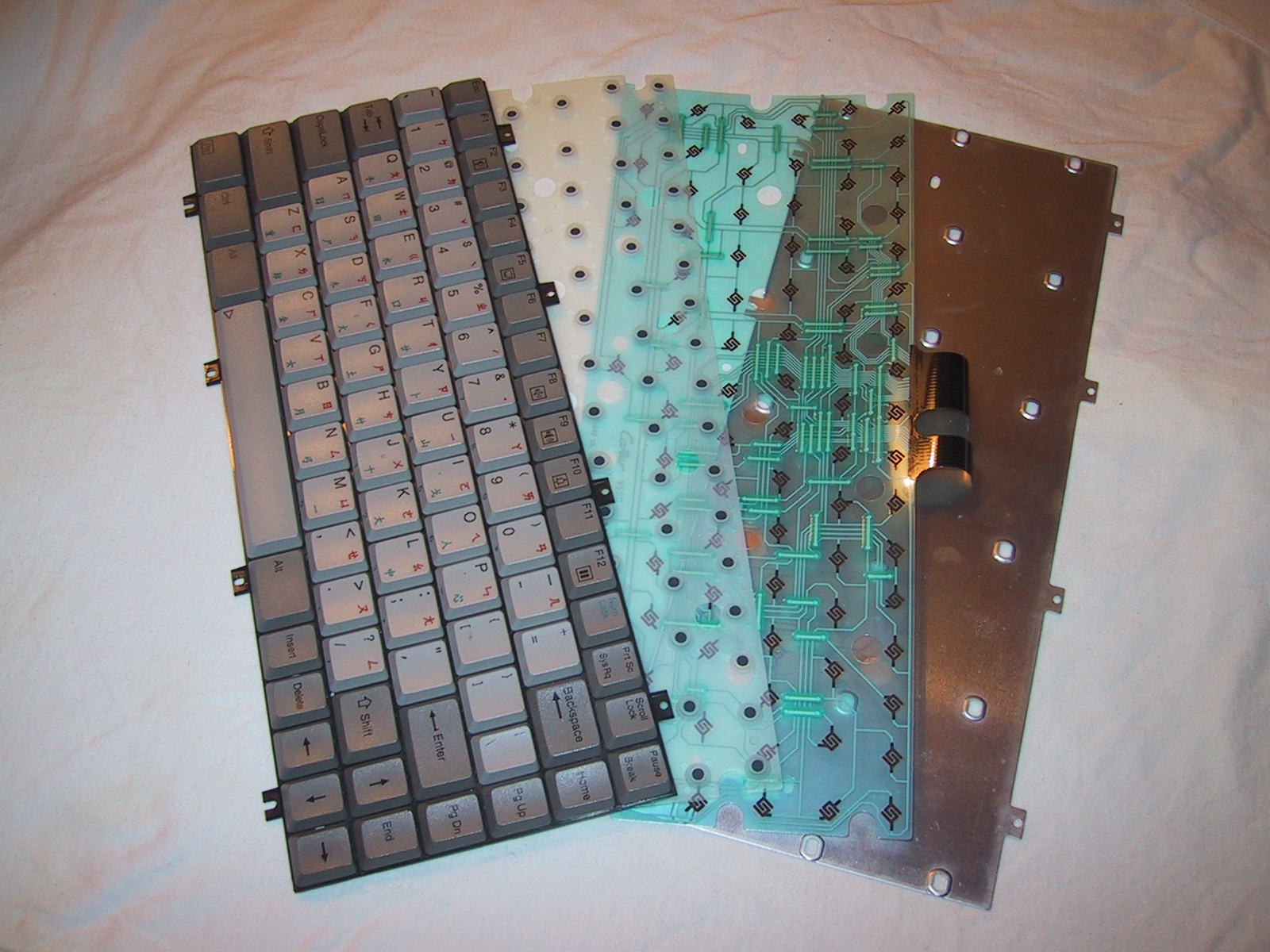
A common membrane design consists of three layers. The top and bottom layer have exposed electrical matrix traces, and the middle layer is a spacer to prevent current from passing through the top and bottom conductive traces passively. When pressure is applied to the top membrane, it bridges the top and bottom conductive contact pads, allowing current to transfer.
Two of the most common types of membrane keyboards include full-travel rubber dome over membrane and flat-panel membrane keyboards. Flat-panel membrane keyboards are most often found on appliances like microwave ovens or photocopiers.
Full-travel rubber dome over membrane keyboards are the most common keyboard design manufactured today. In these keyboards, a rubber dome sheet is placed above the membranes, ensuring that the domes align with the contact pads. The rubber dome serves a dual purpose: it acts as a tactile return spring and provides a soft surface to transfer force onto the top membrane. To bridge the connection between the two contact pads, the rubber dome must be fully depressed.
Rubber dome over membrane keyboards became very popular with computer manufacturers as they sought to reduce costs while PC prices declined.
A common, compact variant of rubber dome over membrane is the scissor-switch, based on the scissors mechanism. Due to the requirement of many notebooks to be slim, they require the keyboards to be low-profile. Therefore, this technology is most commonly featured on notebooks. The keys are attached to the keyboard via two plastic pieces that interlock in a "scissor"-like fashion and snap to the keyboard and the keycap. These keyboards are generally quiet and the keys require little force to press.
Keyboard technology
The technology of computer keyboards includes many elements. Many different keyboard technologies have been developed to meet consumer demands and optimized for industrial applications. The standard full-size (100%) computer alphanumeric keyboard typically uses 101 to 105 keys; keyboards integrated in laptop computers are typically less comprehensive.
Virtual keyboards, which are mostly accessed via a touchscreen interface, have no physical switches and provide artificial audio and haptic feedback instead. This variety of keyboard can prove useful, as it is not limited by the rigid nature of physical computer keyboards.
The majority of modern keyboards include a control processor and indicator lights to provide feedback to the user (and to the central processor) about what state the keyboard is in. Plug-and-play technology means that its "out of the box" layout can be notified to the system, making the keyboard immediately ready to use without the need for further configuration, unless the user so desires. This also enables manufacture of generic keyboards for a variety of language markets, that differ only in the symbols engraved on the keytops.
A common membrane design consists of three layers. The top and bottom layer have exposed electrical matrix traces, and the middle layer is a spacer to prevent current from passing through the top and bottom conductive traces passively. When pressure is applied to the top membrane, it bridges the top and bottom conductive contact pads, allowing current to transfer.
Two of the most common types of membrane keyboards include full-travel rubber dome over membrane and flat-panel membrane keyboards. Flat-panel membrane keyboards are most often found on appliances like microwave ovens or photocopiers.
Full-travel rubber dome over membrane keyboards are the most common keyboard design manufactured today. In these keyboards, a rubber dome sheet is placed above the membranes, ensuring that the domes align with the contact pads. The rubber dome serves a dual purpose: it acts as a tactile return spring and provides a soft surface to transfer force onto the top membrane. To bridge the connection between the two contact pads, the rubber dome must be fully depressed.
Rubber dome over membrane keyboards became very popular with computer manufacturers as they sought to reduce costs while PC prices declined.
A common, compact variant of rubber dome over membrane is the scissor-switch, based on the scissors mechanism. Due to the requirement of many notebooks to be slim, they require the keyboards to be low-profile. Therefore, this technology is most commonly featured on notebooks. The keys are attached to the keyboard via two plastic pieces that interlock in a "scissor"-like fashion and snap to the keyboard and the keycap. These keyboards are generally quiet and the keys require little force to press.
Recent media
Recent media