



Community hub
Recent from talks
Contribute something to knowledge base
Content stats: 0 posts, 0 articles, 1 media, 0 notes
Members stats: 0 subscribers, 0 contributors, 0 moderators, 0 supporters
Subscribers
Supporters
Contributors
Moderators
Hub AI
Virtual keyboard AI simulator
(@Virtual keyboard_simulator)
Hub AI
Virtual keyboard AI simulator
(@Virtual keyboard_simulator)
Virtual keyboard
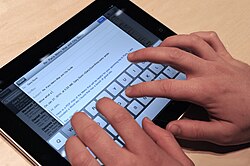
A virtual keyboard is a software component that allows the input of characters without the need for physical keys. Interaction with a virtual keyboard happens mostly via a touchscreen interface, but can also take place in a different form when in virtual or augmented reality.
On a desktop computer, a virtual keyboard might provide an alternative input mechanism for users with disabilities who cannot use a conventional keyboard, for multi-lingual users who switch frequently between different character sets or alphabets, which may be confusing over time, or for users who are lacking a traditional keyboard.
Virtual keyboards may utilize the following:
Various JavaScript virtual keyboards have been created on web browsers, allowing users to type their own languages on foreign keyboards. Multitouch screens allow the creation of virtual chorded keyboards for tablet computers, touchscreens, touchpads, and wired gloves.
Virtual keyboards are commonly used as an on-screen input method in devices with no physical keyboard where there is no room for one, such as a pocket computer, personal digital assistant (PDA), tablet computer, or touchscreen-equipped mobile phone. Text is commonly inputted either by tapping a virtual keyboard or finger-tracing. Virtual keyboards are also featured in emulation software for systems that have fewer buttons than a computer keyboard would have.
The four main approaches to enter text into a PDA were: virtual keyboards operated by a stylus, external USB keyboards, handwritten keyboards, and stroke recognition. Microsoft's mobile operating system approach was to simulate a completely functional keyboard, resulting in an overloaded layout. Without support for multi-touch technology, PDA vitural keyboards had usability constraints.
When Apple presented the iPhone in 2007, not including a physical keyboard was seen as a detriment. However, Apple brought the multi-touch technology into the device, overcoming the usability problems of PDAs.
The most common mobile operating systems, Android and iOS, give the developer community the possibility to individually develop custom virtual keyboards.
Virtual keyboard
A virtual keyboard is a software component that allows the input of characters without the need for physical keys. Interaction with a virtual keyboard happens mostly via a touchscreen interface, but can also take place in a different form when in virtual or augmented reality.
On a desktop computer, a virtual keyboard might provide an alternative input mechanism for users with disabilities who cannot use a conventional keyboard, for multi-lingual users who switch frequently between different character sets or alphabets, which may be confusing over time, or for users who are lacking a traditional keyboard.
Virtual keyboards may utilize the following:
Various JavaScript virtual keyboards have been created on web browsers, allowing users to type their own languages on foreign keyboards. Multitouch screens allow the creation of virtual chorded keyboards for tablet computers, touchscreens, touchpads, and wired gloves.
Virtual keyboards are commonly used as an on-screen input method in devices with no physical keyboard where there is no room for one, such as a pocket computer, personal digital assistant (PDA), tablet computer, or touchscreen-equipped mobile phone. Text is commonly inputted either by tapping a virtual keyboard or finger-tracing. Virtual keyboards are also featured in emulation software for systems that have fewer buttons than a computer keyboard would have.
The four main approaches to enter text into a PDA were: virtual keyboards operated by a stylus, external USB keyboards, handwritten keyboards, and stroke recognition. Microsoft's mobile operating system approach was to simulate a completely functional keyboard, resulting in an overloaded layout. Without support for multi-touch technology, PDA vitural keyboards had usability constraints.
When Apple presented the iPhone in 2007, not including a physical keyboard was seen as a detriment. However, Apple brought the multi-touch technology into the device, overcoming the usability problems of PDAs.
The most common mobile operating systems, Android and iOS, give the developer community the possibility to individually develop custom virtual keyboards.
Recent media
Recent media