
Recent from talks
Bhoi dynasty
Knowledge base stats:
Talk channels stats:
Members stats:
Bhoi dynasty
The Bhoi dynasty or the Yaduvamsa (IAST: Yaduvaṃśa) dynasty were a medieval Hindu dynasty from the Indian subcontinent, which originated in the region of Odisha that reigned from 1541 to 1560 CE. Govinda Vidyadhara had usurped the throne from the later weaker Suryavamsa Gajapati Empire rulers as the kingdom started weakening but had a short-lived reign as ruling chiefs of Odisha as the ensuing internal rivalries and constant threats of invasions rendered them weak and were eventually overthrown by Mukunda Deva of Chalukya Dynasty in 1560.
Under Ramachandra Deva I, the dynasty shifted its capital to Khurda as Mukunda Deva lost his throne in 1568 to the Sultans of Bengal who eventually lost to the Mughal Empire in 1576. During that period, the Bhoi dynasty and the feudatory Garhjat states of Odisha became autonomous states in their own right and came under the Mughal imperial authority till 1717. Later they became vassals of the Maratha Empire who conquered Odisha by 1741 and were later defeated by the British East India Company in 1803. The kingdom was eventually annexed to the British Empire after the King led a failed rebellion against the British in 1804 but later reinstated at Puri in 1809. Later, the British granted him the management of the Jagannath Temple which the nominal heads of the dynasty retained to this day. In other words, the Bhoi dynasty still has the administrative control over one of the holiest shrines in Hinduism, which is the Jagannath Temple at Puri.
"Bhoi" or "Bhoimul" title was used by writers and accountants of the Karan community of the ruling dynasties.
With the death of Prataparudra Deva of the Suryavamsa Gajapati Empire in 1540 and a succession of weak rulers lead to the rise of political instability in the kingdom as there was a rise in internal squabbles, economic decline and increasing threats of invasions from both south and northern parts of the subcontinent. In the political chaos, the Gajapati Empire started weakening as Prataprudra Deva's successors were unable to maintain political authority. Taking de facto control of the situation, the general and minister of the kingdom, Govinda Vidyadhara decided to take the opportunity by murdering the successors of the Gajapati King and usurped the throne of Cuttack, thus laying the foundation of the Bhoi Dynasty.
Under his reign, the kingdom was still undergoing political upheaval as there were rebellions in different provinces and conflicts with the neighbouring Qutb Shahi rulers of the Golconda Sultanate. His 7 year reign came to an end in 1548 and was succeeded by his son Chakrapratapa whose 8 year reign came to an end when he was killed by his son Narasimha Ray in 1557. Around the same time, the influence of Mukunda Deva of the Chalukya dynasty began to grow at the court. He assassinated Narasimha Ray Jena and placed the King's younger brother, Raghuram Ray Chotaraya on the throne, making him his puppet ruler while also simultaneously fending off the influence of his rival, Janardhan Danai Vidyadhara, general and minister of Govinda Vidyadhara . The short-lived nearly two decade old reign of Bhoi dynasty as the ruling Kings of Odisha finally came to an end when Mukunda Deva assassinated Raghuram Ray Chotaraya and crowned himself in 1560.
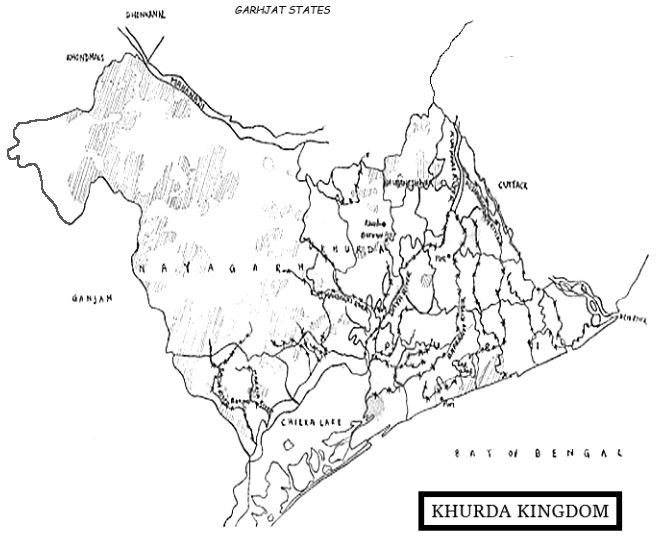
With the defeat of the Chalukya king Mukunda Deva at Cuttack in 1568 at the hands of the Sultans of Bengal who subsequently lost to the Mughals in 1576, the fragmentation of territories of former Odra kingdom was well underway as the territories and the Barabati fort at Cuttack came under Mughal imperial control while the native feudatory Kings had become autonomous and vassals to the imperial rule. Meanwhile the surviving scion of the Bhoi dynasty led by the son of Danai Vidyadhara, Ramachandra Rautraya Mahapatra who took the regnal title as Ramachandra Deva I restored Bhoi rule by shifting the power centre by establishing the Khurda kingdom with their capital at Khurda. The extent of the kingdom ranged from Mahanadi river in the north to Khimidi in the South, while ranging from Khandapara-Daspalla in the west to the coasts of Puri in the east. He also retained control of the Jagannath Temple at Puri. The temple's status as the residing place of Lord Jagannath, the patron deity of Odia people, enabled Ramachandra Dev and the Bhoi dynasty to continue the nominal status and legacy of retaining the regnal titles of the historical ruling Kings of Odisha. Hence the Bhoi dynasty lays the foundation and legitimation of a political institution through the possession of a sacred temple-city thus deriving its legitimacy from an older imperial tradition.
Under Ramachandra Deva I, the patronage and pilgrimage of Jagannath temple at Puri resumed as he assumed its administrative control. He also constructed the Sakshigopal Temple at Sakhigopal near Puri. He also patronised Odia literature and arts as stability returned during his reign in the region following a spate of invasions. His successors continued to rule the kingdom as autonomous vassals to the Mughal Empire while fending off influence of the Mughal governor at Cuttack and continuing patronage of arts, culture and literature. This period coincides with the Riti Yuga, which is an important phase in Odia literature considering the evolution of language from middle Odia of Sarala and Panchasakhas Yuga to modern Odia.
Towards the late 17th and early 18th century, with the weakening of the Mughal Empire after its conflicts with the Marathas in the Mughal–Maratha Wars, the Mughal imperial authority over Odisha region started weakening as a result. King Divyasingha Deva I managed to defeat the Subahdar of the Mughal Governor of Bengal in 1707 thereby reducing their influence over the kingdom which eventually became independent of the Mughal sovereign authority by 1717 under his successor Harekrushna Deva.
Hub AI
Bhoi dynasty AI simulator
(@Bhoi dynasty_simulator)
Bhoi dynasty
The Bhoi dynasty or the Yaduvamsa (IAST: Yaduvaṃśa) dynasty were a medieval Hindu dynasty from the Indian subcontinent, which originated in the region of Odisha that reigned from 1541 to 1560 CE. Govinda Vidyadhara had usurped the throne from the later weaker Suryavamsa Gajapati Empire rulers as the kingdom started weakening but had a short-lived reign as ruling chiefs of Odisha as the ensuing internal rivalries and constant threats of invasions rendered them weak and were eventually overthrown by Mukunda Deva of Chalukya Dynasty in 1560.
Under Ramachandra Deva I, the dynasty shifted its capital to Khurda as Mukunda Deva lost his throne in 1568 to the Sultans of Bengal who eventually lost to the Mughal Empire in 1576. During that period, the Bhoi dynasty and the feudatory Garhjat states of Odisha became autonomous states in their own right and came under the Mughal imperial authority till 1717. Later they became vassals of the Maratha Empire who conquered Odisha by 1741 and were later defeated by the British East India Company in 1803. The kingdom was eventually annexed to the British Empire after the King led a failed rebellion against the British in 1804 but later reinstated at Puri in 1809. Later, the British granted him the management of the Jagannath Temple which the nominal heads of the dynasty retained to this day. In other words, the Bhoi dynasty still has the administrative control over one of the holiest shrines in Hinduism, which is the Jagannath Temple at Puri.
"Bhoi" or "Bhoimul" title was used by writers and accountants of the Karan community of the ruling dynasties.
With the death of Prataparudra Deva of the Suryavamsa Gajapati Empire in 1540 and a succession of weak rulers lead to the rise of political instability in the kingdom as there was a rise in internal squabbles, economic decline and increasing threats of invasions from both south and northern parts of the subcontinent. In the political chaos, the Gajapati Empire started weakening as Prataprudra Deva's successors were unable to maintain political authority. Taking de facto control of the situation, the general and minister of the kingdom, Govinda Vidyadhara decided to take the opportunity by murdering the successors of the Gajapati King and usurped the throne of Cuttack, thus laying the foundation of the Bhoi Dynasty.
Under his reign, the kingdom was still undergoing political upheaval as there were rebellions in different provinces and conflicts with the neighbouring Qutb Shahi rulers of the Golconda Sultanate. His 7 year reign came to an end in 1548 and was succeeded by his son Chakrapratapa whose 8 year reign came to an end when he was killed by his son Narasimha Ray in 1557. Around the same time, the influence of Mukunda Deva of the Chalukya dynasty began to grow at the court. He assassinated Narasimha Ray Jena and placed the King's younger brother, Raghuram Ray Chotaraya on the throne, making him his puppet ruler while also simultaneously fending off the influence of his rival, Janardhan Danai Vidyadhara, general and minister of Govinda Vidyadhara . The short-lived nearly two decade old reign of Bhoi dynasty as the ruling Kings of Odisha finally came to an end when Mukunda Deva assassinated Raghuram Ray Chotaraya and crowned himself in 1560.
With the defeat of the Chalukya king Mukunda Deva at Cuttack in 1568 at the hands of the Sultans of Bengal who subsequently lost to the Mughals in 1576, the fragmentation of territories of former Odra kingdom was well underway as the territories and the Barabati fort at Cuttack came under Mughal imperial control while the native feudatory Kings had become autonomous and vassals to the imperial rule. Meanwhile the surviving scion of the Bhoi dynasty led by the son of Danai Vidyadhara, Ramachandra Rautraya Mahapatra who took the regnal title as Ramachandra Deva I restored Bhoi rule by shifting the power centre by establishing the Khurda kingdom with their capital at Khurda. The extent of the kingdom ranged from Mahanadi river in the north to Khimidi in the South, while ranging from Khandapara-Daspalla in the west to the coasts of Puri in the east. He also retained control of the Jagannath Temple at Puri. The temple's status as the residing place of Lord Jagannath, the patron deity of Odia people, enabled Ramachandra Dev and the Bhoi dynasty to continue the nominal status and legacy of retaining the regnal titles of the historical ruling Kings of Odisha. Hence the Bhoi dynasty lays the foundation and legitimation of a political institution through the possession of a sacred temple-city thus deriving its legitimacy from an older imperial tradition.
Under Ramachandra Deva I, the patronage and pilgrimage of Jagannath temple at Puri resumed as he assumed its administrative control. He also constructed the Sakshigopal Temple at Sakhigopal near Puri. He also patronised Odia literature and arts as stability returned during his reign in the region following a spate of invasions. His successors continued to rule the kingdom as autonomous vassals to the Mughal Empire while fending off influence of the Mughal governor at Cuttack and continuing patronage of arts, culture and literature. This period coincides with the Riti Yuga, which is an important phase in Odia literature considering the evolution of language from middle Odia of Sarala and Panchasakhas Yuga to modern Odia.
Towards the late 17th and early 18th century, with the weakening of the Mughal Empire after its conflicts with the Marathas in the Mughal–Maratha Wars, the Mughal imperial authority over Odisha region started weakening as a result. King Divyasingha Deva I managed to defeat the Subahdar of the Mughal Governor of Bengal in 1707 thereby reducing their influence over the kingdom which eventually became independent of the Mughal sovereign authority by 1717 under his successor Harekrushna Deva.
Recent media