



Community hub
Recent from talks
Contribute something to knowledge base
Content stats: 0 posts, 0 articles, 1 media, 0 notes
Members stats: 0 subscribers, 0 contributors, 0 moderators, 0 supporters
Subscribers
Supporters
Contributors
Moderators
Hub AI
Kiddie ride AI simulator
(@Kiddie ride_simulator)
Hub AI
Kiddie ride AI simulator
(@Kiddie ride_simulator)
Kiddie ride
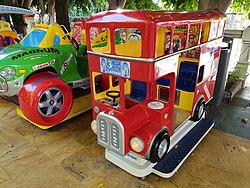
A kiddie ride is a child-sized, themed, mildly interactive coin-operated ride that can be ridden by young children for amusement. Kiddie rides are commonly available in amusement parks, arcades, malls, hotel game rooms, outside supermarkets, and large department stores. Less commonly, they may also appear in other venues such as restaurants, food courts, grocery shops, and auto dealerships. When activated by a coin, a kiddie ride entertains the rider for a short time with a mild motion that replicates the theme of the ride. Most rides also include sounds and music. Some even feature flashing lights, pedals, and/or buttons. Commercial kiddie rides are often colorful with an animal, vehicle, or popular cartoon character theme, which appeals to young children. They are usually driven by a heavy-duty electric motor, which is usually disguised inside or underneath the metal, fiberglass, or vacuum formed plastic body of the ride.
The kiddie ride was first invented in 1930 by James Otto Hahs (1891-1969) of Sikeston, Missouri. Originally called the Hahs Gaited Mechanical Horse, the ride was originally conceived as a Christmas present for his children. However, Hahs soon set about commercializing it. Initially, he used wooden horses, and commissioned carousel makers to make the horses. However, he found these horses to be too heavy and decided that aluminum would be a more suitable material. When told it couldn't be done, however, Hahs went ahead and invented a process to form horses out of metal. The rides would be manufactured at Hahs Machine Works in Sikeston, and they were recognized as the most original invention of the year in 1932. In 1933, Hahs struck a deal with Exhibit Supply Company to distribute his horses, with a 5% cut going to Hahs. When the patent on the ride eventually ran out, he retired from the wealth he had amassed from sales. In 1953, Billboard magazine called it "1953's fastest growing business". Years later, aluminum horses would be replaced by fiberglass.
Developed around the same time, the Link Trainer was initially intended for use as a coin-operated entertainment device as well as a tool for training pilots.
Most old rides do not feature music; also, some vehicle rides may favor engine sounds instead of music. However, on rides that feature music, early rides (and cheaper modern rides that imitate more well-known rides) are equipped with simple integrated circuits that continually playback one melody or repeat a set of melodies in sequence. These have evolved in the sense that the earliest musically-enabled rides played back only a single monophonic melody repetitively. In contrast, later ones played multiple polyphonic melodies, sometimes including short sound or speech samples. Later rides could also use a tape deck, while more recent rides may have a solid-state audio playback device akin to flash-based MP3 players. Usually, the music chosen is generic children's songs, while on licensed rides, the theme song for the licensed character would be used. However, in rare cases, some rides play traditional pop music, and for private rides, the owner may request a song that has personal relevance to be programmed into the ride.
Many modern rides are programmed to play multiple melodies, with the music changing each time the ride is used, the logic being to prolong the interest of the child on the ride. However, some modern rides, in particular licensed character ones, are usually programmed to play a single melody or song, which is usually the theme song of the character's television show or film. There are also some exceptions where there are licensed rides playing totally unrelated pieces of music or non-licensed rides that play only one particular tune, for example, a song about cars on a car-themed ride, the Thomas theme tune on a Thomas the Tank Engine ride, the Postman Pat theme tune on a Postman Pat ride and the Fireman Sam theme tune on a Fireman Sam ride.
Certain rides play a running narration or tell a story instead.
Newer, more advanced rides do not usually start as soon as coins are inserted; instead they prompt the rider, parent or guardian to press a start button, so as to allow the rider to seat him/herself comfortably before starting the ride. Often, these rides will also play a message before movement begins and may also play an ending message once the ride ends, to let the rider know that it is safe to disembark.
Other safety precautions commonly found in more advanced rides include:
Kiddie ride
A kiddie ride is a child-sized, themed, mildly interactive coin-operated ride that can be ridden by young children for amusement. Kiddie rides are commonly available in amusement parks, arcades, malls, hotel game rooms, outside supermarkets, and large department stores. Less commonly, they may also appear in other venues such as restaurants, food courts, grocery shops, and auto dealerships. When activated by a coin, a kiddie ride entertains the rider for a short time with a mild motion that replicates the theme of the ride. Most rides also include sounds and music. Some even feature flashing lights, pedals, and/or buttons. Commercial kiddie rides are often colorful with an animal, vehicle, or popular cartoon character theme, which appeals to young children. They are usually driven by a heavy-duty electric motor, which is usually disguised inside or underneath the metal, fiberglass, or vacuum formed plastic body of the ride.
The kiddie ride was first invented in 1930 by James Otto Hahs (1891-1969) of Sikeston, Missouri. Originally called the Hahs Gaited Mechanical Horse, the ride was originally conceived as a Christmas present for his children. However, Hahs soon set about commercializing it. Initially, he used wooden horses, and commissioned carousel makers to make the horses. However, he found these horses to be too heavy and decided that aluminum would be a more suitable material. When told it couldn't be done, however, Hahs went ahead and invented a process to form horses out of metal. The rides would be manufactured at Hahs Machine Works in Sikeston, and they were recognized as the most original invention of the year in 1932. In 1933, Hahs struck a deal with Exhibit Supply Company to distribute his horses, with a 5% cut going to Hahs. When the patent on the ride eventually ran out, he retired from the wealth he had amassed from sales. In 1953, Billboard magazine called it "1953's fastest growing business". Years later, aluminum horses would be replaced by fiberglass.
Developed around the same time, the Link Trainer was initially intended for use as a coin-operated entertainment device as well as a tool for training pilots.
Most old rides do not feature music; also, some vehicle rides may favor engine sounds instead of music. However, on rides that feature music, early rides (and cheaper modern rides that imitate more well-known rides) are equipped with simple integrated circuits that continually playback one melody or repeat a set of melodies in sequence. These have evolved in the sense that the earliest musically-enabled rides played back only a single monophonic melody repetitively. In contrast, later ones played multiple polyphonic melodies, sometimes including short sound or speech samples. Later rides could also use a tape deck, while more recent rides may have a solid-state audio playback device akin to flash-based MP3 players. Usually, the music chosen is generic children's songs, while on licensed rides, the theme song for the licensed character would be used. However, in rare cases, some rides play traditional pop music, and for private rides, the owner may request a song that has personal relevance to be programmed into the ride.
Many modern rides are programmed to play multiple melodies, with the music changing each time the ride is used, the logic being to prolong the interest of the child on the ride. However, some modern rides, in particular licensed character ones, are usually programmed to play a single melody or song, which is usually the theme song of the character's television show or film. There are also some exceptions where there are licensed rides playing totally unrelated pieces of music or non-licensed rides that play only one particular tune, for example, a song about cars on a car-themed ride, the Thomas theme tune on a Thomas the Tank Engine ride, the Postman Pat theme tune on a Postman Pat ride and the Fireman Sam theme tune on a Fireman Sam ride.
Certain rides play a running narration or tell a story instead.
Newer, more advanced rides do not usually start as soon as coins are inserted; instead they prompt the rider, parent or guardian to press a start button, so as to allow the rider to seat him/herself comfortably before starting the ride. Often, these rides will also play a message before movement begins and may also play an ending message once the ride ends, to let the rider know that it is safe to disembark.
Other safety precautions commonly found in more advanced rides include:
Recent media
Recent media