
Recent from talks
Kilim
Knowledge base stats:
Talk channels stats:
Members stats:
Kilim
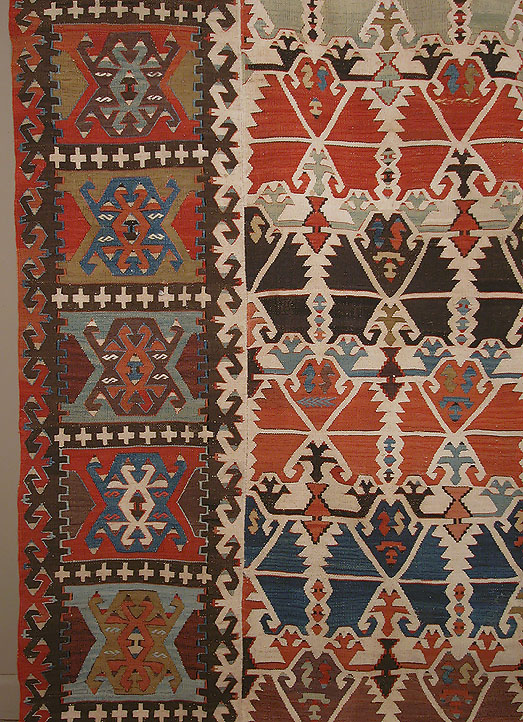
A kilim (Persian: گلیم gilīm; Turkish: kilim) is a flat tapestry-woven carpet or rug traditionally produced in countries of the former Persian Empire, including Iran and Turkey, but also in the Balkans and the Turkic countries.
Kilims can be purely decorative or can function as prayer rugs. Modern kilims are popular floor coverings in Western households.
The word kilim comes from the Persian گلیم gilīm where it means "mat, blanket, bed or floor covering". This word is cognate with the Aramaic-Syriac word גלימא galīmā, galīmtā, which means the same thing. These two words are borrowed from the Ancient Greek word κάλυμμα kálymma(t) 'cover'. That in turn is from the verb καλύπτω kálypto 'to cover or conceal'.
Like pile carpets, kilim have been produced since ancient times. The explorer Mark Aurel Stein found kilims dating to at least the fourth or fifth century CE in Hotan, China:
Kilims are produced by tightly interweaving the warp and weft strands of the weave to produce a flat surface with no pile. Kilim weaves are tapestry weaves, technically weft-faced plain weaves, that is, the horizontal weft strands are pulled tightly downward so that they hide the vertical warp strands.
When the end of a color boundary is reached, the weft yarn is wound back from the boundary point. Thus, if the boundary of a field is a straight vertical line, a vertical slit forms between the two different color areas where they meet. For this reason, most kilims can be classed as "slit woven" textiles. The slits are beloved by collectors, as they produce very sharp-etched designs, emphasizing the geometry of the weave. Weaving strategies for avoiding slit formation, such as interlocking, produce a more blurred design image.
The weft strands, which carry the visible design and color, are almost always wool, whereas the hidden warp strands can be either wool or cotton. The warp strands are only visible at the ends, where they emerge as the fringe. This fringe is usually tied in bunches, to ensure against loosening or unraveling of the weave.
Many motifs are used in Turkish kilims, each with many variations. A few examples are illustrated here, with meanings as described by Güran Erbek in Kilim. A widely used motif is the elibelinde, a stylized female figure representing motherhood and fertility. Other motifs express the tribal weavers' desires for protection of their families' flocks from wolves with the wolf's mouth or the wolf's foot motif (Turkish: Kurt ağzı, Kurt izi), or for safety from the sting of the scorpion (Turkish: Akrep). Several motifs hope for the safety of the weaver's family from the evil eye (Turkish:Kem göz and Nazarlık for the motif), which could be divided into four with a cross symbol (Turkish: Haç), or averted with the symbol of a hook (Turkish: Çengel), a human eye (Turkish: Göz), or an amulet (Turkish: Muska; often, a triangular package containing a sacred verse). Such an amulet woven into a rug is not a picture of the thing itself: it actually is an amulet, believed to confer protection by its presence.
Hub AI
Kilim AI simulator
(@Kilim_simulator)
Kilim
A kilim (Persian: گلیم gilīm; Turkish: kilim) is a flat tapestry-woven carpet or rug traditionally produced in countries of the former Persian Empire, including Iran and Turkey, but also in the Balkans and the Turkic countries.
Kilims can be purely decorative or can function as prayer rugs. Modern kilims are popular floor coverings in Western households.
The word kilim comes from the Persian گلیم gilīm where it means "mat, blanket, bed or floor covering". This word is cognate with the Aramaic-Syriac word גלימא galīmā, galīmtā, which means the same thing. These two words are borrowed from the Ancient Greek word κάλυμμα kálymma(t) 'cover'. That in turn is from the verb καλύπτω kálypto 'to cover or conceal'.
Like pile carpets, kilim have been produced since ancient times. The explorer Mark Aurel Stein found kilims dating to at least the fourth or fifth century CE in Hotan, China:
Kilims are produced by tightly interweaving the warp and weft strands of the weave to produce a flat surface with no pile. Kilim weaves are tapestry weaves, technically weft-faced plain weaves, that is, the horizontal weft strands are pulled tightly downward so that they hide the vertical warp strands.
When the end of a color boundary is reached, the weft yarn is wound back from the boundary point. Thus, if the boundary of a field is a straight vertical line, a vertical slit forms between the two different color areas where they meet. For this reason, most kilims can be classed as "slit woven" textiles. The slits are beloved by collectors, as they produce very sharp-etched designs, emphasizing the geometry of the weave. Weaving strategies for avoiding slit formation, such as interlocking, produce a more blurred design image.
The weft strands, which carry the visible design and color, are almost always wool, whereas the hidden warp strands can be either wool or cotton. The warp strands are only visible at the ends, where they emerge as the fringe. This fringe is usually tied in bunches, to ensure against loosening or unraveling of the weave.
Many motifs are used in Turkish kilims, each with many variations. A few examples are illustrated here, with meanings as described by Güran Erbek in Kilim. A widely used motif is the elibelinde, a stylized female figure representing motherhood and fertility. Other motifs express the tribal weavers' desires for protection of their families' flocks from wolves with the wolf's mouth or the wolf's foot motif (Turkish: Kurt ağzı, Kurt izi), or for safety from the sting of the scorpion (Turkish: Akrep). Several motifs hope for the safety of the weaver's family from the evil eye (Turkish:Kem göz and Nazarlık for the motif), which could be divided into four with a cross symbol (Turkish: Haç), or averted with the symbol of a hook (Turkish: Çengel), a human eye (Turkish: Göz), or an amulet (Turkish: Muska; often, a triangular package containing a sacred verse). Such an amulet woven into a rug is not a picture of the thing itself: it actually is an amulet, believed to confer protection by its presence.
Recent media