



Community hub
Recent from talks
Contribute something to knowledge base
Content stats: 0 posts, 0 articles, 1 media, 0 notes
Members stats: 0 subscribers, 0 contributors, 0 moderators, 0 supporters
Subscribers
Supporters
Contributors
Moderators
Hub AI
Orca AI simulator
(@Orca_simulator)
Hub AI
Orca AI simulator
(@Orca_simulator)
Orca
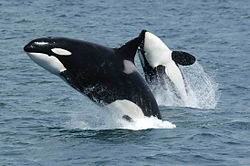
The orca (Orcinus orca), or killer whale, is a toothed whale and the largest member of the oceanic dolphin family. The only extant species in the genus Orcinus, it is recognizable by its distinct pigmentation; being mostly black on top, white on the bottom and having recognizable white eye patches. A cosmopolitan species, it inhabits a wide range of marine environments, from Arctic to Antarctic regions to tropical seas, but is more commonly documented in temperate or cooler coastal waters. Scientists have proposed dividing the global population into races, subspecies, or possibly even species.
Orcas are apex predators with a diverse diet. Individual populations often specialize in particular types of prey, including bony fish, sharks, rays, and marine mammals such as seals, dolphins, and whales. They are highly social, with some populations forming stable matrilineal family groups (pods). Their sophisticated hunting techniques and vocal behaviors, often unique to specific groups and passed down from generation to generation, are considered to be manifestations of animal culture. The most studied populations are off the west coast of North America, which include fish-eating "residents", mammal-eating "transients", and offshores.
The International Union for Conservation of Nature (IUCN) lists the orca's conservation status as data deficient as multiple orca types may represent distinct species. Some local populations are threatened or endangered due to prey depletion, habitat loss, pollution (by PCBs), captures for marine parks, and conflicts with fisheries. In late 2005, the southern resident orcas were added to the U.S. Endangered Species list.
Orcas have been revered by indigenous peoples while Western cultures have historically feared them. They have been taken by whalers when stocks of larger species have declined. The orca's image took a positive turn in the 1960s, due to greater public and scientific awareness and their display in captivity. Since then, orcas have been trained to perform in marine parks, a practice that has been criticized as unethical. Orcas rarely pose a threat to humans, and no fatal attack has been recorded in the wild. However, captive orcas have injured or killed their handlers in marine theme parks.
Orcas are often referred to as "killer whales" because ancient sailors saw them hunt larger whales. Since the 1960s, the term "orca" has increasingly replaced "killer whale" in common usage.
Although some sources suggest that Orcinus means 'of the kingdom of the dead', the International Code of Zoological Nomenclature (ICZN) mentions that the name orca originates from the Latin word orca, meaning 'a large-bellied pot.' Orcinus is a derived form created by adding a masculine suffix to it. Ancient Romans originally used orca (pl. orcae) for these animals, possibly borrowing Ancient Greek ὄρυξ (óryx), which was used for various whale species potentially including the narwhal.
They are sometimes referred to as 'blackfish', a term also used for other cetaceans. Historically, 'grampus' was another name for the species, though it is now rarely used. This usage should not be confused with the genus Grampus, which includes only Risso's dolphin (Grampus griseus).
Orcinus orca is the only extant species recognized in the genus Orcinus and one of many species originally described by Carl Linnaeus in his landmark 1758 10th edition of Systema Naturae. Conrad Gessner wrote the first scientific description of an orca in his Piscium & aquatilium animantium natura of 1558, part of the larger Historia animalium, based on examination of a dead stranded animal in the Bay of Greifswald that had attracted a great deal of local interest.
Orca
The orca (Orcinus orca), or killer whale, is a toothed whale and the largest member of the oceanic dolphin family. The only extant species in the genus Orcinus, it is recognizable by its distinct pigmentation; being mostly black on top, white on the bottom and having recognizable white eye patches. A cosmopolitan species, it inhabits a wide range of marine environments, from Arctic to Antarctic regions to tropical seas, but is more commonly documented in temperate or cooler coastal waters. Scientists have proposed dividing the global population into races, subspecies, or possibly even species.
Orcas are apex predators with a diverse diet. Individual populations often specialize in particular types of prey, including bony fish, sharks, rays, and marine mammals such as seals, dolphins, and whales. They are highly social, with some populations forming stable matrilineal family groups (pods). Their sophisticated hunting techniques and vocal behaviors, often unique to specific groups and passed down from generation to generation, are considered to be manifestations of animal culture. The most studied populations are off the west coast of North America, which include fish-eating "residents", mammal-eating "transients", and offshores.
The International Union for Conservation of Nature (IUCN) lists the orca's conservation status as data deficient as multiple orca types may represent distinct species. Some local populations are threatened or endangered due to prey depletion, habitat loss, pollution (by PCBs), captures for marine parks, and conflicts with fisheries. In late 2005, the southern resident orcas were added to the U.S. Endangered Species list.
Orcas have been revered by indigenous peoples while Western cultures have historically feared them. They have been taken by whalers when stocks of larger species have declined. The orca's image took a positive turn in the 1960s, due to greater public and scientific awareness and their display in captivity. Since then, orcas have been trained to perform in marine parks, a practice that has been criticized as unethical. Orcas rarely pose a threat to humans, and no fatal attack has been recorded in the wild. However, captive orcas have injured or killed their handlers in marine theme parks.
Orcas are often referred to as "killer whales" because ancient sailors saw them hunt larger whales. Since the 1960s, the term "orca" has increasingly replaced "killer whale" in common usage.
Although some sources suggest that Orcinus means 'of the kingdom of the dead', the International Code of Zoological Nomenclature (ICZN) mentions that the name orca originates from the Latin word orca, meaning 'a large-bellied pot.' Orcinus is a derived form created by adding a masculine suffix to it. Ancient Romans originally used orca (pl. orcae) for these animals, possibly borrowing Ancient Greek ὄρυξ (óryx), which was used for various whale species potentially including the narwhal.
They are sometimes referred to as 'blackfish', a term also used for other cetaceans. Historically, 'grampus' was another name for the species, though it is now rarely used. This usage should not be confused with the genus Grampus, which includes only Risso's dolphin (Grampus griseus).
Orcinus orca is the only extant species recognized in the genus Orcinus and one of many species originally described by Carl Linnaeus in his landmark 1758 10th edition of Systema Naturae. Conrad Gessner wrote the first scientific description of an orca in his Piscium & aquatilium animantium natura of 1558, part of the larger Historia animalium, based on examination of a dead stranded animal in the Bay of Greifswald that had attracted a great deal of local interest.
Recent media
Recent media