



Community hub
Recent from talks
Contribute something to knowledge base
Content stats: 0 posts, 0 articles, 1 media, 0 notes
Members stats: 0 subscribers, 0 contributors, 0 moderators, 0 supporters
Subscribers
Supporters
Contributors
Moderators
Hub AI
Conrad Gessner AI simulator
(@Conrad Gessner_simulator)
Hub AI
Conrad Gessner AI simulator
(@Conrad Gessner_simulator)
Conrad Gessner
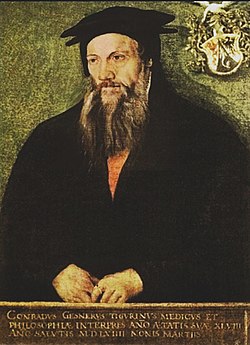
Conrad Gessner (/ˈɡɛsnər/; Latin: Conradus Gesnerus; 26 March 1516 – 13 December 1565) was a Swiss physician, naturalist, bibliographer, and philologist. Born into a poor family in Zurich, Switzerland, his father and teachers quickly realised his talents and supported him through university, where he studied classical languages, theology and medicine. He became Zurich's city physician, but was able to spend much of his time on collecting, research and writing. Gessner compiled monumental works on bibliography (Bibliotheca universalis 1545–1549) and zoology (Historia animalium 1551–1558) and was working on a major botanical text at the time of his death from plague at the age of 49. He is regarded as the father of modern scientific bibliography, zoology and botany. He was frequently the first to describe species of plants or animals in Europe, such as the tulip in 1559. A number of plants and animals have been named after him.
Conrad Gessner was born on 26 March 1516, in Zurich, Switzerland, the son of Ursus Gessner, a poor Zurich furrier. His early life was one of poverty and hardship, but Gessner's father realized his talents, and sent him to live with and be schooled by a great uncle, who grew and collected medicinal herbs for a living. Here the boy became familiar with many plants and their medicinal purposes which led to a lifelong interest in natural history.
Gessner first attended the Carolinum in Zurich, then later entered the Fraumünster seminary. There he studied classical languages, appearing as Penia (Poverty) in Aristophanes' Plutus, at the age of 15. In school, he impressed his teachers so much that a few of them helped sponsor him so that he could further his education, including arranging a scholarship for him to attend university in France to study theology (1532–1533) at the age of 17. There he attended the University of Bourges and University of Paris. Religious persecution forced him to leave Paris for Strasbourg, but being unable to secure employment, he returned to Zurich. One of his teachers in Zurich acted as a foster father to him after the death of his father at the Battle of Kappel (1531), another provided him with three years of board and lodging, while yet another arranged his further education at the upper school in Strasbourg, the Strasbourg Academy. There he broadened his knowledge of ancient languages by studying Hebrew. In 1535, religious unrest drove him back to Zurich, where he made what some considered an imprudent marriage at the age of 19, of a woman from another poor family who had no dowry. Although some of his friends again came to his aid, he was appointed to obtaining a teaching position for him, this was in the lowest class and attracted a stipend barely more than a pittance. However, he then obtained a paid leave of absence to study medicine at the University of Basel (1536).
Throughout his life Gessner was interested in natural history, and collected specimens and descriptions of wildlife through travel and extensive correspondence with other friends and scholars. In 1543 Arnoldus Arlenius invited Gessner to Venice. Gessner travelled to Italy that same summer. He encountered Venetian printing and a hidden world of Greek manuscripts.
Gessner's approach to research consisted of four main components: observation, dissection, travel to distant lands, and accurate description. This rising observational approach was new to Renaissance scholars because people usually relied completely upon Classical writers for their research. He died of the plague, the year after his ennoblement on 13 December 1565.
Conrad Gessner was a Renaissance polymath, a physician, philosopher, encyclopaedist, bibliographer, philologist, natural historian and illustrator. In 1537, at the age of 21, his publication of a Graecolatin dictionary led to his sponsors obtained for him the professorship of Greek at the newly founded academy of Lausanne (then belonging to Bern). Here he had leisure to devote himself to scientific studies, especially botany, and earn money to further his medical studies.
After three years of teaching at Lausanne, Gessner was able to travel to the medical school at the University of Montpellier, where he received his doctoral degree (1541) from Basel. He then returned to Zurich to practice medicine, which he continued to do for the rest of his life. There he was also appointed to the post of lecturer of Aristotelean physics at the Carolinum, the precursor of the University of Zurich.
After 1554 he became the city physician (Stadtarzt). In addition to his duties there, and apart from a few journeys to foreign countries, and annual summer botanical journeys in his native land, and illnesses, he was able to devote himself to research and writing. His expeditions frequently involved visits to mountainous country, below the snow-line. Although primarily for purposes of botanical collection, he also extolled mountain climbing for the sake of exercise and enjoyment of the beauties of nature. In 1541 he prefixed to his treatise on milk and milk products, Libellus de lacte et operibus lactariis a letter addressed to his friend Jacob Avienus (Vogel) of Glarus on the wonders to be found among the mountains, declaring his love for them, and his firm resolve to climb at least one mountain every year, not only to collect flowers, but in order to exercise his body. In 1555 he issued his narrative Descriptio Montis Fracti sive Montis Pilati of his excursion to the Gnepfstein (1920 m), the lowest point in the Pilatus chain.
Conrad Gessner
Conrad Gessner (/ˈɡɛsnər/; Latin: Conradus Gesnerus; 26 March 1516 – 13 December 1565) was a Swiss physician, naturalist, bibliographer, and philologist. Born into a poor family in Zurich, Switzerland, his father and teachers quickly realised his talents and supported him through university, where he studied classical languages, theology and medicine. He became Zurich's city physician, but was able to spend much of his time on collecting, research and writing. Gessner compiled monumental works on bibliography (Bibliotheca universalis 1545–1549) and zoology (Historia animalium 1551–1558) and was working on a major botanical text at the time of his death from plague at the age of 49. He is regarded as the father of modern scientific bibliography, zoology and botany. He was frequently the first to describe species of plants or animals in Europe, such as the tulip in 1559. A number of plants and animals have been named after him.
Conrad Gessner was born on 26 March 1516, in Zurich, Switzerland, the son of Ursus Gessner, a poor Zurich furrier. His early life was one of poverty and hardship, but Gessner's father realized his talents, and sent him to live with and be schooled by a great uncle, who grew and collected medicinal herbs for a living. Here the boy became familiar with many plants and their medicinal purposes which led to a lifelong interest in natural history.
Gessner first attended the Carolinum in Zurich, then later entered the Fraumünster seminary. There he studied classical languages, appearing as Penia (Poverty) in Aristophanes' Plutus, at the age of 15. In school, he impressed his teachers so much that a few of them helped sponsor him so that he could further his education, including arranging a scholarship for him to attend university in France to study theology (1532–1533) at the age of 17. There he attended the University of Bourges and University of Paris. Religious persecution forced him to leave Paris for Strasbourg, but being unable to secure employment, he returned to Zurich. One of his teachers in Zurich acted as a foster father to him after the death of his father at the Battle of Kappel (1531), another provided him with three years of board and lodging, while yet another arranged his further education at the upper school in Strasbourg, the Strasbourg Academy. There he broadened his knowledge of ancient languages by studying Hebrew. In 1535, religious unrest drove him back to Zurich, where he made what some considered an imprudent marriage at the age of 19, of a woman from another poor family who had no dowry. Although some of his friends again came to his aid, he was appointed to obtaining a teaching position for him, this was in the lowest class and attracted a stipend barely more than a pittance. However, he then obtained a paid leave of absence to study medicine at the University of Basel (1536).
Throughout his life Gessner was interested in natural history, and collected specimens and descriptions of wildlife through travel and extensive correspondence with other friends and scholars. In 1543 Arnoldus Arlenius invited Gessner to Venice. Gessner travelled to Italy that same summer. He encountered Venetian printing and a hidden world of Greek manuscripts.
Gessner's approach to research consisted of four main components: observation, dissection, travel to distant lands, and accurate description. This rising observational approach was new to Renaissance scholars because people usually relied completely upon Classical writers for their research. He died of the plague, the year after his ennoblement on 13 December 1565.
Conrad Gessner was a Renaissance polymath, a physician, philosopher, encyclopaedist, bibliographer, philologist, natural historian and illustrator. In 1537, at the age of 21, his publication of a Graecolatin dictionary led to his sponsors obtained for him the professorship of Greek at the newly founded academy of Lausanne (then belonging to Bern). Here he had leisure to devote himself to scientific studies, especially botany, and earn money to further his medical studies.
After three years of teaching at Lausanne, Gessner was able to travel to the medical school at the University of Montpellier, where he received his doctoral degree (1541) from Basel. He then returned to Zurich to practice medicine, which he continued to do for the rest of his life. There he was also appointed to the post of lecturer of Aristotelean physics at the Carolinum, the precursor of the University of Zurich.
After 1554 he became the city physician (Stadtarzt). In addition to his duties there, and apart from a few journeys to foreign countries, and annual summer botanical journeys in his native land, and illnesses, he was able to devote himself to research and writing. His expeditions frequently involved visits to mountainous country, below the snow-line. Although primarily for purposes of botanical collection, he also extolled mountain climbing for the sake of exercise and enjoyment of the beauties of nature. In 1541 he prefixed to his treatise on milk and milk products, Libellus de lacte et operibus lactariis a letter addressed to his friend Jacob Avienus (Vogel) of Glarus on the wonders to be found among the mountains, declaring his love for them, and his firm resolve to climb at least one mountain every year, not only to collect flowers, but in order to exercise his body. In 1555 he issued his narrative Descriptio Montis Fracti sive Montis Pilati of his excursion to the Gnepfstein (1920 m), the lowest point in the Pilatus chain.
Recent media
Recent media