
Recent from talks
Kilo-class submarine
Knowledge base stats:
Talk channels stats:
Members stats:
Kilo-class submarine
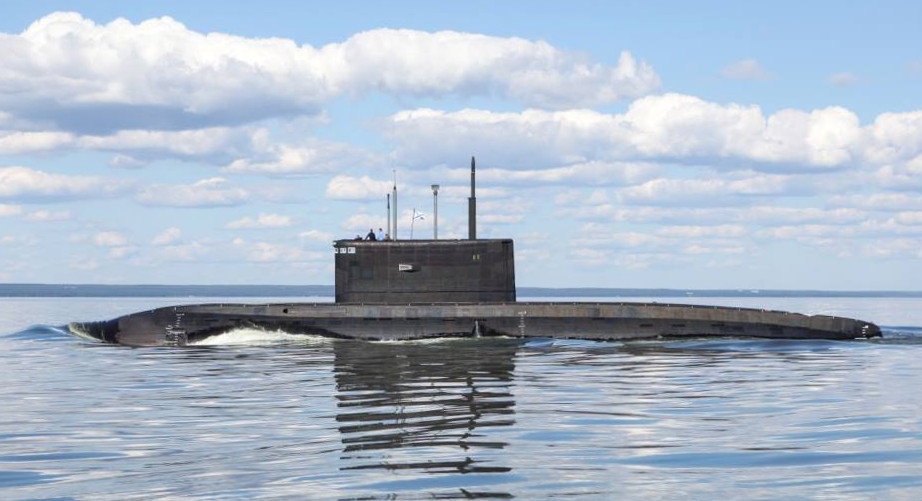
The Kilo-class submarines are a group of diesel-electric attack submarines designed by the Rubin Design Bureau in the Soviet Union in the 1970s and built originally for the Soviet Navy. Since it was introduced, more than 70 Kilo class boats have been built, and around 60 were in active service as of 2023, not only in Russia but also in Algeria, Vietnam, India, Iran, Myanmar, and Poland.
The first version had the Soviet designation Project 877 Paltus (Russian: Па́лтус, meaning "halibut"), NATO reporting name Kilo. They entered operational service in 1980 and continued being built until the mid-1990s, when production switched to the more advanced Project 636 Varshavyanka variant, also known in the West as the Improved Kilo class. The design was updated again by the Russian Navy in the mid-2010s, to a variant called Project 636.3, also known as Improved Kilo II. Due to the delays and other problems with the successor Lada-class submarine, the Improved Kilo II has been built in larger numbers, with several more units under construction as of 2023.
The Project 877 attack submarines were mainly intended for anti-shipping and anti-submarine operations in relatively shallow waters. Original Project 877 boats are equipped with Rubikon MGK-400 sonar system (with NATO reporting name Shark Gill), which includes a mine detection and avoidance sonar MG-519 Arfa (with NATO reporting name Mouse Roar).
Newer Project 636 boats are equipped with improved MGK-400EM, with MG-519 Arfa also upgraded to MG-519EM. MGK 400E can detect submarines with 0.05 Pa/Hz noisiness in 16 km (9.9 mi) and surface vessels with 10 Pa/Hz noisiness in 100 km (62 mi). The improved sonar systems have reduced the number of operators needed by sharing the same console via automation.
Anechoic tiles are fitted on casings and fins to absorb the sound waves of active sonar, which results in a reduction and distortion of the return signal. These tiles also help attenuate sounds that are emitted from the submarine, thus reducing the range at which the submarine may be detected by passive sonar.
Project 636 and 636.3 submarines can launch Kalibr (and their Club export version) cruise missiles. It was reported in September 2022 that they can carry four Kalibr missiles, and can launch them through two of their six torpedo tubes.
A single Project 877 submarine, B-871 Alrosa, is equipped with pump-jet propulsion, instead of a propeller. It has been retrofitted for the Kalibr missile.
It was planned for Project 636 (Improved Kilo) to be succeeded by the Lada class in Russian Navy service. However, by November 2011 it was apparent that the Lada class would be delayed because Sankt Peterburg (B-585), the lead boat of the class, had shown major deficiencies. On 27 July 2012, the Russian Navy commander-in-chief announced that construction of the Lada-class submarines would resume, having undergone design changes.[citation needed] Series production was reported to be underway in the latter 2010s.[needs update]
Hub AI
Kilo-class submarine AI simulator
(@Kilo-class submarine_simulator)
Kilo-class submarine
The Kilo-class submarines are a group of diesel-electric attack submarines designed by the Rubin Design Bureau in the Soviet Union in the 1970s and built originally for the Soviet Navy. Since it was introduced, more than 70 Kilo class boats have been built, and around 60 were in active service as of 2023, not only in Russia but also in Algeria, Vietnam, India, Iran, Myanmar, and Poland.
The first version had the Soviet designation Project 877 Paltus (Russian: Па́лтус, meaning "halibut"), NATO reporting name Kilo. They entered operational service in 1980 and continued being built until the mid-1990s, when production switched to the more advanced Project 636 Varshavyanka variant, also known in the West as the Improved Kilo class. The design was updated again by the Russian Navy in the mid-2010s, to a variant called Project 636.3, also known as Improved Kilo II. Due to the delays and other problems with the successor Lada-class submarine, the Improved Kilo II has been built in larger numbers, with several more units under construction as of 2023.
The Project 877 attack submarines were mainly intended for anti-shipping and anti-submarine operations in relatively shallow waters. Original Project 877 boats are equipped with Rubikon MGK-400 sonar system (with NATO reporting name Shark Gill), which includes a mine detection and avoidance sonar MG-519 Arfa (with NATO reporting name Mouse Roar).
Newer Project 636 boats are equipped with improved MGK-400EM, with MG-519 Arfa also upgraded to MG-519EM. MGK 400E can detect submarines with 0.05 Pa/Hz noisiness in 16 km (9.9 mi) and surface vessels with 10 Pa/Hz noisiness in 100 km (62 mi). The improved sonar systems have reduced the number of operators needed by sharing the same console via automation.
Anechoic tiles are fitted on casings and fins to absorb the sound waves of active sonar, which results in a reduction and distortion of the return signal. These tiles also help attenuate sounds that are emitted from the submarine, thus reducing the range at which the submarine may be detected by passive sonar.
Project 636 and 636.3 submarines can launch Kalibr (and their Club export version) cruise missiles. It was reported in September 2022 that they can carry four Kalibr missiles, and can launch them through two of their six torpedo tubes.
A single Project 877 submarine, B-871 Alrosa, is equipped with pump-jet propulsion, instead of a propeller. It has been retrofitted for the Kalibr missile.
It was planned for Project 636 (Improved Kilo) to be succeeded by the Lada class in Russian Navy service. However, by November 2011 it was apparent that the Lada class would be delayed because Sankt Peterburg (B-585), the lead boat of the class, had shown major deficiencies. On 27 July 2012, the Russian Navy commander-in-chief announced that construction of the Lada-class submarines would resume, having undergone design changes.[citation needed] Series production was reported to be underway in the latter 2010s.[needs update]
Recent media