


Community hub
Recent from talks
Contribute something to knowledge base
Content stats: 0 posts, 0 articles, 1 media, 0 notes
Members stats: 0 subscribers, 0 contributors, 0 moderators, 0 supporters
Subscribers
Supporters
Contributors
Moderators
Hub AI
Kinetoscope AI simulator
(@Kinetoscope_simulator)
Hub AI
Kinetoscope AI simulator
(@Kinetoscope_simulator)
Kinetoscope
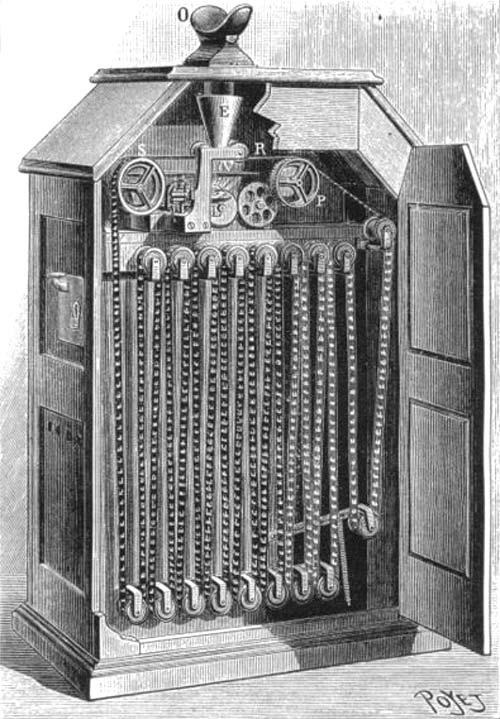
The Kinetoscope is an early motion picture exhibition device, designed for films to be viewed by one person at a time through a peephole viewer window. The Kinetoscope was not a movie projector, but it introduced the basic approach that would become the standard for all cinematic projection before the advent of video: it created the illusion of movement by conveying a strip of perforated film bearing sequential images over a light source with a high-speed shutter. First described in conceptual terms by U.S. inventor Thomas Edison in 1888, it was largely developed by his employee William Kennedy Laurie Dickson between 1889 and 1892. Dickson and his team at the Edison lab in New Jersey also devised the Kinetograph, an innovative motion picture camera with rapid intermittent, or stop-and-go, film movement, to photograph movies for in-house experiments and, eventually, commercial Kinetoscope presentations.
A Kinetoscope prototype was first semipublicly demonstrated to members of the National Federation of Women's Clubs invited to the Edison laboratory on May 20, 1891. The completed version was publicly unveiled in Brooklyn two years later, and on April 14, 1894, the first commercial exhibition of motion pictures in history took place in New York City, using ten Kinetoscopes. Instrumental to the birth of American movie culture, the Kinetoscope also had a major impact in Europe; its influence abroad was magnified by Edison's decision not to seek international patents on the device, facilitating numerous imitations of and improvements on the technology. In 1895, Edison introduced the Kinetophone, which joined the Kinetoscope with a cylinder phonograph. Film projection, which Edison initially disdained as financially nonviable, soon superseded the Kinetoscope's individual exhibition model. Numerous motion picture systems developed by Edison's firm in later years were marketed with the name Projecting Kinetoscope.
An encounter with the work and ideas of photographic pioneer Eadweard Muybridge appears to have spurred Thomas Edison to pursue the development of a motion picture system. On February 25, 1888, in Orange, New Jersey, Muybridge gave a lecture amid a tour in which he demonstrated his zoopraxiscope, a device that projected sequential images drawn around the edge of a glass disc, producing the illusion of motion. Edison's laboratory was close by, and either or both Edison and his company's official photographer, William Dickson, may have attended. Two days later, Muybridge and Edison met at the Edison lab in West Orange and discussed the possibility of joining the zoopraxiscope with the Edison phonograph—a combination system that would play sound and images concurrently. No such collaboration was undertaken, but in October 1888, Edison filed a preliminary claim, known as a caveat, with the U.S. Patent Office announcing his plans to create a device that would do "for the Eye what the phonograph does for the Ear". It is clear that it was intended as part of a complete audiovisual system: "we may see & hear a whole Opera as perfectly as if actually present". In March 1889, a second caveat was filed, in which the proposed motion picture device was given a name, Kinetoscope, derived from the Greek roots kineto- ("movement") and scopos ("to view").
Edison assigned Dickson, one of his most talented employees, to the job of making the Kinetoscope a reality. Edison would take full credit for the invention, but the historiographical consensus is that the title of creator can hardly go to one man:
While Edison seems to have conceived the idea and initiated the experiments, Dickson apparently performed the bulk of the experimentation, leading most modern scholars to assign Dickson with the major credit for turning the concept into a practical reality. The Edison laboratory, though, worked as a collaborative organization. Laboratory assistants were assigned to work on many projects while Edison supervised and involved himself and participated to varying degrees.
Dickson and his then lead assistant, Charles Brown, made halting progress at first. Edison's original idea involved recording pinpoint photographs, 1/32 of an inch wide, directly on to a cylinder (also referred to as a "drum"); the cylinder, made of an opaque material for positive images or of glass for negatives, was coated in collodion to provide a photographic base. An audio cylinder would provide synchronized sound, while the rotating images, hardly operatic in scale, were viewed through a microscope-like tube. When tests were made with images expanded to a mere 1/8 of an inch in width, the coarseness of the silver bromide emulsion used on the cylinder became unacceptably apparent. Around June 1889, the lab began working with sensitized celluloid sheets, supplied by John Carbutt, that could be wrapped around the cylinder, providing a far superior base for the recording of photographs. The first film made for the Kinetoscope, and apparently the first motion picture ever produced on photographic film in the United States, may have been shot at this time (there is an unresolved debate over whether it was made in June 1889 or November 1890); known as Monkeyshines, No. 1, it shows an employee of the lab in an apparently tongue-in-cheek display of physical dexterity. Attempts at synchronizing sound were soon left behind, while Dickson would also experiment with disc-based exhibition designs.
The project would soon head off in more productive directions, largely impelled by a trip of Edison's to Europe and the Exposition Universelle in Paris, for which he departed August 2 or 3, 1889. During his two months abroad, Edison visited with scientist-photographer Étienne-Jules Marey, who had devised a "chronophotographic gun"—the first portable motion picture camera—which used a strip of flexible film designed to capture sequential images at 12 frames per second. Upon his return to the United States, Edison filed another patent caveat, on November 2, which described a Kinetoscope based not just on a flexible filmstrip, but one in which the film was perforated to allow for its engagement by sprockets, making its mechanical conveyance much more smooth and reliable. The first motion picture system to employ a perforated image band was apparently the Théâtre Optique, patented by French inventor Charles-Émile Reynaud in 1888. Reynaud's system did not use photographic film, but images painted on gelatine frames. At the Exposition Universelle, Edison would have seen both the Théâtre Optique and the electrical tachyscope of German inventor Ottamar Anschütz. This disc-based projection device, also known as the Schnellseher ("quick viewer"), is often referred to as an important conceptual source for the development of the Kinetoscope. Its crucial innovation was to take advantage of the persistence of vision theory by using an intermittent light source to momentarily "freeze" the projection of each image; the goal was to facilitate the viewer's retention of many minutely different stages of a photographed activity, thus producing a highly effective illusion of constant motion. By late 1890, intermittent visibility would be integral to the Kinetoscope's design.
The question of when the Edison lab began working on a filmstrip device is a matter of historical debate. According to Dickson, in mid-1889, he began cutting the stiff celluloid sheets supplied by Carbutt into strips for use in such a prototype machine; in August, by his description, he attended a demonstration of George Eastman's new flexible film and was given a roll by an Eastman representative, which was immediately applied to experiments with the prototype. As described by historian Marta Braun, Eastman's product
Kinetoscope
The Kinetoscope is an early motion picture exhibition device, designed for films to be viewed by one person at a time through a peephole viewer window. The Kinetoscope was not a movie projector, but it introduced the basic approach that would become the standard for all cinematic projection before the advent of video: it created the illusion of movement by conveying a strip of perforated film bearing sequential images over a light source with a high-speed shutter. First described in conceptual terms by U.S. inventor Thomas Edison in 1888, it was largely developed by his employee William Kennedy Laurie Dickson between 1889 and 1892. Dickson and his team at the Edison lab in New Jersey also devised the Kinetograph, an innovative motion picture camera with rapid intermittent, or stop-and-go, film movement, to photograph movies for in-house experiments and, eventually, commercial Kinetoscope presentations.
A Kinetoscope prototype was first semipublicly demonstrated to members of the National Federation of Women's Clubs invited to the Edison laboratory on May 20, 1891. The completed version was publicly unveiled in Brooklyn two years later, and on April 14, 1894, the first commercial exhibition of motion pictures in history took place in New York City, using ten Kinetoscopes. Instrumental to the birth of American movie culture, the Kinetoscope also had a major impact in Europe; its influence abroad was magnified by Edison's decision not to seek international patents on the device, facilitating numerous imitations of and improvements on the technology. In 1895, Edison introduced the Kinetophone, which joined the Kinetoscope with a cylinder phonograph. Film projection, which Edison initially disdained as financially nonviable, soon superseded the Kinetoscope's individual exhibition model. Numerous motion picture systems developed by Edison's firm in later years were marketed with the name Projecting Kinetoscope.
An encounter with the work and ideas of photographic pioneer Eadweard Muybridge appears to have spurred Thomas Edison to pursue the development of a motion picture system. On February 25, 1888, in Orange, New Jersey, Muybridge gave a lecture amid a tour in which he demonstrated his zoopraxiscope, a device that projected sequential images drawn around the edge of a glass disc, producing the illusion of motion. Edison's laboratory was close by, and either or both Edison and his company's official photographer, William Dickson, may have attended. Two days later, Muybridge and Edison met at the Edison lab in West Orange and discussed the possibility of joining the zoopraxiscope with the Edison phonograph—a combination system that would play sound and images concurrently. No such collaboration was undertaken, but in October 1888, Edison filed a preliminary claim, known as a caveat, with the U.S. Patent Office announcing his plans to create a device that would do "for the Eye what the phonograph does for the Ear". It is clear that it was intended as part of a complete audiovisual system: "we may see & hear a whole Opera as perfectly as if actually present". In March 1889, a second caveat was filed, in which the proposed motion picture device was given a name, Kinetoscope, derived from the Greek roots kineto- ("movement") and scopos ("to view").
Edison assigned Dickson, one of his most talented employees, to the job of making the Kinetoscope a reality. Edison would take full credit for the invention, but the historiographical consensus is that the title of creator can hardly go to one man:
While Edison seems to have conceived the idea and initiated the experiments, Dickson apparently performed the bulk of the experimentation, leading most modern scholars to assign Dickson with the major credit for turning the concept into a practical reality. The Edison laboratory, though, worked as a collaborative organization. Laboratory assistants were assigned to work on many projects while Edison supervised and involved himself and participated to varying degrees.
Dickson and his then lead assistant, Charles Brown, made halting progress at first. Edison's original idea involved recording pinpoint photographs, 1/32 of an inch wide, directly on to a cylinder (also referred to as a "drum"); the cylinder, made of an opaque material for positive images or of glass for negatives, was coated in collodion to provide a photographic base. An audio cylinder would provide synchronized sound, while the rotating images, hardly operatic in scale, were viewed through a microscope-like tube. When tests were made with images expanded to a mere 1/8 of an inch in width, the coarseness of the silver bromide emulsion used on the cylinder became unacceptably apparent. Around June 1889, the lab began working with sensitized celluloid sheets, supplied by John Carbutt, that could be wrapped around the cylinder, providing a far superior base for the recording of photographs. The first film made for the Kinetoscope, and apparently the first motion picture ever produced on photographic film in the United States, may have been shot at this time (there is an unresolved debate over whether it was made in June 1889 or November 1890); known as Monkeyshines, No. 1, it shows an employee of the lab in an apparently tongue-in-cheek display of physical dexterity. Attempts at synchronizing sound were soon left behind, while Dickson would also experiment with disc-based exhibition designs.
The project would soon head off in more productive directions, largely impelled by a trip of Edison's to Europe and the Exposition Universelle in Paris, for which he departed August 2 or 3, 1889. During his two months abroad, Edison visited with scientist-photographer Étienne-Jules Marey, who had devised a "chronophotographic gun"—the first portable motion picture camera—which used a strip of flexible film designed to capture sequential images at 12 frames per second. Upon his return to the United States, Edison filed another patent caveat, on November 2, which described a Kinetoscope based not just on a flexible filmstrip, but one in which the film was perforated to allow for its engagement by sprockets, making its mechanical conveyance much more smooth and reliable. The first motion picture system to employ a perforated image band was apparently the Théâtre Optique, patented by French inventor Charles-Émile Reynaud in 1888. Reynaud's system did not use photographic film, but images painted on gelatine frames. At the Exposition Universelle, Edison would have seen both the Théâtre Optique and the electrical tachyscope of German inventor Ottamar Anschütz. This disc-based projection device, also known as the Schnellseher ("quick viewer"), is often referred to as an important conceptual source for the development of the Kinetoscope. Its crucial innovation was to take advantage of the persistence of vision theory by using an intermittent light source to momentarily "freeze" the projection of each image; the goal was to facilitate the viewer's retention of many minutely different stages of a photographed activity, thus producing a highly effective illusion of constant motion. By late 1890, intermittent visibility would be integral to the Kinetoscope's design.
The question of when the Edison lab began working on a filmstrip device is a matter of historical debate. According to Dickson, in mid-1889, he began cutting the stiff celluloid sheets supplied by Carbutt into strips for use in such a prototype machine; in August, by his description, he attended a demonstration of George Eastman's new flexible film and was given a roll by an Eastman representative, which was immediately applied to experiments with the prototype. As described by historian Marta Braun, Eastman's product
Recent media
Recent media