
Recent from talks
Kingdome
Knowledge base stats:
Talk channels stats:
Members stats:
Kingdome
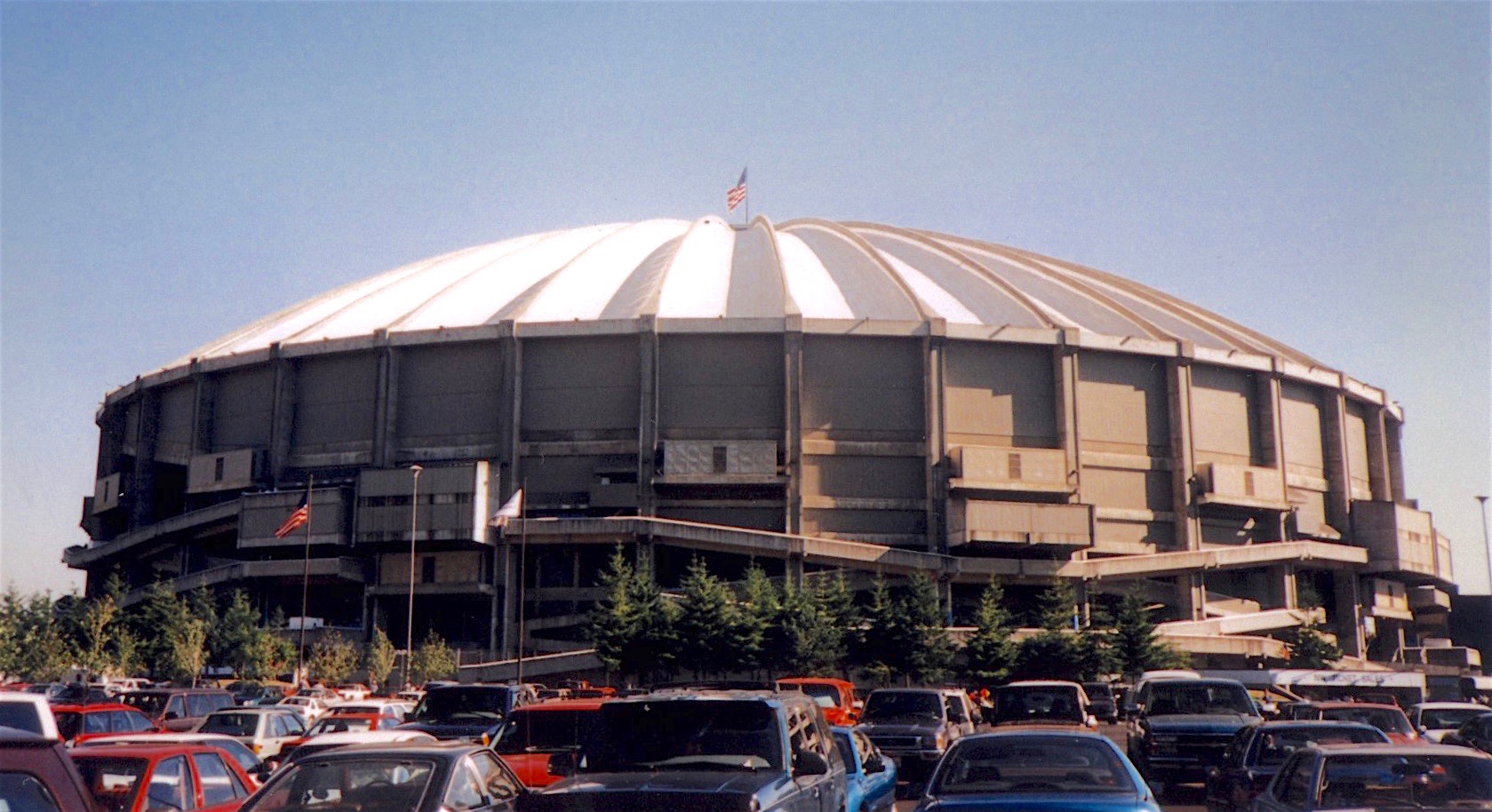
The Kingdome (officially the King County Stadium) was a multi-purpose stadium located in the Industrial District (later SoDo) neighborhood of Seattle, Washington, United States. Owned and operated by King County, it was the home stadium of the Seattle Seahawks of the National Football League (NFL) and the Seattle Mariners of Major League Baseball (MLB); it was also home to the Seattle SuperSonics of the National Basketball Association (NBA) from 1978 to 1985 and additionally served as both the home outdoor and indoor venue for the Seattle Sounders of the North American Soccer League (NASL). The Kingdome measured 660 feet (200 m) wide from its inside walls.
The idea of constructing a covered stadium for a major league football or baseball team was first proposed to Seattle officials in 1959. Voters rejected separate measures to approve public funding for such a stadium in 1960 and 1966, but the outcome was different in 1968; King County voters approved the issue of $40 million in municipal bonds to construct the stadium. Construction began in 1972 and the stadium opened in 1976 as the home of the Sounders and Seahawks. The Mariners moved in the following year, and the SuperSonics moved in the year after that, only to move back to the Seattle Center Coliseum in 1985. The stadium hosted several major sports events, including the Soccer Bowl in August 1976, the Pro Bowl in January 1977, the Major League Baseball All-Star Game in July 1979, the NBA All-Star Game in 1987, and the NCAA Final Four in 1984, 1989, and 1995.
During the 1990s, the Seahawks' and Mariners' respective ownership groups began to question the suitability of the Kingdome as a venue for each team, threatening to relocate unless new, publicly funded stadiums were built. An issue was that neither team saw their shared tenancy as profitable; both teams also questioned the integrity of the stadium's roof as highlighted by the collapse of ceiling tiles onto the seating area before a scheduled Mariners game in 1994. As a result, public funding packages for new, purpose-built stadiums for the Mariners and Seahawks were respectively approved in 1995 and 1997.
The Mariners moved to Safeco Field, now known as T-Mobile Park, midway through the 1999 season, and the Seahawks temporarily moved to Husky Stadium after the 1999 season. On March 26, 2000, the Kingdome was demolished by implosion. The Seahawks' new stadium, now known as Lumen Field, was built on the site and opened in 2002. King County finally paid off the bonds used to build and repair the Kingdome in 2015, fifteen years after its demolition.
In 1959, Seattle restaurateur David L. Cohn wrote a letter to the Seattle City Council suggesting the city needed a covered stadium for a major professional sports franchise. A domed stadium was thought to be a must because of Seattle's frequent rain. At the time, the city had Husky Stadium and Sick's Stadium for college football and minor league baseball, respectively, but both were deemed inadequate for a major league team.
In 1960, King County commissioners placed a $15 million bond issue measure on the ballot to fund construction of a stadium, but voters on November 8 defeated it with only 48 percent approval because of doubt the stadium could be built within that budget, and lack of a guarantee the city would have a team to play in the stadium. By 1966, the National Football League and the American League were both considering granting the city an expansion franchise, and as a result, the King County Council placed another bond issue measure on the ballot for a September vote. While it received 51.5 percent approval, it did not reach the 60 percent required to proceed; the requirement was due to a 1932 initiative that mandated a supermajority for tax levies over 40 mills.
In 1967, the American League granted Seattle an expansion franchise that would be known as the Seattle Pilots. The league clearly stated Sick's Stadium was not adequate as a major-league stadium, and stipulated that as a condition of being awarded the franchise, bonds had to be issued to fund construction of a domed stadium that had to be completed by 1970; additionally, the capacity at Sick's Stadium had to be expanded from 11,000 to 30,000 by Opening Day 1969, when the team was scheduled to begin playing. The Pilots were supposed to begin play in 1971 along with the Kansas City Royals. However, when Senator Stuart Symington of Missouri got wind of those plans, he demanded both teams begin play in 1969. The American League had birthed the Royals and Pilots as a result of the Kansas City Athletics moving to Oakland, and Symington would not accept the prospect of Kansas City waiting three years for baseball's return.
On February 13, 1968, King County voters approved the issue of $40 million in bonds to fund construction of the "King County Multipurpose Domed Stadium" with 62 percent in favor; it was part of the Forward Thrust group of bond propositions that, among other items, had a regional rapid transit system rejected. That year, a committee considered over 100 sites throughout Seattle and King County for the stadium; they unanimously decided the best site would be on the grounds of Seattle Center, site of the 1962 World's Fair. Community members decried the idea, claiming the committee was influenced by special interest groups.
Hub AI
Kingdome AI simulator
(@Kingdome_simulator)
Kingdome
The Kingdome (officially the King County Stadium) was a multi-purpose stadium located in the Industrial District (later SoDo) neighborhood of Seattle, Washington, United States. Owned and operated by King County, it was the home stadium of the Seattle Seahawks of the National Football League (NFL) and the Seattle Mariners of Major League Baseball (MLB); it was also home to the Seattle SuperSonics of the National Basketball Association (NBA) from 1978 to 1985 and additionally served as both the home outdoor and indoor venue for the Seattle Sounders of the North American Soccer League (NASL). The Kingdome measured 660 feet (200 m) wide from its inside walls.
The idea of constructing a covered stadium for a major league football or baseball team was first proposed to Seattle officials in 1959. Voters rejected separate measures to approve public funding for such a stadium in 1960 and 1966, but the outcome was different in 1968; King County voters approved the issue of $40 million in municipal bonds to construct the stadium. Construction began in 1972 and the stadium opened in 1976 as the home of the Sounders and Seahawks. The Mariners moved in the following year, and the SuperSonics moved in the year after that, only to move back to the Seattle Center Coliseum in 1985. The stadium hosted several major sports events, including the Soccer Bowl in August 1976, the Pro Bowl in January 1977, the Major League Baseball All-Star Game in July 1979, the NBA All-Star Game in 1987, and the NCAA Final Four in 1984, 1989, and 1995.
During the 1990s, the Seahawks' and Mariners' respective ownership groups began to question the suitability of the Kingdome as a venue for each team, threatening to relocate unless new, publicly funded stadiums were built. An issue was that neither team saw their shared tenancy as profitable; both teams also questioned the integrity of the stadium's roof as highlighted by the collapse of ceiling tiles onto the seating area before a scheduled Mariners game in 1994. As a result, public funding packages for new, purpose-built stadiums for the Mariners and Seahawks were respectively approved in 1995 and 1997.
The Mariners moved to Safeco Field, now known as T-Mobile Park, midway through the 1999 season, and the Seahawks temporarily moved to Husky Stadium after the 1999 season. On March 26, 2000, the Kingdome was demolished by implosion. The Seahawks' new stadium, now known as Lumen Field, was built on the site and opened in 2002. King County finally paid off the bonds used to build and repair the Kingdome in 2015, fifteen years after its demolition.
In 1959, Seattle restaurateur David L. Cohn wrote a letter to the Seattle City Council suggesting the city needed a covered stadium for a major professional sports franchise. A domed stadium was thought to be a must because of Seattle's frequent rain. At the time, the city had Husky Stadium and Sick's Stadium for college football and minor league baseball, respectively, but both were deemed inadequate for a major league team.
In 1960, King County commissioners placed a $15 million bond issue measure on the ballot to fund construction of a stadium, but voters on November 8 defeated it with only 48 percent approval because of doubt the stadium could be built within that budget, and lack of a guarantee the city would have a team to play in the stadium. By 1966, the National Football League and the American League were both considering granting the city an expansion franchise, and as a result, the King County Council placed another bond issue measure on the ballot for a September vote. While it received 51.5 percent approval, it did not reach the 60 percent required to proceed; the requirement was due to a 1932 initiative that mandated a supermajority for tax levies over 40 mills.
In 1967, the American League granted Seattle an expansion franchise that would be known as the Seattle Pilots. The league clearly stated Sick's Stadium was not adequate as a major-league stadium, and stipulated that as a condition of being awarded the franchise, bonds had to be issued to fund construction of a domed stadium that had to be completed by 1970; additionally, the capacity at Sick's Stadium had to be expanded from 11,000 to 30,000 by Opening Day 1969, when the team was scheduled to begin playing. The Pilots were supposed to begin play in 1971 along with the Kansas City Royals. However, when Senator Stuart Symington of Missouri got wind of those plans, he demanded both teams begin play in 1969. The American League had birthed the Royals and Pilots as a result of the Kansas City Athletics moving to Oakland, and Symington would not accept the prospect of Kansas City waiting three years for baseball's return.
On February 13, 1968, King County voters approved the issue of $40 million in bonds to fund construction of the "King County Multipurpose Domed Stadium" with 62 percent in favor; it was part of the Forward Thrust group of bond propositions that, among other items, had a regional rapid transit system rejected. That year, a committee considered over 100 sites throughout Seattle and King County for the stadium; they unanimously decided the best site would be on the grounds of Seattle Center, site of the 1962 World's Fair. Community members decried the idea, claiming the committee was influenced by special interest groups.
Recent media