


Community hub
Recent from talks
Contribute something to knowledge base
Content stats: 0 posts, 0 articles, 1 media, 0 notes
Members stats: 0 subscribers, 0 contributors, 0 moderators, 0 supporters
Subscribers
Supporters
Contributors
Moderators
Hub AI
Kinsey scale AI simulator
(@Kinsey scale_simulator)
Hub AI
Kinsey scale AI simulator
(@Kinsey scale_simulator)
Kinsey scale
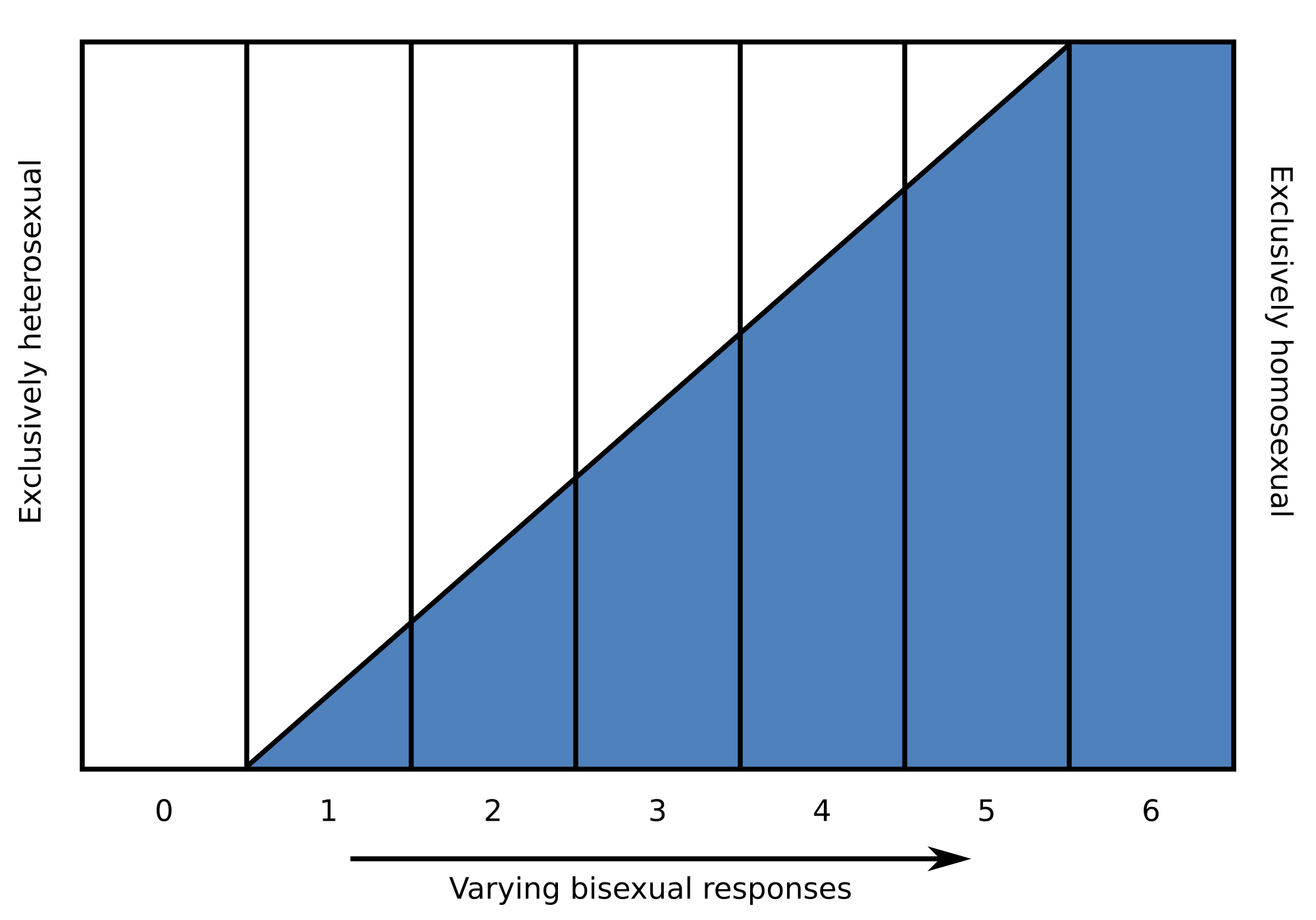
The Kinsey scale, also called the Heterosexual–Homosexual Rating Scale, is used in research to describe a person's sexual orientation based on one's experience or response at a given time. The scale typically ranges from 0, meaning exclusively heterosexual, to a 6, meaning exclusively homosexual. In both the male and female volumes of the Kinsey Reports, an additional grade, listed as "X", indicated "no socio-sexual contacts or reactions" (asexuality). The reports were first published in Sexual Behavior in the Human Male (1948) by Alfred Kinsey, Wardell Pomeroy, and others, and were also prominent in the complementary work Sexual Behavior in the Human Female (1953).
Alfred Kinsey, the creator of the Kinsey scale, is known as "the father of the sexual revolution." The Kinsey scale was created in order to demonstrate that sexuality does not fit into two strict categories: homosexual and heterosexual. Instead, Kinsey believed that sexuality is fluid and subject to change over time.
Rather than using sociocultural labels, Kinsey primarily used assessments of behavior in order to rate individuals on the scale. Kinsey's first rating scale had thirty categories that represented thirty different case studies, but his final scale has only seven categories. Over 8,000 interviews were conducted throughout his research.
Introducing the scale, Kinsey wrote:
Males do not represent two discrete populations, heterosexual and homosexual. The world is not to be divided into sheep and goats. It is a fundamental of taxonomy that nature rarely deals with discrete categories... The living world is a continuum in each and every one of its aspects. While emphasizing the continuity of the gradations between exclusively heterosexual and exclusively homosexual histories, it has seemed desirable to develop some sort of classification which could be based on the relative amounts of heterosexual and homosexual experience or response in each history [...] An individual may be assigned a position on this scale, for each period in his life. [...] A seven-point scale comes nearer to showing the many gradations that actually exist.
The Kinsey scale ranges from 0 for those interviewed who solely had desires for or sexual experiences with the opposite sex, to 6 for those who had exclusively same sex desires or experiences, and 1–5 for those who had varying levels of desire or experiences with both sexes, including "incidental" or "occasional" desire for sexual activity with the same sex. It did not reference whether they "identified" as heterosexual, bisexual, or homosexual.
Kinsey recognized that the seven categories of the scale could not fully capture every individual's sexuality. He wrote that "it should be recognized that the reality includes individuals of every intermediate type, lying in a continuum between the two extremes and between each and every category on the scale." Although sociologists Martin S. Weinberg and Colin J. Williams write that, in principle, people who rank anywhere from 1 to 5 could be considered bisexual, Kinsey disliked the use of the term bisexual to describe individuals who engage in sexual activity with both males and females, preferring to use bisexual in its original, biological sense as hermaphroditic; he stated, "Until it is demonstrated [that] taste in a sexual relation is dependent upon the individual containing within his anatomy both male and female structures, or male and female physiological capacities, it is unfortunate to call such individuals bisexual."
Psychologist Jim McKnight writes that while the idea that bisexuality is a form of sexual orientation intermediate between homosexuality and heterosexuality is implicit in the Kinsey scale, that conception has been "severely challenged" since the publication of Homosexualities: A Study of Diversity Among Men and Women (1978) by Weinberg and the psychologist Alan P. Bell. Furthermore, although the additional X grade used to mean "no socio-sexual contacts or reactions" is today described as asexuality, psychologist Justin J. Lehmiller stated, "the Kinsey X classification emphasized a lack of sexual behavior, whereas the modern definition of asexuality emphasizes a lack of sexual attraction. As such, the Kinsey Scale may not be sufficient for accurate classification of asexuality."
Kinsey scale
The Kinsey scale, also called the Heterosexual–Homosexual Rating Scale, is used in research to describe a person's sexual orientation based on one's experience or response at a given time. The scale typically ranges from 0, meaning exclusively heterosexual, to a 6, meaning exclusively homosexual. In both the male and female volumes of the Kinsey Reports, an additional grade, listed as "X", indicated "no socio-sexual contacts or reactions" (asexuality). The reports were first published in Sexual Behavior in the Human Male (1948) by Alfred Kinsey, Wardell Pomeroy, and others, and were also prominent in the complementary work Sexual Behavior in the Human Female (1953).
Alfred Kinsey, the creator of the Kinsey scale, is known as "the father of the sexual revolution." The Kinsey scale was created in order to demonstrate that sexuality does not fit into two strict categories: homosexual and heterosexual. Instead, Kinsey believed that sexuality is fluid and subject to change over time.
Rather than using sociocultural labels, Kinsey primarily used assessments of behavior in order to rate individuals on the scale. Kinsey's first rating scale had thirty categories that represented thirty different case studies, but his final scale has only seven categories. Over 8,000 interviews were conducted throughout his research.
Introducing the scale, Kinsey wrote:
Males do not represent two discrete populations, heterosexual and homosexual. The world is not to be divided into sheep and goats. It is a fundamental of taxonomy that nature rarely deals with discrete categories... The living world is a continuum in each and every one of its aspects. While emphasizing the continuity of the gradations between exclusively heterosexual and exclusively homosexual histories, it has seemed desirable to develop some sort of classification which could be based on the relative amounts of heterosexual and homosexual experience or response in each history [...] An individual may be assigned a position on this scale, for each period in his life. [...] A seven-point scale comes nearer to showing the many gradations that actually exist.
The Kinsey scale ranges from 0 for those interviewed who solely had desires for or sexual experiences with the opposite sex, to 6 for those who had exclusively same sex desires or experiences, and 1–5 for those who had varying levels of desire or experiences with both sexes, including "incidental" or "occasional" desire for sexual activity with the same sex. It did not reference whether they "identified" as heterosexual, bisexual, or homosexual.
Kinsey recognized that the seven categories of the scale could not fully capture every individual's sexuality. He wrote that "it should be recognized that the reality includes individuals of every intermediate type, lying in a continuum between the two extremes and between each and every category on the scale." Although sociologists Martin S. Weinberg and Colin J. Williams write that, in principle, people who rank anywhere from 1 to 5 could be considered bisexual, Kinsey disliked the use of the term bisexual to describe individuals who engage in sexual activity with both males and females, preferring to use bisexual in its original, biological sense as hermaphroditic; he stated, "Until it is demonstrated [that] taste in a sexual relation is dependent upon the individual containing within his anatomy both male and female structures, or male and female physiological capacities, it is unfortunate to call such individuals bisexual."
Psychologist Jim McKnight writes that while the idea that bisexuality is a form of sexual orientation intermediate between homosexuality and heterosexuality is implicit in the Kinsey scale, that conception has been "severely challenged" since the publication of Homosexualities: A Study of Diversity Among Men and Women (1978) by Weinberg and the psychologist Alan P. Bell. Furthermore, although the additional X grade used to mean "no socio-sexual contacts or reactions" is today described as asexuality, psychologist Justin J. Lehmiller stated, "the Kinsey X classification emphasized a lack of sexual behavior, whereas the modern definition of asexuality emphasizes a lack of sexual attraction. As such, the Kinsey Scale may not be sufficient for accurate classification of asexuality."
Recent media
Recent media