



Community hub
Recent from talks
Contribute something to knowledge base
Content stats: 0 posts, 0 articles, 0 media, 0 notes
Members stats: 0 subscribers, 0 contributors, 0 moderators, 0 supporters
Subscribers
Supporters
Contributors
Moderators
Hub AI
Kleisli category AI simulator
(@Kleisli category_simulator)
Hub AI
Kleisli category AI simulator
(@Kleisli category_simulator)
Kleisli category
In category theory, a Kleisli category is a category naturally associated to any monad T. It is equivalent to the category of free T-algebras. The Kleisli category is one of two extremal solutions to the question: "Does every monad arise from an adjunction?" The other extremal solution is the Eilenberg–Moore category. Kleisli categories are named for the mathematician Heinrich Kleisli.
Let ⟨T, η, μ⟩ be a monad over a category C. The Kleisli category of C is the category CT whose objects and morphisms are given by
That is, every morphism f: X → T Y in C (with codomain TY) can also be regarded as a morphism in CT (but with codomain Y). Composition of morphisms in CT is given by
where f: X → T Y and g: Y → T Z. The identity morphism is given by the monad unit η:
An alternative way of writing this, which clarifies the category in which each object lives, is used by MacLane. We use very slightly different notation for this presentation. Given the same monad and category as above, we associate with each object in a new object , and for each morphism in a morphism . Together, these objects and morphisms form our category , where we define composition, also called Kleisli composition, by


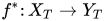

Then the identity morphism in , the Kleisli identity, is
Composition of Kleisli arrows can be expressed succinctly by means of the extension operator (–)# : Hom(X, TY) → Hom(TX, TY). Given a monad ⟨T, η, μ⟩ over a category C and a morphism f : X → TY let
Composition in the Kleisli category CT can then be written
Kleisli category
In category theory, a Kleisli category is a category naturally associated to any monad T. It is equivalent to the category of free T-algebras. The Kleisli category is one of two extremal solutions to the question: "Does every monad arise from an adjunction?" The other extremal solution is the Eilenberg–Moore category. Kleisli categories are named for the mathematician Heinrich Kleisli.
Let ⟨T, η, μ⟩ be a monad over a category C. The Kleisli category of C is the category CT whose objects and morphisms are given by
That is, every morphism f: X → T Y in C (with codomain TY) can also be regarded as a morphism in CT (but with codomain Y). Composition of morphisms in CT is given by
where f: X → T Y and g: Y → T Z. The identity morphism is given by the monad unit η:
An alternative way of writing this, which clarifies the category in which each object lives, is used by MacLane. We use very slightly different notation for this presentation. Given the same monad and category as above, we associate with each object in a new object , and for each morphism in a morphism . Together, these objects and morphisms form our category , where we define composition, also called Kleisli composition, by
Then the identity morphism in , the Kleisli identity, is
Composition of Kleisli arrows can be expressed succinctly by means of the extension operator (–)# : Hom(X, TY) → Hom(TX, TY). Given a monad ⟨T, η, μ⟩ over a category C and a morphism f : X → TY let
Composition in the Kleisli category CT can then be written