Hubbry Logo
Free objectFree objectMain
Open search
Free object
Community hub
Free object
logo
7 pages, 0 posts
0 subscribers
Be the first to start a discussion here.
Free object
Free object
from Wikipedia

In mathematics, the idea of a free object is one of the basic concepts of abstract algebra. Informally, a free object over a set A can be thought of as being a "generic" algebraic structure over A: the only equations that hold between elements of the free object are those that follow from the defining axioms of the algebraic structure. Examples include free groups, tensor algebras, or free lattices.

The concept is a part of universal algebra, in the sense that it relates to all types of algebraic structure (with finitary operations). It also has a formulation in terms of category theory, although this is in yet more abstract terms.

Definition

[edit]

Free objects are the direct generalization to categories of the notion of basis in a vector space. A linear function u : E1E2 between vector spaces is entirely determined by its values on a basis of the vector space E1. The following definition translates this to any category.

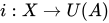
A concrete category is a category that is equipped with a faithful functor to Set, the category of sets. Let C be a concrete category with a faithful functor U : CSet. Let X be a set (that is, an object in Set), which will be the basis of the free object to be defined. A free object on X is a pair consisting of an object in C and an injection , called the canonical injection, that satisfies the following universal property:

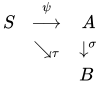
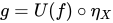
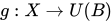
For any object B in C and any map between sets , there exists a unique morphism in C such that . That is, the following diagram commutes:
Commutative diagram
Commutative diagram

If free objects exist in C, the universal property implies every map between two sets induces a unique morphism between the free objects built on them, and this defines a functor . It follows that, if free objects exist in C, the functor F, called the free functor is a left adjoint to the faithful functor U; that is, there is a bijection

Examples

[edit]

The creation of free objects proceeds in two steps. For algebras that conform to the associative law, the first step is to consider the collection of all possible words formed from an alphabet. Then one imposes a set of equivalence relations upon the words, where the relations are the defining relations of the algebraic object at hand. The free object then consists of the set of equivalence classes.

Consider, for example, the construction of the free group in two generators. One starts with an alphabet consisting of the five letters . In the first step, there is not yet any assigned meaning to the "letters" or ; these will be given later, in the second step. Thus, one could equally well start with the alphabet in five letters that is . In this example, the set of all words or strings will include strings such as aebecede and abdc, and so on, of arbitrary finite length, with the letters arranged in every possible order.

In the next step, one imposes a set of equivalence relations. The equivalence relations for a group are that of multiplication by the identity, , and the multiplication of inverses: . Applying these relations to the strings above, one obtains


where it was understood that is a stand-in for , and is a stand-in for , while is the identity element. Similarly, one has

Denoting the equivalence relation or congruence by , the free object is then the collection of equivalence classes of words. Thus, in this example, the free group in two generators is the quotient


This is often written as where is the set of all words, and is the equivalence class of the identity, after the relations defining a group are imposed.

A simpler example are the free monoids. The free monoid on a set X, is the monoid of all finite strings using X as alphabet, with operation concatenation of strings. The identity is the empty string. In essence, the free monoid is simply the set of all words, with no equivalence relations imposed. This example is developed further in the article on the Kleene star.

General case

[edit]

In the general case, the algebraic relations need not be associative, in which case the starting point is not the set of all words, but rather, strings punctuated with parentheses, which are used to indicate the non-associative groupings of letters. Such a string may equivalently be represented by a binary tree or a free magma; the leaves of the tree are the letters from the alphabet.

The algebraic relations may then be general arities or finitary relations on the leaves of the tree. Rather than starting with the collection of all possible parenthesized strings, it can be more convenient to start with the Herbrand universe. Properly describing or enumerating the contents of a free object can be easy or difficult, depending on the particular algebraic object in question. For example, the free group in two generators is easily described. By contrast, little or nothing is known about the structure of free Heyting algebras in more than one generator.[1] The problem of determining if two different strings belong to the same equivalence class is known as the word problem.

As the examples suggest, free objects look like constructions from syntax; one may reverse that to some extent by saying that major uses of syntax can be explained and characterised as free objects, in a way that makes apparently heavy 'punctuation' explicable (and more memorable).[clarification needed]

Free universal algebras

[edit]

Let be a set and be an algebraic structure of type generated by . The underlying set of this algebraic structure , often called its universe, is denoted by . Let be a function. We say that (or informally just ) is a free algebra of type on the set of free generators if the following universal property holds:

For every algebra of type and every function , where is the universe of , there exists a unique homomorphism such that the following diagram commutes:

This means that .

Free functor

[edit]

The most general setting for a free object is in category theory, where one defines a functor, the free functor, that is the left adjoint to the forgetful functor.

Consider a category C of algebraic structures; the objects can be thought of as sets plus operations, obeying some laws. This category has a functor, , the forgetful functor, which maps objects and morphisms in C to Set, the category of sets. The forgetful functor is very simple: it just ignores all of the operations.

The free functor F, when it exists, is the left adjoint to U. That is, takes sets X in Set to their corresponding free objects F(X) in the category C. The set X can be thought of as the set of "generators" of the free object F(X).

For the free functor to be a left adjoint, one must also have a Set-morphism . More explicitly, F is, up to isomorphisms in C, characterized by the following universal property:

Whenever B is an algebra in C, and is a function (a morphism in the category of sets), then there is a unique C-morphism such that .

Concretely, this sends a set into the free object on that set; it is the "inclusion of a basis". Abusing notation, (this abuses notation because X is a set, while F(X) is an algebra; correctly, it is ).

The natural transformation is called the unit; together with the counit , one may construct a T-algebra, and so a monad.

The cofree functor is the right adjoint to the forgetful functor.

Existence

[edit]

There are general existence theorems that apply; the most basic of them guarantees that

Whenever C is a variety, then for every set X there is a free object F(X) in C.

Here, a variety is a synonym for a finitary algebraic category, thus implying that the set of relations are finitary, and algebraic because it is monadic over Set.

General case

[edit]

Other types of forgetfulness also give rise to objects quite like free objects, in that they are left adjoint to a forgetful functor, not necessarily to sets.

For example, the tensor algebra construction on a vector space is the left adjoint to the functor on associative algebras that ignores the algebra structure. It is therefore often also called a free algebra. Likewise the symmetric algebra and exterior algebra are free symmetric and anti-symmetric algebras on a vector space.

List of free objects

[edit]

See also

[edit]

Notes

[edit]
[edit]
Revisions and contributorsEdit on WikipediaRead on Wikipedia
from Grokipedia
In , a free object on a set XX in a C\mathcal{C} is an object FF equipped with a function i:XFi: X \to |F| (where F|F| denotes the underlying set of FF) such that for every object AA in C\mathcal{C} and every function f:XAf: X \to |A|, there exists a unique f:FA\overline{f}: F \to A in C\mathcal{C} satisfying fi=f\overline{f} \circ i = f. This ensures that FF is the "freest" or most general object generated by XX, such that any object AA equipped with a function f:XAf: X \to |A| admits a unique f:FA\overline{f}: F \to A extending ff, and in algebraic categories, such AA is often a of FF by relations imposed on the generators. Free objects embody objects in auxiliary categories of structured systems, representing s such as the underlying-set functor raised to the power of XX, and their existence is guaranteed in many algebraic categories like groups, rings, and modules. The concept originates from universal algebra and category theory, where free objects provide a canonical way to adjoin generators without imposing relations, facilitating the study of varieties of algebras through homological and homotopical methods. Key examples include the free group on XX, which consists of all reduced words over the alphabet XX1X \cup X^{-1} with concatenation as the operation, satisfying the universal property for group homomorphisms from generators; the free abelian group on XX, isomorphic to the direct sum of X|X| copies of Z\mathbb{Z}; and the free ring on XX, comprising non-commutative polynomials in elements of XX. Up to unique isomorphism, free objects on sets of the same cardinality are equivalent, underscoring their structural uniqueness. Free objects play a foundational role in algebraic topology and homological algebra, where they underpin resolutions like the bar resolution for computing derived functors, and in computer science, they model term algebras in rewriting systems and type theory. Their study extends to more abstract settings, such as free modules over rings or free categories generated by graphs, highlighting the interplay between generators, relations, and universal constructions across mathematics.

Definitions

Universal Algebra Definition

In universal algebra, a variety of algebras is defined as an equational class of similar algebras satisfying a given set of identities, which is closed under the formation of homomorphic images, subalgebras, and direct products. Such varieties include structures like groups and rings, where the algebras share a common of operations and are axiomatized equationally. Within a variety VV of algebras, the free object FV(X)F_V(X) generated by a set XX is the algebra in VV that freely generates all possible structures without additional relations imposed beyond those defining VV. It serves as the initial object in the category of algebras in VV over XX, meaning it is generated by XX in a way that admits no nontrivial relations among the generators except those required by the variety. The defining universal property of FV(X)F_V(X) states that for any algebra BB in VV and any function f:XBf: X \to |B| (where B|B| denotes the underlying set of BB), there exists a unique homomorphism ϕ:FV(X)B\phi: F_V(X) \to B such that ϕ\phi restricted to XX equals ff, i.e., ϕ(x)=f(x)\phi(x) = f(x) for all xXx \in X. This property ensures that FV(X)F_V(X) is unique up to isomorphism and captures the "freest" way to extend mappings from generators to arbitrary algebras in the variety.

Category Theory Definition

In , a free object on a set XX in a category C\mathcal{C} equipped with a U:CSetU: \mathcal{C} \to \mathbf{Set} is defined as an object F(X)F(X) in C\mathcal{C} that is in the comma category (XU)(X \downarrow U). This means that for any object AA in C\mathcal{C} and any f:XU(A)f: X \to U(A) in Set\mathbf{Set}, there exists a unique ϕ:F(X)A\phi: F(X) \to A in C\mathcal{C} such that the diagram \begin{tikzcd} X \arrow[r, "\eta_X"] \arrow[dr, "f"'] & U(F(X)) \\ & U(A) \arrow[ul, "U(\phi)"'] \end{tikzcd} commutes, where ηX:XU(F(X))\eta_X: X \to U(F(X)) is the structure map making F(X)F(X) . This ensures that F(X)F(X) freely generates the structure of C\mathcal{C} from the elements of XX, preserving no relations beyond those imposed by the category. Free objects arise precisely as the images under the left to a , forming a free-forgetful adjunction FUF \dashv U. In this adjunction, the unit η:IdSetUF\eta: \mathrm{Id}_{\mathbf{Set}} \to U F supplies the canonical generators from XX to U(F(X))U(F(X)), embedding the set as a basis without additional constraints. Conversely, if free objects exist for every set XX, then the assignment XF(X)X \mapsto F(X) defines a left to UU. This adjunction captures the essence of "freedom" by allowing arbitrary maps from XX to underlying sets of objects in C\mathcal{C} to extend uniquely to structure-preserving morphisms from the free object. The construction generalizes beyond sets to free objects on arbitrary objects in other categories; for instance, in the category RMod\mathbf{R}\mathbf{-Mod} of modules over a ring RR, the forgetful functor to Ab\mathbf{Ab} (abelian groups) has a left adjoint sending an abelian group MM to the free RR-module RZMR \otimes_{\mathbb{Z}} M. The universal property of this free object is expressed by the natural isomorphism \HomC(F(X),A)\HomSet(X,U(A)),\Hom_{\mathcal{C}}(F(X), A) \cong \Hom_{\mathbf{Set}}(X, U(A)), which holds naturally in both ACA \in \mathcal{C} and XSetX \in \mathbf{Set}. This bijection underscores the role of free objects in mediating between structured categories and their underlying sets, facilitating constructions that preserve categorical structure.

Examples

Algebraic Examples

In , the on a set XX is the group generated by the elements of XX with no relations imposed other than the existence of inverses for each generator, making it the "freest" possible group structure on XX. Its elements can be represented as reduced words formed from symbols in XX1X \cup X^{-1}, where serves as the group operation, and the empty word acts as the identity. For example, the on the set {a,b}\{a, b\} consists of all reduced words such as aba1b1a b a^{-1} b^{-1}, with no additional equalities beyond those required for inverses and associativity. The on a set XX, also known as the free Z\mathbb{Z}-module on XX, is the freely generated by XX under , with elements expressed as finite linear combinations of basis elements from XX. It is isomorphic to the of X|X| copies of Z\mathbb{Z}, where XX serves as a basis, ensuring over Z\mathbb{Z}. This structure captures the universal property of abelian groups by allowing arbitrary homomorphisms from it to other abelian groups to be uniquely determined by their action on the basis XX. The free ring on a set XX is the ring generated by XX without any multiplicative relations beyond those inherent to ring axioms, consisting of non-commutative polynomials in the indeterminates from XX with integer coefficients. Addition and multiplication are defined termwise and by concatenation of monomials, respectively, yielding expressions like sums of words from XX scaled by integers. In the commutative case, it reduces to the polynomial ring Z[X]\mathbb{Z}[X], where variables commute. For a RR with identity, the free RR-module on a set XX is the module generated by XX with no linear relations, isomorphic to the of X|X| copies of RR itself, with XX as a basis. Elements are finite RR-linear combinations of basis elements, and by ring elements extends naturally from the structure. This construction ensures that any RR- from the free to another is uniquely specified by the images of the basis elements. The free lattice on a set XX is the lattice freely generated by XX under the operations of meet and join, with no additional relations beyond the lattice axioms, resulting in a distributive structure known as the free distributive lattice. For finite XX with nn elements, its cardinality grows rapidly, as enumerated by Dedekind numbers, reflecting the complexity of term expressions without collapses. Similarly, the free on XX is the Boolean algebra generated by XX with no relations other than Boolean identities, forming an atomistic structure where every element is a join of atoms when XX is finite. For infinite XX, it becomes atomless, emphasizing the generative freedom in Boolean operations.

Categorical Examples

In the category of , the free monoid on a set XX consists of all finite (words) of elements from XX, equipped with as the monoid operation and the empty as the identity. This construction satisfies the universal property: for any monoid MM and any function f:XMf: X \to M, there exists a unique monoid homomorphism f~\tilde{f} from the free monoid to MM that extends ff on generators. In the , the free topological space on a set XX is the set XX equipped with the discrete topology, where every subset is open. This is the finest topology on XX, ensuring that every function from XX to any YY is continuous, and it satisfies the universal property that any such function factors uniquely through a continuous map from the on XX to YY. The free profinite group on a set XX is defined in the category of as the profinite completion of the generated by XX, realized as an of finite quotients. It serves as the initial object in this category with respect to continuous from sets to , ensuring that any such map extends uniquely to a continuous . For a YY and a set XX, the free sheaf on XX in the category of sheaves of sets on YY is the sheaf X\underline{X}, obtained by sheafifying the presheaf that assigns XX to every nonempty UYU \subseteq Y and the to the empty set, with restriction maps. Over a connected UU, sections of this sheaf are elements of XX, and the universal property allows any assignment of elements from XX to stalks to glue uniquely into global sections respecting the sheaf axioms. In the category of small categories, the free category on a GG (with vertices as objects and edges as generating morphisms) has objects given by the vertices of GG and morphisms given by finite paths (compositions of edges) in GG, with composition by . This construction is the left adjoint to the from categories to , satisfying the universal property that any from GG to the underlying graph of a category C\mathcal{C} extends uniquely to a from the free category to C\mathcal{C}.

Constructions

Free Universal Algebras

In , the construction of free objects begins with the term algebra, denoted T(X)T(X), which is freely generated by a set XX of variables over a given type FF consisting of operation symbols of various arities. The universe of T(X)T(X) comprises all formal terms built inductively: the variables in XX form the base, and further terms are obtained by applying operations from FF, such as f(g(x,y),z)f(g(x, y), z) where ff and gg are binary operations. This structure imposes no relations on the terms, making T(X)T(X) the absolutely free algebra on XX. To obtain the free algebra within a specific variety VV of algebras—defined by a set of identities or equations—the term algebra T(X)T(X) is quotiented by a fully invariant congruence θV\theta_V generated by the equations of VV. A congruence on T(X)T(X) is an compatible with the operations, and full invariance ensures it is preserved under all endomorphisms of T(X)T(X), capturing the equational theory of VV uniformly. The resulting free FV(X)=T(X)/θVF_V(X) = T(X) / \theta_V then satisfies all identities of VV while remaining freely generated by the images of XX, serving as the initial object in the category of algebras in VV with generators mapping from XX. The construction proceeds in three main steps: first, form the set of all terms T(X)T(X) as the carrier set equipped with interpretations of the operations from FF; second, define the fully invariant congruence θV\theta_V as the smallest such relation containing all pairs of terms (s,t)(s, t) where sts \approx t is an identity in VV, obtained by closing under substitutions and operational compatibility; third, take the FV(X)=T(X)/θVF_V(X) = T(X) / \theta_V, where elements are equivalence classes of terms and operations act naturally on these classes. For instance, in the variety of groups, θV\theta_V includes pairs like xy(y1x1)exy(y^{-1}x^{-1}) \approx e, enforcing the group axioms without further details on the full . Free algebras play a central role in presenting arbitrary algebras in a variety VV, as every such algebra is isomorphic to a of some FV(X)F_V(X) by a congruence on it, allowing any algebra to be described via generators and relations derived from the free construction. This presentation theorem underscores the universality of free algebras, enabling the study of equational logic and variety properties through homomorphic images and substructures.

Free Functors

In , free functors arise as left adjoints to , providing a systematic way to construct free objects across various categories. Consider a category C\mathbf{C} of algebraic structures over the Set\mathbf{Set}, equipped with a U:CSetU: \mathbf{C} \to \mathbf{Set} that maps each structured object to its underlying set. The free functor F:SetCF: \mathbf{Set} \to \mathbf{C} serves as the left adjoint to UU, with F(X)F(X) denoting the free object in C\mathbf{C} generated by the set XX. This adjunction FUF \dashv U encapsulates the universal mapping properties of free objects, allowing morphisms from XX in Set\mathbf{Set} to be freely extended to morphisms from F(X)F(X) in C\mathbf{C}. The unit of the adjunction is a η:IdSetUF\eta: \mathrm{Id}_{\mathbf{Set}} \to U F, whose component at XX is the function ηX:XU(F(X))\eta_X: X \to U(F(X)) that sends each element xXx \in X to its image as a generator in the underlying set of the free object F(X)F(X). This unit provides the inclusion of generators, ensuring that every element of XX corresponds to a free generator in F(X)F(X), while relations in C\mathbf{C} are imposed minimally. The counit ε:FUIdC\varepsilon: F U \to \mathrm{Id}_{\mathbf{C}} then projects structured objects back onto themselves, respecting the algebraic operations. As left adjoints, free functors preserve all colimits, reflecting their role in freely generating structure from unstructured data. For example, in categories where coproducts exist in Set\mathbf{Set} and direct sums in C\mathbf{C}, the free functor satisfies the isomorphism F(XY)F(X)F(Y),F(X \sqcup Y) \cong F(X) \oplus F(Y), allowing disjoint unions in the base category to map to corresponding sums of free objects. This colimit preservation underscores the functorial nature of free constructions, enabling the extension of diagrams from Set\mathbf{Set} to C\mathbf{C} while maintaining universal properties. In a more general setting, for a U:CDU: \mathbf{C} \to \mathbf{D} where C\mathbf{C} is an algebraic category over the base D\mathbf{D} (such as modules over a ring or groups over sets) and D\mathbf{D} admits , the free functor F:DCF: \mathbf{D} \to \mathbf{C} exists as the left to UU. This construction relies on the structure in D\mathbf{D} to build free objects by adjoining generators and minimal relations. The adjunction is witnessed by the natural of hom-sets: HomC(F(X),A)HomD(X,U(A)),\mathrm{Hom}_{\mathbf{C}}(F(X), A) \cong \mathrm{Hom}_{\mathbf{D}}(X, U(A)), where a ϕ:F(X)A\phi: F(X) \to A in C\mathbf{C} corresponds to the composite U(ϕ)ηX:XU(A)U(\phi) \circ \eta_X: X \to U(A) in D\mathbf{D}, and conversely, any such map in D\mathbf{D} factors uniquely through the universal property of F(X)F(X). In the specific case of universal , this free functor aligns with the term construction, generating terms from variables in the base category.

Properties

Universal Property

The universal property of a free object F(X)F(X) on a generating set XX in a category C\mathcal{C} with forgetful functor U:CSetU: \mathcal{C} \to \mathbf{Set} states that there is a morphism i:XU(F(X))i: X \to U(F(X)) such that for any object AA in C\mathcal{C} and any morphism f:XU(A)f: X \to U(A), there exists a unique morphism ϕ:F(X)A\phi: F(X) \to A satisfying U(ϕ)i=fU(\phi) \circ i = f. This property captures the essence of F(X)F(X) as the "initial" or most general object generated by XX under the operations of C\mathcal{C}, ensuring that homomorphisms from F(X)F(X) are determined precisely by their action on the generators i(X)i(X). The implications of this property are that free objects are freely generated by XX, imposing no additional relations on the elements of i(X)i(X) beyond those inherent to the ambient algebraic or categorical structure. In other words, F(X)F(X) provides the universal solution to the problem of extending maps from XX to the underlying sets of objects in C\mathcal{C} while respecting the structure. From the Yoneda perspective, this universal property is equivalent to the representability of the functor \HomSet(X,U())\Hom_{\mathbf{Set}}(X, U(-)) by F(X)F(X), meaning there is a natural isomorphism \HomC(F(X),A)\HomSet(X,U(A))\Hom_{\mathcal{C}}(F(X), A) \cong \Hom_{\mathbf{Set}}(X, U(A)) for all AA in C\mathcal{C}. This characterizing property ensures the minimality of free objects, as any other object F(X)F'(X) equipped with a map i:XU(F(X))i': X \to U(F'(X)) satisfying the same universal condition must be isomorphic to F(X)F(X) via a unique isomorphism ψ:F(X)F(X)\psi: F(X) \to F'(X) such that U(ψ)i=iU(\psi) \circ i = i'. The universal property of free objects thus guarantees their uniqueness up to and serves as the foundation for defining key constructions like products, coproducts, and tensor products in free algebraic settings, where these operations inherit the free generation from the underlying sets. This property arises from the adjunction between the free functor and the .

Existence and Uniqueness

In the context of , the existence of in a variety VV is established by constructing the term T(X)T(X) on a generating set XX, which consists of all finite terms formed using the operation symbols of the and variables from XX. This term is then quotiented by the fully invariant congruence θV\theta_V generated by the identities defining VV, yielding the FV(X)=T(X)/θVF_V(X) = T(X)/\theta_V. The set T(X)T(X) is always small when XX is small, ensuring the construction is well-defined in the , and the resulting satisfies the equations of VV while being freely generated by the images of XX. This is unique up to : if F(X)F(X) and F(X)F'(X) are two free algebras on XX in VV, then the universal property induces unique homomorphisms F(X)F(X)F(X) \to F'(X) and F(X)F(X)F'(X) \to F(X) such that the triangles with the inclusions of XX commute; these homomorphisms compose to the identity on each side, establishing an . In a broader categorical setting, free objects exist for forgetful functors from algebraic categories over Set\mathbf{Set} to Set\mathbf{Set}, as these functors are monadic and admit left adjoints by virtue of the category being cocomplete and the monad being algebraic. Beck's monadicity provides a criterion: a functor U:BCU: \mathcal{B} \to \mathcal{C} is monadic if it reflects and coequalizers of reflexive pairs, and B\mathcal{B} has and UU creates certain coequalizers, implying the existence of the free functor as the left when C=Set\mathcal{C} = \mathbf{Set} and the theory is finitary. However, free objects do not always exist in arbitrary categories. For instance, in the category FinSet\mathbf{FinSet} of finite sets and functions, which lacks infinite coproducts, there is no free group on a countably infinite generating set, as the free group on countably many generators is infinite and thus not an object of FinSet\mathbf{FinSet}. More generally, in locally presentable categories, free objects exist for compactly generated reflective subcategories: such a category C\mathcal{C} is cocomplete and generated under λ\lambda-filtered colimits by a small set of λ\lambda-presentable objects, allowing the free completion via the λ\lambda-Kan extension or reflector, ensuring the free functor preserves the necessary colimits.

References

Add your contribution
Related Hubs
User Avatar
No comments yet.