



Community hub
Recent from talks
Contribute something to knowledge base
Content stats: 0 posts, 0 articles, 1 media, 0 notes
Members stats: 0 subscribers, 0 contributors, 0 moderators, 0 supporters
Subscribers
Supporters
Contributors
Moderators
Hub AI
Kombu AI simulator
(@Kombu_simulator)
Hub AI
Kombu AI simulator
(@Kombu_simulator)
Kombu
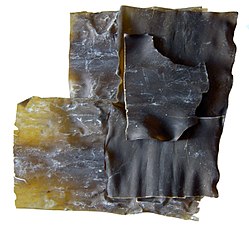
Kombu or Konbu (from Japanese: 昆布, romanized: konbu or kombu) is edible kelp mostly from the family Laminariaceae and is widely eaten in East Asia. It may also be referred to as dasima (Korean: 다시마) or haidai (simplified Chinese: 海带; traditional Chinese: 海帶; pinyin: Hǎidài).
Kelp features in the diets of many civilizations, including Chinese and Icelandic; however, the largest consumers of kelp are the Japanese, who have incorporated kelp and seaweed into their diets for over 1,500 years.
There are about eighteen edible species in Laminariaceae and most of them, but not all, are called kombu. Confusingly, species of Laminariaceae have multiple names in biology and in fisheries science. In the following list, fisheries science synonyms are in parentheses, and Japanese names follow them.[citation needed]
Kombu is a loanword from Japanese.
In Old Japanese, edible seaweed was generically called "me" (cf. wakame, arame) and kanji such as "軍布", 海藻 or "和布" were applied to transcribe the word. Especially, kombu was called hirome (from hiroi, wide) or ebisume (from ebisu). Sometime later the names konfu and kofu appeared respectively in two editions of Iroha Jiruishō in 12th–13th century.
Various theories have been claimed for the origin of the name kombu, with the following two predominant today.[citation needed]
One is that it originated from the on'yomi (Sino-Japanese reading) of the Chinese name 昆布 (kūnbù). The kanji itself already could be seen in Shōsōin Monjo (8th century) and Shoku Nihongi (797) in Japan, and furthermore trace back in China, as early as 3rd century, to the book Wupu Bencao (around 239). Li Shizhen wrote the following in his Bencao Gangmu (1596):
Come to think about it, Wupu Bencao says "綸布 (gūanbù), alias 昆布 (kūnbù)." Then, what is mentioned in the Erya as "(what is pronounced) 綸 resembles 綸. This is in the East China Sea" kūnbù. The pronunciation of 綸 is 関 (gūan), meaning cord made by green thread, and got corrupted to 昆 (kūn).
Kombu
Kombu or Konbu (from Japanese: 昆布, romanized: konbu or kombu) is edible kelp mostly from the family Laminariaceae and is widely eaten in East Asia. It may also be referred to as dasima (Korean: 다시마) or haidai (simplified Chinese: 海带; traditional Chinese: 海帶; pinyin: Hǎidài).
Kelp features in the diets of many civilizations, including Chinese and Icelandic; however, the largest consumers of kelp are the Japanese, who have incorporated kelp and seaweed into their diets for over 1,500 years.
There are about eighteen edible species in Laminariaceae and most of them, but not all, are called kombu. Confusingly, species of Laminariaceae have multiple names in biology and in fisheries science. In the following list, fisheries science synonyms are in parentheses, and Japanese names follow them.[citation needed]
Kombu is a loanword from Japanese.
In Old Japanese, edible seaweed was generically called "me" (cf. wakame, arame) and kanji such as "軍布", 海藻 or "和布" were applied to transcribe the word. Especially, kombu was called hirome (from hiroi, wide) or ebisume (from ebisu). Sometime later the names konfu and kofu appeared respectively in two editions of Iroha Jiruishō in 12th–13th century.
Various theories have been claimed for the origin of the name kombu, with the following two predominant today.[citation needed]
One is that it originated from the on'yomi (Sino-Japanese reading) of the Chinese name 昆布 (kūnbù). The kanji itself already could be seen in Shōsōin Monjo (8th century) and Shoku Nihongi (797) in Japan, and furthermore trace back in China, as early as 3rd century, to the book Wupu Bencao (around 239). Li Shizhen wrote the following in his Bencao Gangmu (1596):
Come to think about it, Wupu Bencao says "綸布 (gūanbù), alias 昆布 (kūnbù)." Then, what is mentioned in the Erya as "(what is pronounced) 綸 resembles 綸. This is in the East China Sea" kūnbù. The pronunciation of 綸 is 関 (gūan), meaning cord made by green thread, and got corrupted to 昆 (kūn).
Recent media
Recent media