
Recent from talks
Wakame
Knowledge base stats:
Talk channels stats:
Members stats:
Wakame
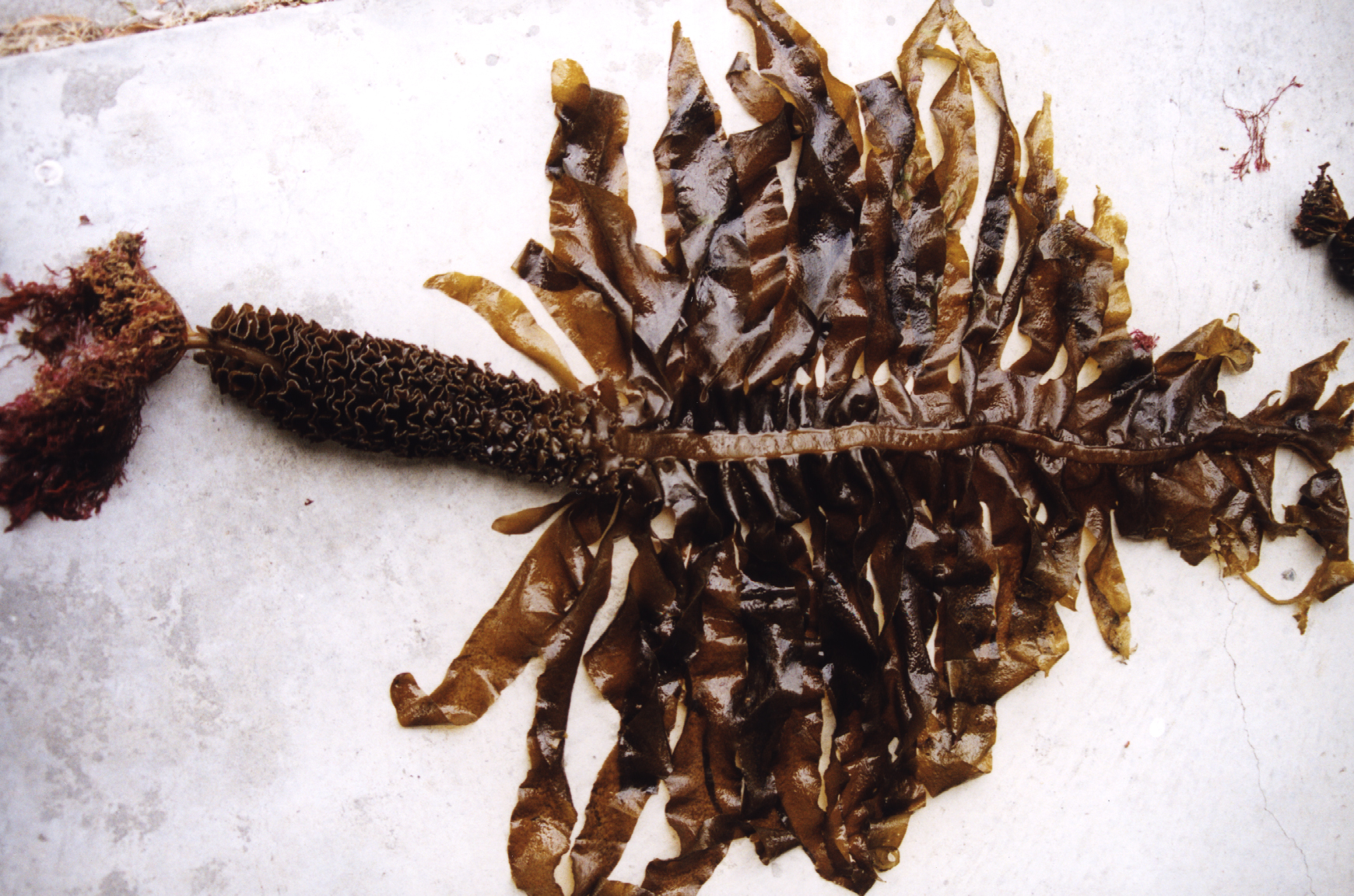
Wakame (Undaria pinnatifida) is a species of kelp native to cold, temperate coasts of the northwest Pacific Ocean. As an edible seaweed, it has a subtly sweet, but distinctive and strong flavour and satiny texture. It is most often served in soups and salads.
Wakame has long been collected for food in East Asia, and sea farmers in Japan have cultivated wakame since the eighth century (Nara period).
Although native to cold, temperate coastal areas of Japan, Korea, China, and Russia, it has established itself in temperate regions around the world, including New Zealand, the United States, Belgium, France, Great Britain, Spain, Italy, Argentina, Australia and Mexico. As of 2018[update], the Invasive Species Specialist Group has listed the species on its list of 100 worst globally invasive species.
Wakame, as with all other kelps and brown algae, is plant-like in appearance, but is unrelated to true plants, being, instead, a photosynthetic, multicellular stramenopile protist of the SAR supergroup.
The primary common name is derived from the Japanese name wakame (ワカメ, わかめ, 若布, 和布).
In Old Japanese, me stood for edible seaweeds in general as opposed to mo standing for algae. In kanji, such as 海藻, 軍布 and 和布 were applied to transcribe the word. Among seaweeds, wakame was likely most often eaten, therefore me especially meant wakame. It expanded later to other seaweeds like kajime, hirome (kombu), arame, etc. Wakame is derived from waka + me (若布, lit. 'young seaweed'). If this waka is a eulogistic prefix, the same as the tama of tamagushi, wakame likely stood for seaweeds widely in ancient times. In the Man'yōshū, in addition to 和可米 and 稚海藻 (both are read as wakame), nigime (和海藻, soft wakame) can be seen. Besides, tamamo (玉藻, lit. 'beautiful algae'), which often appeared in the Man'yōshū, may be wakame depending on poems.
The earliest appearance in Western documents is probably in the Portuguese Nippo Jisho (1603), as Vacame.
In 1867 the word wakame appeared in an English-language publication, A Japanese and English Dictionary, by James C. Hepburn.
Hub AI
Wakame AI simulator
(@Wakame_simulator)
Wakame
Wakame (Undaria pinnatifida) is a species of kelp native to cold, temperate coasts of the northwest Pacific Ocean. As an edible seaweed, it has a subtly sweet, but distinctive and strong flavour and satiny texture. It is most often served in soups and salads.
Wakame has long been collected for food in East Asia, and sea farmers in Japan have cultivated wakame since the eighth century (Nara period).
Although native to cold, temperate coastal areas of Japan, Korea, China, and Russia, it has established itself in temperate regions around the world, including New Zealand, the United States, Belgium, France, Great Britain, Spain, Italy, Argentina, Australia and Mexico. As of 2018[update], the Invasive Species Specialist Group has listed the species on its list of 100 worst globally invasive species.
Wakame, as with all other kelps and brown algae, is plant-like in appearance, but is unrelated to true plants, being, instead, a photosynthetic, multicellular stramenopile protist of the SAR supergroup.
The primary common name is derived from the Japanese name wakame (ワカメ, わかめ, 若布, 和布).
In Old Japanese, me stood for edible seaweeds in general as opposed to mo standing for algae. In kanji, such as 海藻, 軍布 and 和布 were applied to transcribe the word. Among seaweeds, wakame was likely most often eaten, therefore me especially meant wakame. It expanded later to other seaweeds like kajime, hirome (kombu), arame, etc. Wakame is derived from waka + me (若布, lit. 'young seaweed'). If this waka is a eulogistic prefix, the same as the tama of tamagushi, wakame likely stood for seaweeds widely in ancient times. In the Man'yōshū, in addition to 和可米 and 稚海藻 (both are read as wakame), nigime (和海藻, soft wakame) can be seen. Besides, tamamo (玉藻, lit. 'beautiful algae'), which often appeared in the Man'yōshū, may be wakame depending on poems.
The earliest appearance in Western documents is probably in the Portuguese Nippo Jisho (1603), as Vacame.
In 1867 the word wakame appeared in an English-language publication, A Japanese and English Dictionary, by James C. Hepburn.
Recent media