



Community hub
Recent from talks
Knowledge base stats:
Talk channels stats:
Members stats:
Kongo religion
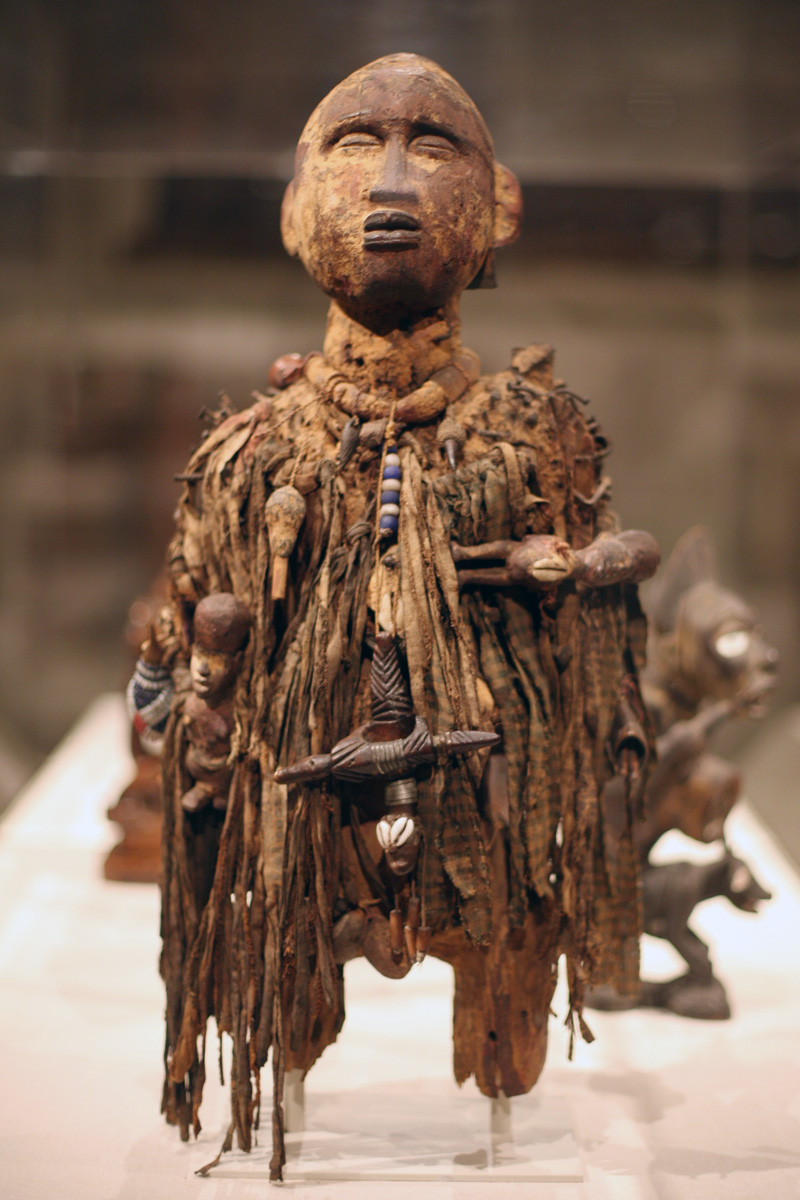
Kongo religion (Kikongo: Bukongo or Bakongo) encompasses the traditional spiritual beliefs of the Bakongo people. Due to the highly centralized position of the Kingdom of Kongo, its leaders were able to influence much of the traditional religious practices across the Congo Basin. As a result, many other ethnic groups and kingdoms in West-Central Africa, like the Chokwe and Ambundu, adopted elements of Bakongo spirituality.
The spirituality is based on a complex animistic system and a pantheon of spirits. The principle Creator God of the world is Nzambi Ampungu, the sovereign master, and his female counterpart, Nzambici. While Nzambi Ampungu, who gave birth to the universe and the spirits who inhabit it, is vital to the spirituality, ancestor veneration is the core principle.
The Bakongo cosmos is split between two worlds: the top half representing the physical world, or ku nseke and the bottom half representing the spiritual world, or ku mpèmba. Expert healers, known as Banganga, undergo extensive training to commune with the ancestors in the spiritual realms and seek guidance from them.
The religion of the Kongo is deeply complex. According to historians John K. Thornton and Linda M. Heywood, "Central Africans have probably never agreed among themselves as to what their cosmology is in detail, a product of what I called the process of continuous revelation and precarious priesthood..." However, the Kongo people had a consensus view amongst themselves, with traditional religious thought best developed in the northern Kikongo-speaking area. There is plenty of description about Kongo religious ideas in the Christian missionary and colonial era records, but as Thornton states, "these are written with a hostile bias and their reliability is problematic".
Generally, these traditions are oral rather than scriptural and passed down from one generation to another through folk tales, songs, and festivals, include belief in an amount of higher and lower gods, sometimes including a supreme creator or force, belief in spirits, veneration of the dead, use of magic and traditional African medicine. Bakongo mythology, like other nearby traditional religions, can be described as animistic with various polytheistic and pantheistic aspects. This includes the worship of tutelary deities, nature worship, ancestor worship and the belief in an afterlife. While some religions adopted a Panentheistic worldview, most follow a polytheistic system with various gods and spirits.
According to researcher Molefi Kete Asante, "Another important characteristic of Bakongo cosmology is the Sun and its movements. The rising, peaking, setting, and absence of the Sun provide the essential pattern for Bakongo religious culture." These "four moments of the sun" equate with the four stages of life: conception, birth, maturity, and death. For the Bakongo, everything transitions through these stages: planets, plants, animals, people, societies, and even ideas. This vital cycle is depicted by a circle with a cross inside. In this Yowa or dikenga cosmogram, the meeting point of the two lines of the cross is the most powerful point and where the person stands.
The Bakongo people believe that "The world in its beginning was empty; it was an mbûngi, an empty thing, a cavity, without visible life." Mbûngi (also called mwasi and mpampa) was symbolized as a circle of emptiness. The creator god Nzambi, along with his female counterpart called Nzambici, is believed to have created a spark of fire, called kalûnga, and summoned it inside of mbûngi. Kalûnga grew and became a great force of energy inside of mbûngi, creating a mass of fusion. When the mass grew too hot, the heated force caused the mass to break apart and hurl projectiles outside of mbûngi. Those projectiles became individual masses that scattered about, and when the fires cooled, planets formed and life came into existence. The Bakongo believe this was the process Nzambi used to create the universe, with the sun, stars, planets, etc. The Bakongo referred to this process as luku lwalamba Nzambi, or "God created and cooked dough." Because of this, kalûnga is seen as the origin of life, or moyo wawo mu nza and a force of motion. The Bakongo believe that life requires constant change and perpetual motion. Nzambi is also referred to as Kalûnga, the god of change. Similarities between the Bakongo belief of kalûnga and the Big Bang Theory have been studied. Unlike many other traditional African religions, the creation beliefs of the Bakongo are compatible with creatio ex nihilo.
Like the creation of the universe, the Bakongo believe that in the beginning, the world was lifeless, circular void of nothingness (or mbûngi). Then Nzambi created a great force of fire (or kalûnga), and filled this empty circle. Kalûnga heated up the contents of mbûngi, and when it cooled, it formed the Earth. The Earth, the starting point of the fire, then became a green planet after it went through four stages. The first stage is the emergence of the fire. The second stage is the red stage where the planet is still burning and has not formed. The third stage is the grey stage where the planet is cooling, but has not produced life. These planets are naked, dry, and covered with dust. The final stage is green stage is when the planet is fully mature because it breathes and carries life. As the Bakongo believe is part of the universal order, all planets must go through this process in order to achieve completeness, or nlunga.
Hub AI
Kongo religion AI simulator
(@Kongo religion_simulator)
Kongo religion
Kongo religion (Kikongo: Bukongo or Bakongo) encompasses the traditional spiritual beliefs of the Bakongo people. Due to the highly centralized position of the Kingdom of Kongo, its leaders were able to influence much of the traditional religious practices across the Congo Basin. As a result, many other ethnic groups and kingdoms in West-Central Africa, like the Chokwe and Ambundu, adopted elements of Bakongo spirituality.
The spirituality is based on a complex animistic system and a pantheon of spirits. The principle Creator God of the world is Nzambi Ampungu, the sovereign master, and his female counterpart, Nzambici. While Nzambi Ampungu, who gave birth to the universe and the spirits who inhabit it, is vital to the spirituality, ancestor veneration is the core principle.
The Bakongo cosmos is split between two worlds: the top half representing the physical world, or ku nseke and the bottom half representing the spiritual world, or ku mpèmba. Expert healers, known as Banganga, undergo extensive training to commune with the ancestors in the spiritual realms and seek guidance from them.
The religion of the Kongo is deeply complex. According to historians John K. Thornton and Linda M. Heywood, "Central Africans have probably never agreed among themselves as to what their cosmology is in detail, a product of what I called the process of continuous revelation and precarious priesthood..." However, the Kongo people had a consensus view amongst themselves, with traditional religious thought best developed in the northern Kikongo-speaking area. There is plenty of description about Kongo religious ideas in the Christian missionary and colonial era records, but as Thornton states, "these are written with a hostile bias and their reliability is problematic".
Generally, these traditions are oral rather than scriptural and passed down from one generation to another through folk tales, songs, and festivals, include belief in an amount of higher and lower gods, sometimes including a supreme creator or force, belief in spirits, veneration of the dead, use of magic and traditional African medicine. Bakongo mythology, like other nearby traditional religions, can be described as animistic with various polytheistic and pantheistic aspects. This includes the worship of tutelary deities, nature worship, ancestor worship and the belief in an afterlife. While some religions adopted a Panentheistic worldview, most follow a polytheistic system with various gods and spirits.
According to researcher Molefi Kete Asante, "Another important characteristic of Bakongo cosmology is the Sun and its movements. The rising, peaking, setting, and absence of the Sun provide the essential pattern for Bakongo religious culture." These "four moments of the sun" equate with the four stages of life: conception, birth, maturity, and death. For the Bakongo, everything transitions through these stages: planets, plants, animals, people, societies, and even ideas. This vital cycle is depicted by a circle with a cross inside. In this Yowa or dikenga cosmogram, the meeting point of the two lines of the cross is the most powerful point and where the person stands.
The Bakongo people believe that "The world in its beginning was empty; it was an mbûngi, an empty thing, a cavity, without visible life." Mbûngi (also called mwasi and mpampa) was symbolized as a circle of emptiness. The creator god Nzambi, along with his female counterpart called Nzambici, is believed to have created a spark of fire, called kalûnga, and summoned it inside of mbûngi. Kalûnga grew and became a great force of energy inside of mbûngi, creating a mass of fusion. When the mass grew too hot, the heated force caused the mass to break apart and hurl projectiles outside of mbûngi. Those projectiles became individual masses that scattered about, and when the fires cooled, planets formed and life came into existence. The Bakongo believe this was the process Nzambi used to create the universe, with the sun, stars, planets, etc. The Bakongo referred to this process as luku lwalamba Nzambi, or "God created and cooked dough." Because of this, kalûnga is seen as the origin of life, or moyo wawo mu nza and a force of motion. The Bakongo believe that life requires constant change and perpetual motion. Nzambi is also referred to as Kalûnga, the god of change. Similarities between the Bakongo belief of kalûnga and the Big Bang Theory have been studied. Unlike many other traditional African religions, the creation beliefs of the Bakongo are compatible with creatio ex nihilo.
Like the creation of the universe, the Bakongo believe that in the beginning, the world was lifeless, circular void of nothingness (or mbûngi). Then Nzambi created a great force of fire (or kalûnga), and filled this empty circle. Kalûnga heated up the contents of mbûngi, and when it cooled, it formed the Earth. The Earth, the starting point of the fire, then became a green planet after it went through four stages. The first stage is the emergence of the fire. The second stage is the red stage where the planet is still burning and has not formed. The third stage is the grey stage where the planet is cooling, but has not produced life. These planets are naked, dry, and covered with dust. The final stage is green stage is when the planet is fully mature because it breathes and carries life. As the Bakongo believe is part of the universal order, all planets must go through this process in order to achieve completeness, or nlunga.