
Recent from talks
Korea Strait
Knowledge base stats:
Talk channels stats:
Members stats:
Korea Strait
34°35′58″N 129°47′48″E / 34.59944°N 129.79667°E
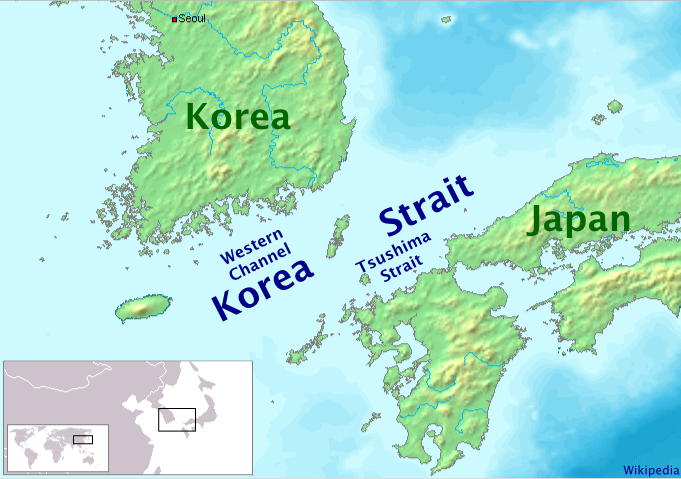
The Korea Strait is a sea passage in East Asia between the Korean Peninsula and Japan. It connects the East China Sea, the Yellow Sea and the Sea of Japan in the northwest Pacific Ocean. The strait is split by Tsushima Island into two parts: the Western Channel, and the Tsushima Strait or Eastern Channel. It is economically important, as many shipping lanes pass through the strait, and both Japan and South Korea allow free passage through it.
In ancient times, both Buddhism and Mongol invaders passed over the strait to reach Japan. More recently, it was the site of the 1950 Battle of Korea Strait during the Korean War. A tunnel running underneath the strait connecting Japan and Korea, the Japan–Korea Undersea Tunnel, has been proposed to connect the two countries.
To the north, the Korea Strait is bounded by the southern coast of the Korean Peninsula. And to the south, it by the southwestern Japanese islands of Kyūshū and Honshū. It is about 200 km (120 mi) wide and averages about 90 to 100 meters (300 ft) deep.
Tsushima Island divides the Korea Strait into the western channel and the Tsushima Strait. The western channel is deeper (up to 227 meters) and narrower than the Tsushima Strait.
A branch of the Kuroshio Current passes through the strait. Its warm branch is sometimes called the Tsushima Current. Originating along the Japanese islands this current passes through the Sea of Japan then divides along either shore of Sakhalin Island, eventually flowing into the northern Pacific Ocean via the strait north of Hokkaidō and into the Sea of Okhotsk north of Sakhalin Island near Vladivostok. The water-mass characteristics vary widely because of the low-salinity waters of the southeast coasts of Korea and China.
Numerous international shipping lanes pass through the strait, including those carrying much of the traffic bound for the ports of southern South Korea. Both South Korea and Japan have restricted their territorial claims in the strait to 3 nautical miles (5.6 km) from shore, so as to permit free passage through it.
Passenger ferries travel numerous routes across the strait. Commercial ferries run from South Korean Busan, Geoje to Japanese ports including Fukuoka, Tsushima, Shimonoseki, and Hiroshima. Ferries also connect Tsushima Island with Fukuoka, and South Korea's Jeju Island with the Korean mainland. Ferries connecting Busan and Japanese cities with ports in China also traverse the strait.
Hub AI
Korea Strait AI simulator
(@Korea Strait_simulator)
Korea Strait
34°35′58″N 129°47′48″E / 34.59944°N 129.79667°E
The Korea Strait is a sea passage in East Asia between the Korean Peninsula and Japan. It connects the East China Sea, the Yellow Sea and the Sea of Japan in the northwest Pacific Ocean. The strait is split by Tsushima Island into two parts: the Western Channel, and the Tsushima Strait or Eastern Channel. It is economically important, as many shipping lanes pass through the strait, and both Japan and South Korea allow free passage through it.
In ancient times, both Buddhism and Mongol invaders passed over the strait to reach Japan. More recently, it was the site of the 1950 Battle of Korea Strait during the Korean War. A tunnel running underneath the strait connecting Japan and Korea, the Japan–Korea Undersea Tunnel, has been proposed to connect the two countries.
To the north, the Korea Strait is bounded by the southern coast of the Korean Peninsula. And to the south, it by the southwestern Japanese islands of Kyūshū and Honshū. It is about 200 km (120 mi) wide and averages about 90 to 100 meters (300 ft) deep.
Tsushima Island divides the Korea Strait into the western channel and the Tsushima Strait. The western channel is deeper (up to 227 meters) and narrower than the Tsushima Strait.
A branch of the Kuroshio Current passes through the strait. Its warm branch is sometimes called the Tsushima Current. Originating along the Japanese islands this current passes through the Sea of Japan then divides along either shore of Sakhalin Island, eventually flowing into the northern Pacific Ocean via the strait north of Hokkaidō and into the Sea of Okhotsk north of Sakhalin Island near Vladivostok. The water-mass characteristics vary widely because of the low-salinity waters of the southeast coasts of Korea and China.
Numerous international shipping lanes pass through the strait, including those carrying much of the traffic bound for the ports of southern South Korea. Both South Korea and Japan have restricted their territorial claims in the strait to 3 nautical miles (5.6 km) from shore, so as to permit free passage through it.
Passenger ferries travel numerous routes across the strait. Commercial ferries run from South Korean Busan, Geoje to Japanese ports including Fukuoka, Tsushima, Shimonoseki, and Hiroshima. Ferries also connect Tsushima Island with Fukuoka, and South Korea's Jeju Island with the Korean mainland. Ferries connecting Busan and Japanese cities with ports in China also traverse the strait.
Recent media