
Recent from talks
Kramgasse
Knowledge base stats:
Talk channels stats:
Members stats:
Kramgasse
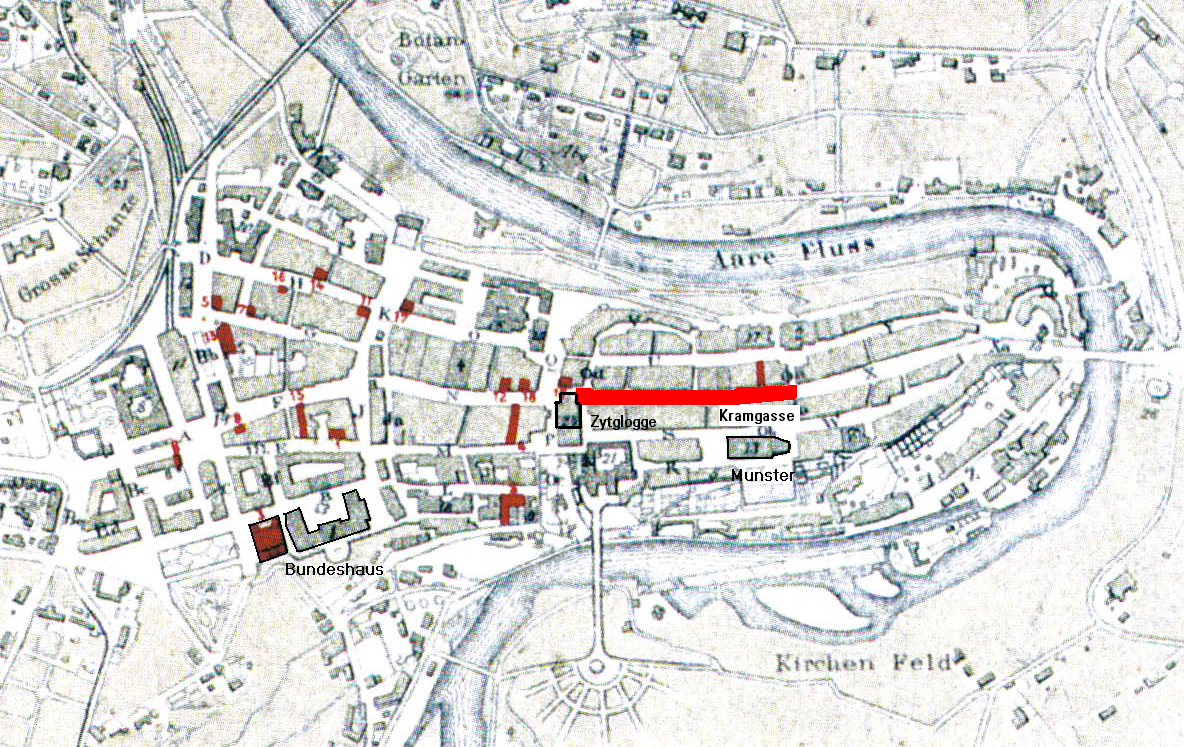
The Kramgasse ("Grocers Alley") is one of the principal streets in the Old City of Bern, the medieval city centre of Bern, Switzerland. It was the center of urban life in Bern until the 19th century. Today, it is a popular shopping street. Its length, slight curve and long line of Baroque façades combine to produce Bern's most impressive streetscape.
The Kramgasse and its buildings are a heritage site of national significance and part of the UNESCO Cultural World Heritage Site that encompasses the Old City.
The Kramgasse is some 330 meters (1,080 ft) long and lies at the center of the old city. It is the western half of the central axis of the city's oldest part, the Zähringerstadt, built right after the founding of the city in 1191. It is bounded to the west by the Zytglogge, Bern's iconic clock tower that served as the city's main gate tower in the 12th century. In the east, the Kreuzgasse, literally a "crossroads", separates it from the other half of the old main street, the Gerechtigkeitsgasse. Several narrow alleys and passageways connect the Kramgasse to the parallel Rathausgasse in the north and the Münstergasse in the south.
The Kramgasse cannot be reached by car without a special permit. It is accessible by foot, bike or by means of the Bernmobil bus line no. 12 that runs through it and has stops at either end of the street (Zytglogge and Rathaus). Both sides of the Kramgasse are covered with Lauben, stone arcades that protect pedestrians from inclement weather.
The Kramgasse was known as the Märitgasse (Swiss German for "Market Alley") until the 15th century and as the Vordere Gasse during the 16th century. The changes in name reflect the street's changes in character. In medieval times, it served as the city's marketplace, but after the Reformation the market stands were gradually replaced by stores. The street remained the commercial center of the city until the middle of the 19th century, its heyday being the 1840s.
Over the centuries, the street was slowly gentrified. Throughout the 19th century, residents complained about the waste, smell and noise associated with the Schaal, an open hall of butcher's stalls vis-à-vis the Simsonbrunnen. The Schaal was eventually demolished in 1938 and a conservatory built in its place, disrupting the medieval streetscape. Local legend has it that a calf once flayed alive here still haunts the place of its death with frightful bleats.
In the second half of the 19th century, the commercial significance of the Kramgasse waned as business moved to the newer, western part of the city and the authorities shut down the many noisy cellar taverns. At the turn of the 20th century, the Kramgasse was already a tourist attraction. Beginning in the 1920s, buses and tramways were routed through it, and from the 1970s on, motor traffic was gradually prohibited throughout the lower Old City. The number of apartments on the Kramgasse steadily dwindled as they came to be replaced by shops and offices. In 2005, the street was thoroughly renovated and its cobblestone pavement replaced. The city ditch (Stadtbach) running through the middle of the street since medieval times is now visible again through metal gratings.
Apart from a few cellars, only fragments of the current buildings on the Kramgasse date from before 1500. Many of the private town-houses retain elements from the Late Gothic period. There are very few preserved 17th century façades. Between 1705 and 1745, the façades and parts of the interior of 72 of the street's 85 buildings were rebuilt in the Baroque style, many of them by the noted architect Albrecht Stürler or his students.
Hub AI
Kramgasse AI simulator
(@Kramgasse_simulator)
Kramgasse
The Kramgasse ("Grocers Alley") is one of the principal streets in the Old City of Bern, the medieval city centre of Bern, Switzerland. It was the center of urban life in Bern until the 19th century. Today, it is a popular shopping street. Its length, slight curve and long line of Baroque façades combine to produce Bern's most impressive streetscape.
The Kramgasse and its buildings are a heritage site of national significance and part of the UNESCO Cultural World Heritage Site that encompasses the Old City.
The Kramgasse is some 330 meters (1,080 ft) long and lies at the center of the old city. It is the western half of the central axis of the city's oldest part, the Zähringerstadt, built right after the founding of the city in 1191. It is bounded to the west by the Zytglogge, Bern's iconic clock tower that served as the city's main gate tower in the 12th century. In the east, the Kreuzgasse, literally a "crossroads", separates it from the other half of the old main street, the Gerechtigkeitsgasse. Several narrow alleys and passageways connect the Kramgasse to the parallel Rathausgasse in the north and the Münstergasse in the south.
The Kramgasse cannot be reached by car without a special permit. It is accessible by foot, bike or by means of the Bernmobil bus line no. 12 that runs through it and has stops at either end of the street (Zytglogge and Rathaus). Both sides of the Kramgasse are covered with Lauben, stone arcades that protect pedestrians from inclement weather.
The Kramgasse was known as the Märitgasse (Swiss German for "Market Alley") until the 15th century and as the Vordere Gasse during the 16th century. The changes in name reflect the street's changes in character. In medieval times, it served as the city's marketplace, but after the Reformation the market stands were gradually replaced by stores. The street remained the commercial center of the city until the middle of the 19th century, its heyday being the 1840s.
Over the centuries, the street was slowly gentrified. Throughout the 19th century, residents complained about the waste, smell and noise associated with the Schaal, an open hall of butcher's stalls vis-à-vis the Simsonbrunnen. The Schaal was eventually demolished in 1938 and a conservatory built in its place, disrupting the medieval streetscape. Local legend has it that a calf once flayed alive here still haunts the place of its death with frightful bleats.
In the second half of the 19th century, the commercial significance of the Kramgasse waned as business moved to the newer, western part of the city and the authorities shut down the many noisy cellar taverns. At the turn of the 20th century, the Kramgasse was already a tourist attraction. Beginning in the 1920s, buses and tramways were routed through it, and from the 1970s on, motor traffic was gradually prohibited throughout the lower Old City. The number of apartments on the Kramgasse steadily dwindled as they came to be replaced by shops and offices. In 2005, the street was thoroughly renovated and its cobblestone pavement replaced. The city ditch (Stadtbach) running through the middle of the street since medieval times is now visible again through metal gratings.
Apart from a few cellars, only fragments of the current buildings on the Kramgasse date from before 1500. Many of the private town-houses retain elements from the Late Gothic period. There are very few preserved 17th century façades. Between 1705 and 1745, the façades and parts of the interior of 72 of the street's 85 buildings were rebuilt in the Baroque style, many of them by the noted architect Albrecht Stürler or his students.
Recent media