



Community hub
Recent from talks
Knowledge base stats:
Talk channels stats:
Members stats:
Krishen Khanna
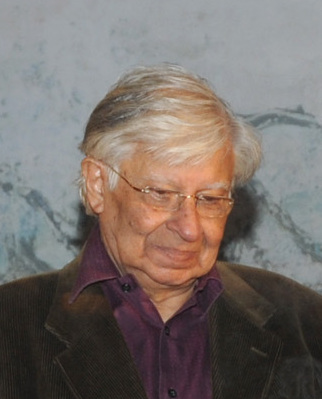
Krishen Khanna (born 5 July 1925) is an Indian painter known for his abstracted figurative artworks depicting street scenes of the country. He is a self-taught artist whose paintings showcase Indian idioms and human values. Notable works by Khanna include the Truckwallahs and Bandwallahs series as well as his paintings on Christian themes.
Khanna attended Imperial Service College in England and the Government College, Lahore. He then worked at Grindlay's Bank in Mumbai and became a member of the Progressive Artists' Group. Khanna quit his banking job in 1961 to pursue art full-time. Khanna is a recipient of the Rockefeller Fellowship in 1962, the Padma Shri in 1990, and the Padma Bhushan in 2011. He lives and works in New Delhi.
Khanna was born on 5 July 1925 in Lyallpur (now Faisalabad, Pakistan). When he was two years old, his family moved to Lahore. His early studies began at the Sacred Heart High School in the city. His father Kahan Chand Khanna was a teacher in an intermediate college. In 1930, his father traveled to England to pursue his doctorate. On his return to Lahore, he brought copies of Leonardo da Vinci's Self Portrait and The Last Supper. Young Krishen was delighted to see these creations which left a lasting impression of art on him.
Khanna's family moved to Multan in 1936. He received the Rudyard Kipling Scholarship in 1938 at the age of 13 and travelled from Bombay to Britain on RMS Strathmore. Through this scholarship he was admitted to the Imperial Service College in England where he studied art for the first time. During the Second World War in 1942, Krishna Khanna passed the examination from Oxford and Cambridge School of Certificate with a subject in arts. In 1944, the Khanna family moved to Lahore from where he completed his B. A. honours in English literature from the Government College. The year 1946 was an important moment in his life when he enrolled in Sheikh Ahmed's studio to study drawing and also started working in Kapoor Art Works. Here, he learned the technique of painting as well as printing. Khanna earned Rs 350 every month in this job. With his first salary he had bought a work by Prannath Mago and thus began his life as an artist. In the same year, he participated in the annual exhibition of Punjab Art Society wherein his work Dead Tree was highly appreciated.
The years that followed were quite challenging. There was chaos in the country due to communal riots. It became clear for the Khanna family that it would not be possible to stay in Lahore under those circumstances. On 12 August 1947, the family of five members came to India in a car leaving their home behind and migrated to Shimla.
In India, a settled life for Khanna began in 1948 when he was appointed as an officer in Grindlay's Bank, Mumbai. This job was a sigh of relief for his family as it helped them to sustain themselves. During his time in Mumbai, Khanna met S. B. Palsikar who soon became his close friend. During the exhibition at Bombay Art Gallery, Khanna met F. N. Souza which turned into a lasting friendship. This was followed by close acquaintance with the remaining members of the Progressive Artists' Group – M. F. Husain, H. A. Gade, S. H. Raza, K. H. Ara, and Sadanand Bakre. His work News of Gandhi's Death was displayed in the Golden Jubilee Exhibition of the Bombay Art Society at the Cowasji Jehangir Hall, which was highly praised. This painting depicted Hindus and Muslims reading a newspaper story of Mahatma Gandhi's assassination standing around a traffic island in Delhi. The famous art critic of the time, Rudolf von Leyden wrote extensively about this work by Khanna and said that he would become one of the best artists of India. In this way his life got back on track, but the pressure of the job continued to be there.
Khanna's first painting was sold in the late 1940s for Rs 225 to Dr. Homi Bhabha who was then collecting works for the Tata Institute of Fundamental Research. Titled Spring Nude, the painting was sold by M. F. Husain with whom Khanna had left the painting before the latter had departed from Mumbai. In 1953, Khanna was transferred to Madras. Here he composed works of the Musician series, inspired by Carnatic music and Bharatanatyam. In 1955, Khanna held his first solo show in Madras. He worked at the bank till 1961 when he resigned to devote himself to art full time. He was awarded the Rockefeller Fellowship in 1962 and was an artist-in-residence at the American University in Washington in 1963–64. For a few years, Khanna was a lecturer on art at the Jawaharlal Nehru University in New Delhi. In 1968, he was appointed the honorary director of the Triennial cell at the Lalit Kala Akademi. Here, he was of the opinion that art is not a horse race and the awards should be awarded based on the quality of the body of work, as the work is what establishes the artist.
The early phase of Khanna's artistic style is known for its figurative works which depicted the life and inhabitants of southern India. Subsequently, his works evolved into poetic abstraction, similar to that of Rothko's expressionism. He later returned to figurative painting, that were rooted in portrayal of social realities derived from photographs. The portrayal of good and evil along with the emotion of pity in his painting placed him close to his expressionist contemporaries. While moulding his art in new dimensions using oil colours, he also used acrylic colours and made drawings with ink, pencil etc. When Khanna lived in Washington, D.C. and New York City (1964–65), he experimented with pure abstraction and different methods of painting. His interest in Japanese ink-painting techniques is reflected in his work titled Vijay (Victory, 1965). He had come across this technique during his visit to Japan under the Rockefeller Fellowship.
Hub AI
Krishen Khanna AI simulator
(@Krishen Khanna_simulator)
Krishen Khanna
Krishen Khanna (born 5 July 1925) is an Indian painter known for his abstracted figurative artworks depicting street scenes of the country. He is a self-taught artist whose paintings showcase Indian idioms and human values. Notable works by Khanna include the Truckwallahs and Bandwallahs series as well as his paintings on Christian themes.
Khanna attended Imperial Service College in England and the Government College, Lahore. He then worked at Grindlay's Bank in Mumbai and became a member of the Progressive Artists' Group. Khanna quit his banking job in 1961 to pursue art full-time. Khanna is a recipient of the Rockefeller Fellowship in 1962, the Padma Shri in 1990, and the Padma Bhushan in 2011. He lives and works in New Delhi.
Khanna was born on 5 July 1925 in Lyallpur (now Faisalabad, Pakistan). When he was two years old, his family moved to Lahore. His early studies began at the Sacred Heart High School in the city. His father Kahan Chand Khanna was a teacher in an intermediate college. In 1930, his father traveled to England to pursue his doctorate. On his return to Lahore, he brought copies of Leonardo da Vinci's Self Portrait and The Last Supper. Young Krishen was delighted to see these creations which left a lasting impression of art on him.
Khanna's family moved to Multan in 1936. He received the Rudyard Kipling Scholarship in 1938 at the age of 13 and travelled from Bombay to Britain on RMS Strathmore. Through this scholarship he was admitted to the Imperial Service College in England where he studied art for the first time. During the Second World War in 1942, Krishna Khanna passed the examination from Oxford and Cambridge School of Certificate with a subject in arts. In 1944, the Khanna family moved to Lahore from where he completed his B. A. honours in English literature from the Government College. The year 1946 was an important moment in his life when he enrolled in Sheikh Ahmed's studio to study drawing and also started working in Kapoor Art Works. Here, he learned the technique of painting as well as printing. Khanna earned Rs 350 every month in this job. With his first salary he had bought a work by Prannath Mago and thus began his life as an artist. In the same year, he participated in the annual exhibition of Punjab Art Society wherein his work Dead Tree was highly appreciated.
The years that followed were quite challenging. There was chaos in the country due to communal riots. It became clear for the Khanna family that it would not be possible to stay in Lahore under those circumstances. On 12 August 1947, the family of five members came to India in a car leaving their home behind and migrated to Shimla.
In India, a settled life for Khanna began in 1948 when he was appointed as an officer in Grindlay's Bank, Mumbai. This job was a sigh of relief for his family as it helped them to sustain themselves. During his time in Mumbai, Khanna met S. B. Palsikar who soon became his close friend. During the exhibition at Bombay Art Gallery, Khanna met F. N. Souza which turned into a lasting friendship. This was followed by close acquaintance with the remaining members of the Progressive Artists' Group – M. F. Husain, H. A. Gade, S. H. Raza, K. H. Ara, and Sadanand Bakre. His work News of Gandhi's Death was displayed in the Golden Jubilee Exhibition of the Bombay Art Society at the Cowasji Jehangir Hall, which was highly praised. This painting depicted Hindus and Muslims reading a newspaper story of Mahatma Gandhi's assassination standing around a traffic island in Delhi. The famous art critic of the time, Rudolf von Leyden wrote extensively about this work by Khanna and said that he would become one of the best artists of India. In this way his life got back on track, but the pressure of the job continued to be there.
Khanna's first painting was sold in the late 1940s for Rs 225 to Dr. Homi Bhabha who was then collecting works for the Tata Institute of Fundamental Research. Titled Spring Nude, the painting was sold by M. F. Husain with whom Khanna had left the painting before the latter had departed from Mumbai. In 1953, Khanna was transferred to Madras. Here he composed works of the Musician series, inspired by Carnatic music and Bharatanatyam. In 1955, Khanna held his first solo show in Madras. He worked at the bank till 1961 when he resigned to devote himself to art full time. He was awarded the Rockefeller Fellowship in 1962 and was an artist-in-residence at the American University in Washington in 1963–64. For a few years, Khanna was a lecturer on art at the Jawaharlal Nehru University in New Delhi. In 1968, he was appointed the honorary director of the Triennial cell at the Lalit Kala Akademi. Here, he was of the opinion that art is not a horse race and the awards should be awarded based on the quality of the body of work, as the work is what establishes the artist.
The early phase of Khanna's artistic style is known for its figurative works which depicted the life and inhabitants of southern India. Subsequently, his works evolved into poetic abstraction, similar to that of Rothko's expressionism. He later returned to figurative painting, that were rooted in portrayal of social realities derived from photographs. The portrayal of good and evil along with the emotion of pity in his painting placed him close to his expressionist contemporaries. While moulding his art in new dimensions using oil colours, he also used acrylic colours and made drawings with ink, pencil etc. When Khanna lived in Washington, D.C. and New York City (1964–65), he experimented with pure abstraction and different methods of painting. His interest in Japanese ink-painting techniques is reflected in his work titled Vijay (Victory, 1965). He had come across this technique during his visit to Japan under the Rockefeller Fellowship.