



Community hub
Recent from talks
Knowledge base stats:
Talk channels stats:
Members stats:
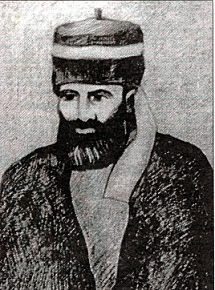
Kunta-Hajji
Kunta-Ḥājjī al-Iliskhānī (Kishiev) (Chechen: Киши КӀант Кунт-Хьаж, romanized: Kishi K'ant Kunt-X́až; c. 1800 – 1867) was a Chechen Muslim mystic, the founder of a Sufi branch named Zikrism, and an ideologue of nonviolence and passive resistance. He was a follower of the Qadiriyya Sufi order.
Kunta-haji Kishiev (literally son of Kishi) was born in a Chechen lowland village of Isti-Su, also known as Melcha-Khi. Later the family moved to the mountain village of Ilskhan-Yurt in the heartland of Chechnya. In his youth he was distinguished by his hard work and sharp mental senses. Kunta received a solid religious education and was a follower of shaykh Gezi-haji from the village of Zandak. Kunta started practicing Zikr: prayer with rolling and recitation of divine names.
Imam Shamil was worried by the unusual practice and ordered an examination of the Koranic knowledge of the youth.[citation needed] After Kunta passed the examination, Shamil left him alone. By another version of the same legend,[citation needed] Shamil forbade Kunta Zikr and promised to execute him if he continued. Yet another legend tells that Shamil exiled Kunta to Mekka and did not allow him to come back.
By the end of 1850s Kunta made his Hajj (according to Mustafa Eldibiev, Kunta made his first hajj at the age of 18, thus, in 1848). In his travel over the Middle East, Kunta not only visited Mekka but also the tomb of Abdul-Qadir Gilani in Baghdad, and became a devoted follower of Qadiriyyah, the teachings developed by Abdul-Qadir Gilani. Kunta became a strong supporter of non-violence and peace. In the midst of the bloody Caucasian War he wrote to Chechnya from Mekka:
and
After the fall of Shamil, Kunta-haji returned to Chechnya. His teaching became quite popular among people tired by the almost fifty years of the Caucasian war. The number of his murids reached five thousand. Kunta-haji required his murids not only to perform the five required prayers during the day, but also to repeat the prayer La ilaha ill-Allah (There is no god but God) at least one hundred times during the day and participate in the ritual of Loud Circular Zikr.
Despite the fact that Kunta-haji repeatedly rejected the title of imam, he was seen as a threat to the Imperial authorities and the official version of Islam supported by Russian authorities. By the request of the tsar's administration, official Islamic clerics (e.g. Abdulkadyr Khordayev and Mustafa Abdulayev) organized public theological discussions with Kunta-haji trying to prove that his teaching contradicted Islam. Still the influence of Kunta-haji only grew. Considering Kunta-haji as a threat, the Governor-General of Terek ordered his arrest. Kunta-haji and his brother, Movsar, were arrested and taken to Novocherkassk prison in January 1863. The arrest caused the so-called Dagger Uprising (or delo pod Shali), when three thousand of Kunta-haji's murids armed only with the ceremonial daggers tried to free their teacher in Shali. The rebels were dispersed by the regular troops of General Tumanov. 160 rebels were killed.
For a long time there was no information about the fate of Kunta-haji. In 1928 documents were found confirming that Kunta-haji died in exile in the town of Ustyuzhna (then Novgorod Guberniya, now Vologda Oblast).
Hub AI
Kunta-Hajji AI simulator
(@Kunta-Hajji_simulator)
Kunta-Hajji
Kunta-Ḥājjī al-Iliskhānī (Kishiev) (Chechen: Киши КӀант Кунт-Хьаж, romanized: Kishi K'ant Kunt-X́až; c. 1800 – 1867) was a Chechen Muslim mystic, the founder of a Sufi branch named Zikrism, and an ideologue of nonviolence and passive resistance. He was a follower of the Qadiriyya Sufi order.
Kunta-haji Kishiev (literally son of Kishi) was born in a Chechen lowland village of Isti-Su, also known as Melcha-Khi. Later the family moved to the mountain village of Ilskhan-Yurt in the heartland of Chechnya. In his youth he was distinguished by his hard work and sharp mental senses. Kunta received a solid religious education and was a follower of shaykh Gezi-haji from the village of Zandak. Kunta started practicing Zikr: prayer with rolling and recitation of divine names.
Imam Shamil was worried by the unusual practice and ordered an examination of the Koranic knowledge of the youth.[citation needed] After Kunta passed the examination, Shamil left him alone. By another version of the same legend,[citation needed] Shamil forbade Kunta Zikr and promised to execute him if he continued. Yet another legend tells that Shamil exiled Kunta to Mekka and did not allow him to come back.
By the end of 1850s Kunta made his Hajj (according to Mustafa Eldibiev, Kunta made his first hajj at the age of 18, thus, in 1848). In his travel over the Middle East, Kunta not only visited Mekka but also the tomb of Abdul-Qadir Gilani in Baghdad, and became a devoted follower of Qadiriyyah, the teachings developed by Abdul-Qadir Gilani. Kunta became a strong supporter of non-violence and peace. In the midst of the bloody Caucasian War he wrote to Chechnya from Mekka:
and
After the fall of Shamil, Kunta-haji returned to Chechnya. His teaching became quite popular among people tired by the almost fifty years of the Caucasian war. The number of his murids reached five thousand. Kunta-haji required his murids not only to perform the five required prayers during the day, but also to repeat the prayer La ilaha ill-Allah (There is no god but God) at least one hundred times during the day and participate in the ritual of Loud Circular Zikr.
Despite the fact that Kunta-haji repeatedly rejected the title of imam, he was seen as a threat to the Imperial authorities and the official version of Islam supported by Russian authorities. By the request of the tsar's administration, official Islamic clerics (e.g. Abdulkadyr Khordayev and Mustafa Abdulayev) organized public theological discussions with Kunta-haji trying to prove that his teaching contradicted Islam. Still the influence of Kunta-haji only grew. Considering Kunta-haji as a threat, the Governor-General of Terek ordered his arrest. Kunta-haji and his brother, Movsar, were arrested and taken to Novocherkassk prison in January 1863. The arrest caused the so-called Dagger Uprising (or delo pod Shali), when three thousand of Kunta-haji's murids armed only with the ceremonial daggers tried to free their teacher in Shali. The rebels were dispersed by the regular troops of General Tumanov. 160 rebels were killed.
For a long time there was no information about the fate of Kunta-haji. In 1928 documents were found confirming that Kunta-haji died in exile in the town of Ustyuzhna (then Novgorod Guberniya, now Vologda Oblast).