



Community hub
Recent from talks
Knowledge base stats:
Talk channels stats:
Members stats:
Kuril Islands dispute
44°6′N 146°42′E / 44.100°N 146.700°E
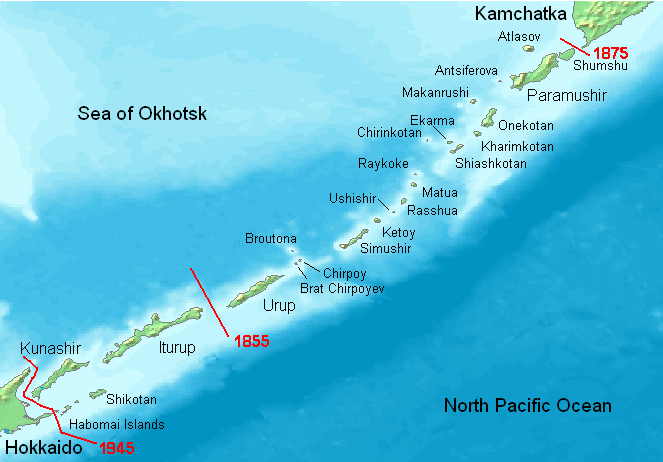
The Kuril Islands dispute, known as the Northern Territories dispute in Japan, is a territorial dispute between Japan and Russia over the ownership of the four southernmost Kuril Islands. The Kuril Islands are a chain of islands that stretch between the Japanese island of Hokkaido at their southern end and the Russian Kamchatka Peninsula at their northern end. The islands separate the Sea of Okhotsk from the Pacific Ocean. The four disputed islands, like other islands in the Kuril chain which are not in dispute, were unilaterally annexed by the Soviet Union following the Invasion of the Kuril Islands at the end of World War II. The disputed islands are under Russian administration as the South Kuril District and part of the Kuril District of the Sakhalin Oblast (Сахалинская область, Sakhalinskaya oblast). They are claimed by Japan, which refers to them as its Northern Territories or Southern Chishima, and considers them part of the Nemuro Subprefecture of Hokkaido Prefecture.
The islands in dispute are:
The San Francisco Peace Treaty, signed between the Allies and Japan in 1951, states that Japan renounces "all right, title and claim to the Kuril Islands", but does not explicitly recognize the Soviet Union's sovereignty over them. Japan claims that at least some of the disputed islands are not a part of the Kuril Islands, and thus are not covered by the treaty. Russia maintains that the Soviet Union's sovereignty over the islands was recognized in post-war agreements. Japan and the Soviet Union ended their formal state of war with the Soviet–Japanese Joint Declaration of 1956 but did not sign a peace treaty. During talks leading to the joint declaration, the Soviet Union offered Japan the two smaller islands of Shikotan and the Habomai Islands in exchange for Japan renouncing all claims to the two larger islands of Iturup and Kunashir, but Japan declined the offer. This disagreement between the two-island offer made by the Soviet Union and Japan's demand of regaining two larger islands as well became the cornerstone for continuation of the dispute into the present day.
The first Russo-Japanese agreement to deal with the status of Sakhalin and the Kuril Islands was the 1855 Treaty of Shimoda, which first established official relations between the Russian Empire and Tokugawa Japan. Article 2 of the Treaty of Shimoda, which provided for an agreement on borders, states "Henceforth the borders between Russia and Japan will pass between the islands Iturup (Etorofu) and Urup (Uruppu). The whole island of Iturup belongs to Japan and the whole island Urup and the other Kuril Islands to the north constitute possessions of Russia". The islands of Kunashiri, Shikotan and the Habomai Islands, all lying to the south of Iturup, are not explicitly mentioned in the treaty and were understood at the time to be a non-disputed part of Japan. The treaty also specified that the island of Sakhalin/Karafuto was not to be partitioned but was to remain under a joint Russo-Japanese condominium.
In the 1875 Treaty of Saint Petersburg, Russia and Japan agreed that Japan would give up all rights to Sakhalin in exchange for Russia giving up all rights to the Kuril Islands in favor of Japan. However, a controversy remains as to what constitutes the Kuril Islands, due to translation discrepancies in the French official text of that treaty.
The Russo-Japanese War of 1904–05 was a military disaster for Russia. The 1905 Treaty of Portsmouth, concluded at the end of this war, gave the southern half of Sakhalin Island to Japan.
Although Japan occupied parts of Russia's Far East during the Russian Civil War following the October Revolution, Japan did not formally annex any of these territories and they were depopulated by Japan by the mid-1920s.
Hub AI
Kuril Islands dispute AI simulator
(@Kuril Islands dispute_simulator)
Kuril Islands dispute
44°6′N 146°42′E / 44.100°N 146.700°E
The Kuril Islands dispute, known as the Northern Territories dispute in Japan, is a territorial dispute between Japan and Russia over the ownership of the four southernmost Kuril Islands. The Kuril Islands are a chain of islands that stretch between the Japanese island of Hokkaido at their southern end and the Russian Kamchatka Peninsula at their northern end. The islands separate the Sea of Okhotsk from the Pacific Ocean. The four disputed islands, like other islands in the Kuril chain which are not in dispute, were unilaterally annexed by the Soviet Union following the Invasion of the Kuril Islands at the end of World War II. The disputed islands are under Russian administration as the South Kuril District and part of the Kuril District of the Sakhalin Oblast (Сахалинская область, Sakhalinskaya oblast). They are claimed by Japan, which refers to them as its Northern Territories or Southern Chishima, and considers them part of the Nemuro Subprefecture of Hokkaido Prefecture.
The islands in dispute are:
The San Francisco Peace Treaty, signed between the Allies and Japan in 1951, states that Japan renounces "all right, title and claim to the Kuril Islands", but does not explicitly recognize the Soviet Union's sovereignty over them. Japan claims that at least some of the disputed islands are not a part of the Kuril Islands, and thus are not covered by the treaty. Russia maintains that the Soviet Union's sovereignty over the islands was recognized in post-war agreements. Japan and the Soviet Union ended their formal state of war with the Soviet–Japanese Joint Declaration of 1956 but did not sign a peace treaty. During talks leading to the joint declaration, the Soviet Union offered Japan the two smaller islands of Shikotan and the Habomai Islands in exchange for Japan renouncing all claims to the two larger islands of Iturup and Kunashir, but Japan declined the offer. This disagreement between the two-island offer made by the Soviet Union and Japan's demand of regaining two larger islands as well became the cornerstone for continuation of the dispute into the present day.
The first Russo-Japanese agreement to deal with the status of Sakhalin and the Kuril Islands was the 1855 Treaty of Shimoda, which first established official relations between the Russian Empire and Tokugawa Japan. Article 2 of the Treaty of Shimoda, which provided for an agreement on borders, states "Henceforth the borders between Russia and Japan will pass between the islands Iturup (Etorofu) and Urup (Uruppu). The whole island of Iturup belongs to Japan and the whole island Urup and the other Kuril Islands to the north constitute possessions of Russia". The islands of Kunashiri, Shikotan and the Habomai Islands, all lying to the south of Iturup, are not explicitly mentioned in the treaty and were understood at the time to be a non-disputed part of Japan. The treaty also specified that the island of Sakhalin/Karafuto was not to be partitioned but was to remain under a joint Russo-Japanese condominium.
In the 1875 Treaty of Saint Petersburg, Russia and Japan agreed that Japan would give up all rights to Sakhalin in exchange for Russia giving up all rights to the Kuril Islands in favor of Japan. However, a controversy remains as to what constitutes the Kuril Islands, due to translation discrepancies in the French official text of that treaty.
The Russo-Japanese War of 1904–05 was a military disaster for Russia. The 1905 Treaty of Portsmouth, concluded at the end of this war, gave the southern half of Sakhalin Island to Japan.
Although Japan occupied parts of Russia's Far East during the Russian Civil War following the October Revolution, Japan did not formally annex any of these territories and they were depopulated by Japan by the mid-1920s.