
Recent from talks
Kutchi language
Knowledge base stats:
Talk channels stats:
Members stats:
Kutchi language
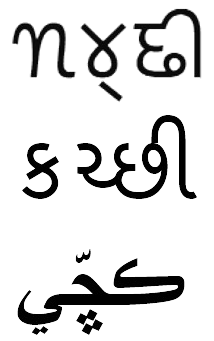
Kutchi (/ˈkʌtʃi/; કચ્છી, 𑊺𑋀𑋪𑋁𑋢, ڪڇّي, IPA: [kətːʃʰiː]) or Kachhi is an Indo-Aryan language spoken in the Kutch region of the Indian state of Gujarat and some parts of the neighbouring state of Rajasthan and in Sindh, Pakistan.
Some scholars have considered Kutchi to be a dialect of Sindhi, but the two languages are quite distinct from one another. Over time, it has borrowed vocabulary from Gujarati. The variety of Kutchi spoken in Sindh and in the Banni region of Kutch is more similar to the Lari dialect of Sindhi, whereas the Kutchi spoken in the eastern parts of Kutch has more Gujarati influence, and is slowly becoming more similar to Gujarati.
Most Kutchis living in India are bilingual or trilingual, due to exposure to closely related neighbouring languages such as Gujarati. Many Pakistani Kutchis are also bilingual or trilingual; many residents of Karachi speak Kutchi. Its differences from neighbouring languages are more pronounced in its spoken varieties, but it has many loans from Gujarati, Marwari (a major western Rajasthani language) and Hindi-Urdu as well. Kutchi-speakers are often part of the Charans, Jadeja, Bhanushalis, Lohanas, Brahmins (Rajgor), Meghwals, Visa Oswal and Dasa Osval (Oshwal) Jains, Ismaili Khojas (and followers of the Satpanth), Bhatias, Rabaris, Siddis, Muslim Kutchi Khatris, the Muslim Royma, and Kutchi Memons. The Jadeja rulers of Cutch and Rajputs of Kutch, speak Kutchi language.
During the British reign, many traders and families of the Kutchi communities left the Indian subcontinent and settled in regions of East Africa such as Kenya, Somalia, Tanzania, Uganda, Zaire/Congo, and even as far south as South Africa. The landing point of entry into Africa was in Zanzibar, a trading post of goods between India and East Africa in the late 1800s. Kutchi communities in this region often integrated Swahili words and phrases into their language, producing a creole language called Kutchi-Swahili.
Kutchi, like other Sindhi languages, has a series of implosive consonants. However, its inventory is incomplete; only the bilabial and retroflex implosives are present and contrastive.
Kutchi has a 10-vowel system similar to Sindhi and other New Indo-Aryan languages. The vowels /ɪ, ʊ, ə/ are phonetically short.
There are distinct regional accents and variations in grammar. As in many languages spoken along Asian trade routes. Many Kutchi speakers also speak Gujarati as a separate language, especially as it is the language in which Kutchi speakers customarily write. Kutchi speakers' Gujarati accent and usage tends towards standard forms that any Gujarati speaker would be able to understand.
The following words are commonly used by Hindu individuals descending from the Kutch rural area of Gujarat, India, who, especially if in east Africa, reject Kutchi. These are colloquial forms of general Gujarati phrases that are often used in daily conversation in villages, particularly of Kutchi predominance, and are Gujaratisized versions of Kutchi words. Kutchi is also very close to Sindhi and Gujarati due to historical, cultural and geographic influences. These relationships are evident in the following examples:
Hub AI
Kutchi language AI simulator
(@Kutchi language_simulator)
Kutchi language
Kutchi (/ˈkʌtʃi/; કચ્છી, 𑊺𑋀𑋪𑋁𑋢, ڪڇّي, IPA: [kətːʃʰiː]) or Kachhi is an Indo-Aryan language spoken in the Kutch region of the Indian state of Gujarat and some parts of the neighbouring state of Rajasthan and in Sindh, Pakistan.
Some scholars have considered Kutchi to be a dialect of Sindhi, but the two languages are quite distinct from one another. Over time, it has borrowed vocabulary from Gujarati. The variety of Kutchi spoken in Sindh and in the Banni region of Kutch is more similar to the Lari dialect of Sindhi, whereas the Kutchi spoken in the eastern parts of Kutch has more Gujarati influence, and is slowly becoming more similar to Gujarati.
Most Kutchis living in India are bilingual or trilingual, due to exposure to closely related neighbouring languages such as Gujarati. Many Pakistani Kutchis are also bilingual or trilingual; many residents of Karachi speak Kutchi. Its differences from neighbouring languages are more pronounced in its spoken varieties, but it has many loans from Gujarati, Marwari (a major western Rajasthani language) and Hindi-Urdu as well. Kutchi-speakers are often part of the Charans, Jadeja, Bhanushalis, Lohanas, Brahmins (Rajgor), Meghwals, Visa Oswal and Dasa Osval (Oshwal) Jains, Ismaili Khojas (and followers of the Satpanth), Bhatias, Rabaris, Siddis, Muslim Kutchi Khatris, the Muslim Royma, and Kutchi Memons. The Jadeja rulers of Cutch and Rajputs of Kutch, speak Kutchi language.
During the British reign, many traders and families of the Kutchi communities left the Indian subcontinent and settled in regions of East Africa such as Kenya, Somalia, Tanzania, Uganda, Zaire/Congo, and even as far south as South Africa. The landing point of entry into Africa was in Zanzibar, a trading post of goods between India and East Africa in the late 1800s. Kutchi communities in this region often integrated Swahili words and phrases into their language, producing a creole language called Kutchi-Swahili.
Kutchi, like other Sindhi languages, has a series of implosive consonants. However, its inventory is incomplete; only the bilabial and retroflex implosives are present and contrastive.
Kutchi has a 10-vowel system similar to Sindhi and other New Indo-Aryan languages. The vowels /ɪ, ʊ, ə/ are phonetically short.
There are distinct regional accents and variations in grammar. As in many languages spoken along Asian trade routes. Many Kutchi speakers also speak Gujarati as a separate language, especially as it is the language in which Kutchi speakers customarily write. Kutchi speakers' Gujarati accent and usage tends towards standard forms that any Gujarati speaker would be able to understand.
The following words are commonly used by Hindu individuals descending from the Kutch rural area of Gujarat, India, who, especially if in east Africa, reject Kutchi. These are colloquial forms of general Gujarati phrases that are often used in daily conversation in villages, particularly of Kutchi predominance, and are Gujaratisized versions of Kutchi words. Kutchi is also very close to Sindhi and Gujarati due to historical, cultural and geographic influences. These relationships are evident in the following examples:
Recent media