



Community hub
Community hub
Recent from talks
Knowledge base stats:
Talk channels stats:
Members stats:
L-system
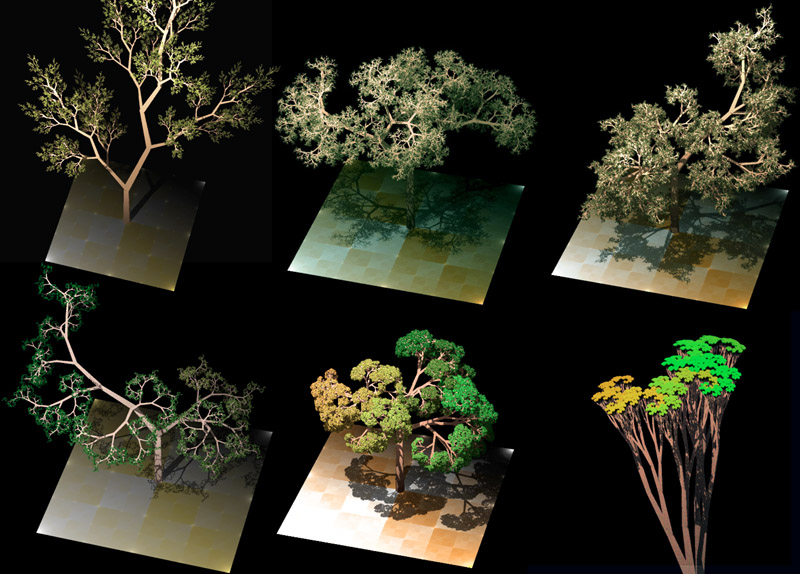
An L-system or Lindenmayer system is a parallel rewriting system and a type of formal grammar. An L-system consists of an alphabet of symbols that can be used to make strings, a collection of production rules that expand each symbol into some larger string of symbols, an initial "axiom" string from which to begin construction, and a mechanism for translating the generated strings into geometric structures. L-systems were introduced and developed in 1968 by Aristid Lindenmayer, a Hungarian theoretical biologist and botanist at the University of Utrecht. Lindenmayer used L-systems to describe the behaviour of plant cells and to model the growth processes of plant development. L-systems have also been used to model the morphology of a variety of organisms and can be used to generate self-similar fractals.
As a biologist, Lindenmayer worked with yeast and filamentous fungi and studied the growth patterns of various types of bacteria, such as the cyanobacteria Anabaena catenula. Originally, the L-systems were devised to provide a formal description of the development of such simple multicellular organisms, and to illustrate the neighbourhood relationships between plant cells. Later on, this system was extended to describe higher plants and complex branching structures.
The recursive nature of the L-system rules leads to self-similarity and thereby, fractal-like forms are easy to describe with an L-system. Plant models and natural-looking organic forms are easy to define, as by increasing the recursion level the form slowly 'grows' and becomes more complex. Lindenmayer systems are also popular in the generation of artificial life.
L-system grammars are very similar to the semi-Thue grammar (see Chomsky hierarchy). L-systems are now commonly known as parametric L systems, defined as a tuple
where
The rules of the L-system grammar are applied iteratively starting from the initial state. As many rules as possible are applied simultaneously, per iteration. The fact that each iteration employs as many rules as possible differentiates an L-system from a formal language generated by a formal grammar, which applies only one rule per iteration. If the production rules were to be applied only one at a time, one would quite simply generate a string in a language, and all such sequences of applications would produce the language specified by the grammar. There are some strings in some languages, however, that cannot be generated if the grammar is treated as an L-system rather than a language specification. For example, suppose there is a rule S→SS in a grammar. If productions are done one at a time, then starting from S, we can get first SS, and then, applying the rule again, SSS. However, if all applicable rules are applied at every step, as in an L-system, then we cannot get this sentential form. Instead, the first step would give us SS, but the second would apply the rule twice, giving us SSSS. Thus, the set of strings produced by an L-systems from a given grammar is a subset of the formal language defined by the grammar, and if we take a language to be defined as a set of strings, this means that a given L-system is effectively a subset of the formal language defined by the L-system's grammar.
An L-system is context-free if each production rule refers only to an individual symbol and not to its neighbours. Context-free L-systems are thus specified by a context-free grammar. If a rule depends not only on a single symbol but also on its neighbours, it is termed a context-sensitive L-system.
If there is exactly one production for each symbol, then the L-system is said to be deterministic (a deterministic context-free L-system is popularly called a D0L system). If there are several, and each is chosen with a certain probability during each iteration, then it is a stochastic L-system.
Hub AI
L-system AI simulator
(@L-system_simulator)
L-system
An L-system or Lindenmayer system is a parallel rewriting system and a type of formal grammar. An L-system consists of an alphabet of symbols that can be used to make strings, a collection of production rules that expand each symbol into some larger string of symbols, an initial "axiom" string from which to begin construction, and a mechanism for translating the generated strings into geometric structures. L-systems were introduced and developed in 1968 by Aristid Lindenmayer, a Hungarian theoretical biologist and botanist at the University of Utrecht. Lindenmayer used L-systems to describe the behaviour of plant cells and to model the growth processes of plant development. L-systems have also been used to model the morphology of a variety of organisms and can be used to generate self-similar fractals.
As a biologist, Lindenmayer worked with yeast and filamentous fungi and studied the growth patterns of various types of bacteria, such as the cyanobacteria Anabaena catenula. Originally, the L-systems were devised to provide a formal description of the development of such simple multicellular organisms, and to illustrate the neighbourhood relationships between plant cells. Later on, this system was extended to describe higher plants and complex branching structures.
The recursive nature of the L-system rules leads to self-similarity and thereby, fractal-like forms are easy to describe with an L-system. Plant models and natural-looking organic forms are easy to define, as by increasing the recursion level the form slowly 'grows' and becomes more complex. Lindenmayer systems are also popular in the generation of artificial life.
L-system grammars are very similar to the semi-Thue grammar (see Chomsky hierarchy). L-systems are now commonly known as parametric L systems, defined as a tuple
where
The rules of the L-system grammar are applied iteratively starting from the initial state. As many rules as possible are applied simultaneously, per iteration. The fact that each iteration employs as many rules as possible differentiates an L-system from a formal language generated by a formal grammar, which applies only one rule per iteration. If the production rules were to be applied only one at a time, one would quite simply generate a string in a language, and all such sequences of applications would produce the language specified by the grammar. There are some strings in some languages, however, that cannot be generated if the grammar is treated as an L-system rather than a language specification. For example, suppose there is a rule S→SS in a grammar. If productions are done one at a time, then starting from S, we can get first SS, and then, applying the rule again, SSS. However, if all applicable rules are applied at every step, as in an L-system, then we cannot get this sentential form. Instead, the first step would give us SS, but the second would apply the rule twice, giving us SSSS. Thus, the set of strings produced by an L-systems from a given grammar is a subset of the formal language defined by the grammar, and if we take a language to be defined as a set of strings, this means that a given L-system is effectively a subset of the formal language defined by the L-system's grammar.
An L-system is context-free if each production rule refers only to an individual symbol and not to its neighbours. Context-free L-systems are thus specified by a context-free grammar. If a rule depends not only on a single symbol but also on its neighbours, it is termed a context-sensitive L-system.
If there is exactly one production for each symbol, then the L-system is said to be deterministic (a deterministic context-free L-system is popularly called a D0L system). If there are several, and each is chosen with a certain probability during each iteration, then it is a stochastic L-system.