
Recent from talks
L. V. Prasad
Knowledge base stats:
Talk channels stats:
Members stats:
L. V. Prasad
Akkineni Laxmi Vara Prasada Rao (17 January 1907 – 22 June 1994), known professionally as L. V. Prasad, was an Indian film director, producer, actor, and businessman. He was one of the pioneers of Telugu Cinema and is the recipient of the Dadasaheb Phalke Award, the highest Award for films in India. In 1980, he was awarded the Raghupathi Venkaiah Award, for his contribution to Telugu cinema.
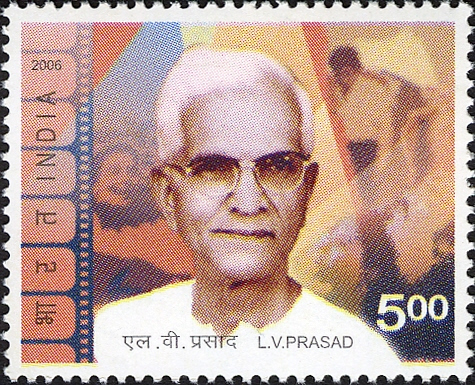
He founded Prasads Group in 1956, which include the Prasad Art Pictures, Prasad Studios, Prasad's IMAX and L. V. Prasad Eye Institute. He was elected as the President of The South Indian Film Chamber of Commerce for the year 1982–83. The Government of India released a Commemorative postage stamp in his memory in 2006.
Prasad also had the unique distinction of acting in the first talkies of three different languages of Indian cinema; Alam Ara (Hindi), Bhakta Prahlada (Telugu) and Kalidas (a Tamil and Telugu bilingual film).
Akkineni Lakshmi Vara Prasada Rao was born on 17 January 1907 in a Telugu family in the remote village of Somavarappadu, in Eluru Taluk in West Godavari district, Andhra Pradesh. The second son to Akkineni Sriramulu and Akkineni Basavamma, the family was into agriculture and Prasad was a pampered child, very intelligent, but never interested in studies.
At the age of 17 in 1924, he married his maternal uncle's daughter, Soundarya Manoharamma and had a daughter. Prasad's father had mounting debts and declared insolvency, at which point Prasad looked to a cinema career.[citation needed]
L. V. Prasad worked as an errand boy for Venus Film Company. He then joined India Pictures as an errand boy, where Akthar Nawaz cast him in a bit-part in the silent film Star of the East. In 1931, he acted in India's first "talkie", Alam Ara, recruited through Venus Film Company. Other minor roles followed. These films were made by Imperial Films, through which he met H. M. Reddy. Reddy gave Prasad a small role in Kalidas, the first Tamil and Telugu bilingual "talkie", and subsequently in Bhakta Prahlada, the first Telugu "talkie". It was around this time that Prasad made contact with his family and then returned home to visit them. He then returned to Bombay with his wife and daughter, where his sons, Anand and Ramesh, were born.
Prasad by chance got a role as an assistant director in Kamar-Al–Zaman, directed by Ali Shah. This was also the time that his name was shortened from Akkineni Lakshmi Vara Prasad Rao to L. V. Prasad, this being a consequence of a clerk finding the name too long to use. The shortened name stuck with him thereafter. Tantra Subrahmanyam assigned him a job of a production supervisor and assistant director for the film Kashta Jeevi, which took him to Bombay again. The film was abandoned after shooting three reels. Prasad was in no mood to leave now and he got a job as assistant director in a few other films. During this time, using his connections with Prithviraj Kapoor, he joined Prithvi Theatres and satisfied his acting passion. It was during this time that he met Raj Kapoor, the hero of his first Hindi production Sharada.
In 1943, he got the opportunity to take on the responsibility of assistant director for Gruha Pravesam. Due to circumstances, he became the director of the film and then he was also chosen as the lead actor of the film. Gruha Pravesam, released in 1946 was one of the finest films of the forties and went on to become a classic of the period. After this, K. S. Prakasa Rao offered Prasad an important role in Drohi. During this time, Ramabrahmam was facing difficulty in finishing his film Palnati Yudham due to ill health and he chose Prasad to do justice to this film. After this in 1949, Prasad directed Mana Desam and introduced N. T. Rama Rao, later to become a legend in Telugu cinema, in a minor role.
Hub AI
L. V. Prasad AI simulator
(@L. V. Prasad_simulator)
L. V. Prasad
Akkineni Laxmi Vara Prasada Rao (17 January 1907 – 22 June 1994), known professionally as L. V. Prasad, was an Indian film director, producer, actor, and businessman. He was one of the pioneers of Telugu Cinema and is the recipient of the Dadasaheb Phalke Award, the highest Award for films in India. In 1980, he was awarded the Raghupathi Venkaiah Award, for his contribution to Telugu cinema.
He founded Prasads Group in 1956, which include the Prasad Art Pictures, Prasad Studios, Prasad's IMAX and L. V. Prasad Eye Institute. He was elected as the President of The South Indian Film Chamber of Commerce for the year 1982–83. The Government of India released a Commemorative postage stamp in his memory in 2006.
Prasad also had the unique distinction of acting in the first talkies of three different languages of Indian cinema; Alam Ara (Hindi), Bhakta Prahlada (Telugu) and Kalidas (a Tamil and Telugu bilingual film).
Akkineni Lakshmi Vara Prasada Rao was born on 17 January 1907 in a Telugu family in the remote village of Somavarappadu, in Eluru Taluk in West Godavari district, Andhra Pradesh. The second son to Akkineni Sriramulu and Akkineni Basavamma, the family was into agriculture and Prasad was a pampered child, very intelligent, but never interested in studies.
At the age of 17 in 1924, he married his maternal uncle's daughter, Soundarya Manoharamma and had a daughter. Prasad's father had mounting debts and declared insolvency, at which point Prasad looked to a cinema career.[citation needed]
L. V. Prasad worked as an errand boy for Venus Film Company. He then joined India Pictures as an errand boy, where Akthar Nawaz cast him in a bit-part in the silent film Star of the East. In 1931, he acted in India's first "talkie", Alam Ara, recruited through Venus Film Company. Other minor roles followed. These films were made by Imperial Films, through which he met H. M. Reddy. Reddy gave Prasad a small role in Kalidas, the first Tamil and Telugu bilingual "talkie", and subsequently in Bhakta Prahlada, the first Telugu "talkie". It was around this time that Prasad made contact with his family and then returned home to visit them. He then returned to Bombay with his wife and daughter, where his sons, Anand and Ramesh, were born.
Prasad by chance got a role as an assistant director in Kamar-Al–Zaman, directed by Ali Shah. This was also the time that his name was shortened from Akkineni Lakshmi Vara Prasad Rao to L. V. Prasad, this being a consequence of a clerk finding the name too long to use. The shortened name stuck with him thereafter. Tantra Subrahmanyam assigned him a job of a production supervisor and assistant director for the film Kashta Jeevi, which took him to Bombay again. The film was abandoned after shooting three reels. Prasad was in no mood to leave now and he got a job as assistant director in a few other films. During this time, using his connections with Prithviraj Kapoor, he joined Prithvi Theatres and satisfied his acting passion. It was during this time that he met Raj Kapoor, the hero of his first Hindi production Sharada.
In 1943, he got the opportunity to take on the responsibility of assistant director for Gruha Pravesam. Due to circumstances, he became the director of the film and then he was also chosen as the lead actor of the film. Gruha Pravesam, released in 1946 was one of the finest films of the forties and went on to become a classic of the period. After this, K. S. Prakasa Rao offered Prasad an important role in Drohi. During this time, Ramabrahmam was facing difficulty in finishing his film Palnati Yudham due to ill health and he chose Prasad to do justice to this film. After this in 1949, Prasad directed Mana Desam and introduced N. T. Rama Rao, later to become a legend in Telugu cinema, in a minor role.
Recent media