Hubbry Logo
Alam AraAlam AraMain
Open search
Alam Ara
Community hub
Alam Ara
logo
8 pages, 0 posts
0 subscribers
Be the first to start a discussion here.
Alam Ara
Alam Ara
from Wikipedia

Alam Ara
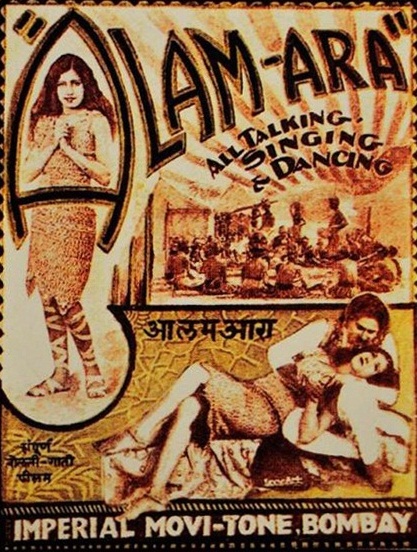
A poster for Alam Ara featuring the lead cast.
Theatrical release poster
Directed byArdeshir Irani
Screenplay byArdeshir Irani
Based onAlam Ara
by Joseph David
Produced byArdeshir Irani
Starring
CinematographyAdi M. Irani
Edited byEzra Mir
Music by
  • Firozshah Mistry
  • B. Irani
Production
company
Imperial Film Company
Distributed bySagar Movietone
Release date
  • 14 March 1931 (1931-03-14)
Running time
124 minutes[1]
CountryIndia
LanguageHindustani
Budget40,000[2]

Alam Ara (transl.Ornament of the World) is a 1931 Indian historical fantasy film directed and produced by Ardeshir Irani. It revolves around a king and his two wives, Navbahaar and Dilbahaar, who are childless; soon, a fakir (Wazir Muhammad Khan) tells the king that the former wife will give birth to a boy, later named Qamar (Master Vithal), but the child will die following his 18th birthday if Navbahaar cannot find the necklace he asks for. Meanwhile, the king finds out that Dilbahaar falls for the senapati Adil (Prithviraj Kapoor), leading the king to arrest him and evicts his pregnant wife, who later gives birth to Alam Ara (Zubeida).

Irani was inspired to make Alam Ara after watching the 1929 American part-talkie Show Boat. The story was adapted from the Bombay-based dramatist Joseph David's play of the same name. Made on a budget of 40,000 (equivalent to 12 million or US$140,000 in 2023), principal photography was handled by Adi M. Irani within four months in Bombay. Because the studio was located near a railway track, it was filmed mostly during the nighttime to avoid noise from the active trains. Following filming, Ardeshir Irani finished the sound recording using the single-system recording. Firozshah Mistry and B. Irani served as the music directors.

Alam Ara was released on 14 March 1931 and performed well at the box office. Critics were appreciative, with the performance and songs getting the most attention, though some of whom criticised the sound recording. In addition to the successes, the film was also widely considered a major breakthrough for the Indian film industry and Ardeshir Irani's career with its status as the country's first sound film. Although no print or gramophone record of the film is known to survive, making it a lost film, surviving artefacts include its stills and posters. In 2017, the British Film Institute declared it as the most important of any lost films produced in India.

Plot

[edit]

A king and his two wives, Navbahaar and Dilbahaar, are childless. Soon, a fakir tells Navbahaar she will give birth to a boy but she must find a necklace tied around a fish's neck—which will appear once at the palace's lake—if she wants her son to live past his 18th birthday. The boy is named Qamar. Besides that, Dilbahaar has an affair with the palace's senapati Adil. The king finds out about this, and Dilbahaar tells him it was Adil who seduced her first. Therefore, the king arrests him and evicts his pregnant wife, Mehar Nigar, from the palace; Nigar gives birth to Alam Ara and dies when a shikari tells her about her husband's affair. The shikari later adopts Ara.

Dilbahaar is jealous of Navbahaar and knows about her agreement with the fakir. When the necklace appears on Qamar's 18th birthday, she secretly replaces it with a fake one, which soon results in Qamar's death. His family, however, does not bury his body and starts looking for the fakir to find out what went wrong. As a result, Qamar comes alive every night when Dilbahaar removes the necklace from her neck and later dies when she wears it in the morning. Apart from that, Ara knows about her innocent father's suffering, vowing to release him from prison. On her visit to the place one night, Ara sees the alive Qamar and falls for him. Everyone in the palace subsequently learns about Dilbahaar's foul play and finally retrieve the real necklace, with Adil being released. The film ends with Qamar and Ara living happily together.[3]

Cast

[edit]

Other supporting roles were played by Jilloo, Sushila, Elizer, Jagdish Sethi, L. V. Prasad, and Yaqub.[7]

Production

[edit]
Ardeshir Irani recording sound for Alam Ara.
Irani at the sets of Alam Ara, recording the film's sound

After watching Harry A. Pollard's 1929 American romantic drama part-talkie Show Boat at Excelsior Theatre in Bombay (present-day Mumbai), Ardeshir Irani was inspired to make his next project a sound film which he would direct and produce.[8] Although having no experience creating this type of film, he determined to make it and decided to not follow any precedential sound films.[9] The project was subsequently titled Alam Ara and produced by Irani for Imperial Film Company (IFC), an entertainment studio he co-founded with the tent showman Abdulally Esoofally in 1926.[10] The story was adapted from the Bombay-based dramatist Joseph David's Parsi play of the same name, while the screenplay was done by Irani.[11] The dialogue was written in Hindustani, a mix of Hindi and Urdu.[12]

Zubeida was cast in the title role after Irani's frequent collaborator and first choice, Ruby Myers, was unable to join the cast due to her inability to speak the film's language.[13] This left Myers disappointed and she took a one-year hiatus from acting, perfecting her ability to speak Hindustani.[14] Irani initially wanted the debutant Mehboob Khan to be the male lead, but later changed his mind and wanted a "more commercially-viable" actor, an opportunity taken by Master Vithal—one of the most successful filmmakers of Indian silent cinema.[13] In later years, Khan would admit that it left him unhappy.[15] When Vithal decided to star in the film, he ended his ongoing contract with Saradhi Studios, at which he started his career, causing him legal issues as the studio believed he was in breach of contract. With help from his lawyer Muhammad Ali Jinnah, he won the case and moved to IFC to play the male lead of Alam Ara.[16]

Alam Ara, which was funded by the business tycoon Seth Badriprasad Dube, cost 40,000 (equivalent to 12 million or US$140,000 in 2023).[17] Principal photography was completed by Adi M. Irani at Jyoti Studios in Bombay within four months, using equipment that was bought from Bell & Howell.[18] When being interviewed by Bhagwan Das Garga, Ardeshir Irani confessed that he kept the project a secret during its production.[9] H. M. Reddy, Bharucha, Gidwani, and Pessi Kerani were the assistant directors.[19] As the studio was located near a railway track, the film was shot mostly during the nighttime—between 1:00 am and 4:00 am—to avoid noise from the active trains, which according to Ardeshir Irani would pass every several minutes.[8] Microphones were placed at concealed locations around the actors.[3]

Irani and Rustom Bharucha, a lawyer and the manager of his other production company, Imperial Studios, worked as sound technicians for the film.[20] Before the shooting started, they learned the basics of sound recording from American expert Wilford Deming. When Deming came to Mumbai to give them the sound machines, he charged 100 (equivalent to 30,000 or US$360 in 2023), which Irani considered a large number at the time. Irani could not fulfill his demand and later finished it by himself and Bharucha. They used Tanar, a single-system recording by which sound is recorded at the same time of shooting.[21] After filming ended, Alam Ara was edited by Ezra Mir and its final reel length was 10,500 ft (3,200 m).[22] In 2012, the magazine Outlook reported that the cast and crew were pleased to be parts of the film and ready to receive lesser pays for their work.[23]

Soundtrack

[edit]

The soundtrack to Alam Ara was released by Saregama,[24] and has a total of seven songs.

No Song name Singer Note
1 De De Khuda Ke Naam Pe Pyaare Wazir Muhammad Khan He became popular at the time of its release and was acknowledged as the first song of Hindi cinema
2 Badla Dilwayega Yaar Ab Tu Sitamgaroon Se -
3 Rootha Hai Aasmaan -
4 Teri Kateelee Nigaahon Ne Mara -
5 De Dil Ko Aaram Aey Saaki Gulfaam -
6 Bhar Bhar Ke Jaam Pila Ja -
7 Daras Bin Morey Hain Tarse Nayna Pyare[3] -

Zubeida performed mostly the rest of the songs.[23] The credit of the film, however, did not mention both the music director and lyricist. According to Ferozshah Mistri's son Kersi Mistri, all of the songs were composed by his father; in contrast, the film's booklets mentioned B. Irani as the composer.[3] Ardeshir Irani said that he did not know who the music directors are, adding that he had only a pump organ and tabla player. Furthermore, he confessed that the lyrical composition was done by himself.[9]

Release and reception

[edit]
A release poster for Alam Ara at Majestic Cinema, featuring Zubeida's image at the right side.
A promotional poster for Alam Ara at Majestic Cinema

Distributed by Sagar Movietone, Alam Ara premiered at Majestic Cinema, Bombay on 14 March 1931, and the screenings ran for eight weeks.[25] Ramesh Roy, an office boy of IFC, brought the film's reel to the theatre. When Mayank Shekhar of the Hindustan Times interviewed him in 2006, he recalled it as "a moment in history, when the public coming out of the show wouldn't stop talking about the film they'd seen, that also talked!"[26] According to Daily Bhaskar, crowds of people would stand in line from 9:00 am although the first show occurred at 3:00 pm. As a solution, police were assigned to the theatre and allowed to use batons to control the crowds and traffic.[27] Sharmistha Gooptu, in her article published in The Times of India, reported: "[Alam Ara] is proving to a great attraction at the Majestic Cinema, and crowded houses have been the order of the day."[28] It was also the first film to be screened at Imperial Cinema in Paharganj.[29]

The film clashed with Shirin Farhad, a J.J. Madan-directed musical film that was released around two months later. Exact figures for the box-office earnings of Alam Ara are not available, but many historians believed that the film performed well. According to the Encyclopaedia of Hindi Cinema in 2003, the film was more successful than Shirin Farhad;[30] a 2006 report from The Hindu stated that it became an "instant hit".[1] Similar thoughts were given by Roy Armes, in his book titled Third World Film Making and the West (1987), calling the film "an enormous popular success".[31] In 2012, the writer of Outlook observed that the film's commercial performance "dealt a body blow to the careers of the reining stars of [silent] cinema", including Vithal especially since he was not fluent in Hindustani language.[23]

Critics were generally positive of Alam Ara, praising the performance of the cast but some of whom criticising the sound recording; they have noted that it has "shared many of the common defects of Indian productions" and ended a trend where the previous Indian films always promoting social values in their plot.[1] On 2 April 1931, The Bombay Chronicle took note of Irani's "thoughtful" direction and applauded the performances from Vithal, Zubeida and Kapoor, which the reviewer thought had evolved dramatic values that silent films could not do.[32] In the magazine's June 1932 issue, American Cinematographer gave a scathing review, saying that "[t]hroughout, the blindest groping for fundamental facts was evident"; the reviewer wrote that the laboratory processing and sound recording were the biggest issues of the film.[33] A writer of The Times of India observed how the actors lacked experience in talking near microphones, which made them sound like they were screaming.[33] Indian Talkie (a magazine published by the Film Federation of India from 1931 to 1956) called the film "the birth cry of the talkie".[34]

Legacy

[edit]
Master Vithal and Zubeida in a scene of Alam Ara
Vithal and Zubeida in a scene of the film. The scene was later re-created by Google into a doodle in 2011

Alam Ara is widely regarded as the first sound film of India.[35] It has been described as the rise of the Indian cinema of the early 1930s, and in its 2013 report, The Times of India added, "... edging out the advantage enjoyed by imported films in the silent era, when the largest share of the Indian market was taken by American films ... this transition also made for the rise of a host of new operators, who would become the industry's vanguard in the first talkie era."[28] The author of Indian Film Music (1991), Nasreen Munni Kabir, said she believed that it has made later films produced in the country more dependent on songs "in a way that has differentiated Indian cinema from most world cinema".[36] Writing for The Rough Guide to World Music (1999), Mark Ellingham reported that the film's success has influenced India, Sri Lanka, and Myanmar.[37] In 2003, the scholar Shoma Chatterji hailed, "With the release of Alam Ara, Indian cinema prove two things—that films could now be made in a regional language that the local viewers could understand; and that songs and music [were] integral part[s] of the entire form and structure of the Indian film."[32]

The film is also considered as a turning point of Ardeshir Irani's career and gave him a reputation as the "father of Indian talkies".[38] Impressed by it, producer Birendranath Sircar acquired the recording equipment of the film and contacted Deming to work with him in Calcutta (present-day Kolkata).[39] Irani used the sets of the film to shoot his next production venture, titled Kalidas, which would become the first Indian multilingual film following its release in 1931.[40] Alam Ara is listed in "40 Firsts in Indian Cinema" by NDTV in 2013,[41] "100 Filmfare Days" by Filmfare in 2014,[42] and "70 Iconic Films of Indian Cinema" by Mint in 2017.[43] In 2011, Google made a doodle to celebrate its 80th release anniversary, featuring Vithal and Zubeida.[44] Writer Renu Saran features the film in the book 101 Hit Films of Indian Cinema (2014).[45] In the same year, a 2015 calendar titled "The Beginnings of Indian Cinema" was released, featuring the poster of its.[46] The film has been remade at least four times: by Chitrapu Narayana Rao in Telugu in 1942 and 1967, and by Nanubhai Vakil in Hindi in 1956 and 1973.[47]

No print of Alam Ara is known to have survived, but several stills and posters are available.[48] According to an article published by The Indian Express, several publications and the film's entry on Wikipedia had mistakenly stated that the film's last print was destroyed by a fire at the National Film Archive of India in 2003. Its founder, P. K. Nair, declined the reports, clarifying in 2011 that it has been lost before the archive itself was established in 1964. He added the fire only destroyed mostly the nitrate negatives of Prabhat Film Company, and confirmed that he had received several photographs of the film from Irani and his son Shapoorji.[49] Nair estimated that 70 percent of pre-1950 Indian films are lost.[50] In 2017, the British Film Institute's Shruti Narayanswamy declared Alam Ara as the most important lost film of India.[51]

See also

[edit]

References

[edit]

Sources

[edit]
[edit]
Revisions and contributorsEdit on WikipediaRead on Wikipedia
from Grokipedia
Alam Ara is a Indian film directed and produced by , widely recognized as the first , or "talkie," in the history of Indian cinema. Released on March 14, , at the Majestic Cinema in Bombay (now ), it premiered with the tagline "All living. Breathing. 100 per cent talking," signaling the end of the silent era and introducing synchronized dialogue, sound effects, and music to Indian audiences. The film, based on a Parsi play by Joseph David, revolves around palace intrigue, jealousy, and romance in a mythical kingdom, centering on a prince's love for a gypsy girl amid conflicts between two warring queens. Featuring a cast that included as the female lead, Master Vithal as the male lead, as the villain, and , Alam Ara incorporated seven songs, with "De De Khuda Ke Naam Par," sung by Wazir Mohammed Khan, becoming the first song recorded for an Indian film and introducing the first recorded songs in Indian films, sung live by the actors on set. Its use of and musical elements laid the foundation for Bollywood's signature song-and-dance format, influencing the industry's shift toward vernacular and audio integration. The generated massive frenzy, with tickets scalped from 4 annas to 4-5 rupees, necessitating police intervention to manage crowds outside the theater. Alam Ara's release not only boosted Irani's Imperial Film Company but also accelerated the decline of silent films across , prompting studios to adopt sound technology rapidly. The film's success ran for eight weeks, launching careers for its actors and establishing Irani as a pioneer in Indian film history. Tragically, no complete prints survive today; the last known reels were destroyed in a fire at the , leaving only stills, posters, and promotional materials as remnants. Efforts by organizations like the continue to search global archives, including in and , for possible surviving copies on nitrate stock.

Background and Development

Historical Context

The transition from silent films to talkies in global cinema accelerated in the late 1920s, with Warner Bros.' (1927), featuring Al Jolson's musical sequences, marking the symbolic end of the silent era worldwide. This innovation inspired filmmakers globally, including in , where imported Hollywood sound films began screening in major theaters by 1929. ' (1929), a with 40% synchronized sound, particularly influenced Indian producer , who viewed it at Mumbai's Excelsior Cinema and recognized the potential for integrating dialogue and music to captivate audiences. In the late 1920s, Indian cinema remained dominated by silent films, with over 1,000 productions made between and 1930, accompanied by live orchestral music and intertitles in regional languages to accommodate diverse audiences. Regional variations flourished, particularly in Bombay and Calcutta, where mythological and genres prevailed, but early experiments were limited to imported films and short demonstrations, such as the 1927 Phonofilm screening at Mumbai's . By 1930, only about 30 of India's 370 theaters were equipped for projection, reflecting a gradual infrastructural shift amid economic challenges from the . Ardeshir Irani, a seasoned filmmaker who had produced several silent films through earlier ventures like Majestic Film Company, was motivated to pioneer sound technology in India to stay ahead of emerging competitors and capitalize on the growing demand for immersive entertainment. Through his Imperial Film Company, co-founded in 1926 with partner Abdulally Esoofally and equipped with a dedicated studio, Irani imported rudimentary sound recording equipment and trained locally to produce Alam Ara as India's first full-length talkie, beating rivals like Sagar Movietone in the race to introduce synchronized sound. In 1930 Bombay, a bustling cosmopolitan hub under British colonial rule, economic factors such as the Parsi community's entrepreneurial wealth fueled the entertainment industry, with theater troupes generating substantial profits from mass spectacles. Culturally, the Parsi theatre , which had thrived since the mid-19th century, profoundly shaped early film narratives through its melodramatic structures, elaborate song-and-dance sequences, and use of Urdu-Hindi for a pan-Indian appeal, providing a ready template for sound-era storytelling. This theatrical legacy, blending Western influences with indigenous elements, addressed social themes while prioritizing commercial viability in a diverse urban audience.

Adaptation and Pre-production

Alam Ara was adapted from the popular Parsi theatre play of the same name, written by Joseph David, a prominent Bombay dramatist associated with the Parsi Imperial Theatrical Company. The play's narrative centered on royal intrigue in the fictional kingdom of Kumarpur, where the ageing king and his two rival queens, the virtuous Navbahar and the scheming Dilbahar, vied for influence amid childlessness. A pivotal element was the fakir's prophecy that Navbahar would bear a son—the rightful heir—only if she retrieved a magical tied around the neck of a from a distant river, symbolizing destiny and legitimacy. Pre-production commenced in late 1930, as director and producer Ardeshir Irani sought to capitalize on the global shift to sound films by creating India's first full-length talkie. The project received funding from business tycoon Seth Badriprasad Dube, who allocated a budget of ₹40,000—equivalent to roughly ₹12 million in 2023 terms—marking a significant investment for the era's nascent sound technology. Irani, inspired by partial talkies like Universal's Show Boat (1929), collaborated with Joseph David to adapt the play into a screenplay, emphasizing dramatic tension and musical sequences to suit the new medium. The script was finalized in Hindustani, a blend of and , to ensure accessibility for audiences across linguistic divides in British . Casting prioritized performers fluent in this language; Zubeida secured the title role of the gypsy girl Alam Ara after Sulochana () withdrew, citing her inability to speak Hindustani fluently. Master Vithal, a silent-era star known for action roles, was selected as Prince Qamar for his physicality and skills; Jinnah, a prominent Bombay , successfully defended Vithal in a breach-of-contract lawsuit from rival Sharada Films, securing his participation in the film. Prithviraj Kapoor was cast as the villainous , bringing theatrical gravitas to the production. These choices reflected Irani's intent to blend established talent with sound-era demands. Securing sound equipment posed major challenges, as lacked domestic manufacturing capabilities, compelling Irani to import the Tanar single-system recorder from overseas suppliers. This captured sound optically on the film negative during shooting, limiting flexibility and requiring precise without booms or mobile microphones. To install and operate it, Irani enlisted American sound engineer Wilford Deming, who arrived in Bombay to train the crew amid logistical hurdles like high fees and technical unfamiliarity, ensuring the setup aligned with the film's ambitious timeline.

Production

Filming Process

for Alam Ara took place at Jyoti Studios in Bombay, spanning approximately four months and concluding by early February 1931. The production utilized rudimentary sets to depict royal palaces, courtly interiors, and outdoor scenes, reflecting the limited resources and early stage of filmmaking in . These basic constructions, often incorporating simple props like painted backdrops and minimal foliage for natural elements, were constructed on-site to accommodate the narrative's elements. Cinematography was handled by Adi M. Irani, who employed static camera shots due to the bulky Tanar single-system equipment that recorded both image and sound simultaneously. This limitation necessitated fixed positioning to avoid vibrations and maintain audio clarity, with filming restricted to nighttime hours—typically from 1 a.m. to 4 a.m.—to minimize ambient noise from nearby railway tracks and urban activity. The studio's proximity to these disturbances further emphasized the need for controlled, enclosed shooting environments. Director drew heavily from Parsi theatre traditions in his visual staging, instructing actors to incorporate exaggerated dramatic gestures and expressive to convey in the new sound medium. This approach bridged the performative style of stage plays, on which the film was based, with cinematic demands, ensuring clarity for audiences transitioning from silent films. Post-production editing was overseen by Ezra Mir, who focused on rhythmic pacing to integrate the film's , songs, and action sequences seamlessly. Mir's work addressed the hybrid challenges of synchronizing visuals with live-recorded audio, trimming footage to a final length of about 10,500 feet while preserving narrative flow and dramatic tension. Sound equipment limitations occasionally required brief adjustments in visual continuity, but the overall edit prioritized coherent storytelling over experimental flair.

Sound Recording Techniques

Alam Ara employed the Tanar single-system sound recording technology, imported from the , which synchronized audio and visuals by capturing both directly onto the film strip during shooting. This pioneering method, assembled at Imperial Studios by technician Wilford Deming Jr., marked a significant technical advancement for Indian cinema, though it demanded precise on-set performance from and crew. Director , along with sound recordist Rustom Bharucha, oversaw the process, learning the rudiments from Deming to adapt the equipment without booms or visible microphones, which were hidden to avoid entering the camera frame. The production faced substantial technical challenges inherent to early sound technology, including poor between sound and image due to the single-system's limitations and echoes within the non-soundproofed studio spaces. To mitigate external noise from the nearby , filming occurred primarily at night when trains were inactive, a strategy Irani described as essential for capturing clean audio in the absence of advanced isolation techniques. The lack of post-dubbing capabilities necessitated live audio recording during , compelling actors—including singers—to deliver dialogues and vocals in real time, often with off-camera instruments like the harmonium and to support musical sequences. These constraints profoundly influenced the , extending the production timeline to several months amid hazardous recording conditions and the scarcity of , which restricted the number of takes and heightened the pressure for flawless on set. This approach, while innovative, underscored the era's rudimentary sound infrastructure and set a for future Indian talkies to refine and dubbing methods.

Cast and Characters

Alam Ara featured a cast drawn from early Indian cinema actors, many transitioning from silent films. The lead roles were played by established performers known for their work in stunts, drama, and Parsi theatre adaptations.
ActorRoleDescription
Master VithalQamarThe prince and son of Queen Dilbahar, who falls in love with the gypsy girl Alam Ara. He is the film's male lead.
ZubeidaAlam AraThe gypsy girl and female lead, daughter of the army chief, central to the romance and intrigue plot.
Prithviraj KapoorAdilThe villainous prince and son of Queen Navbahar, rival to Qamar.
Wazir Mohammed KhanFakirAn ageing mendicant who delivers a prophecy sparking the queens' rivalry; also sang the film's first song in a cameo.
L. V. PrasadSupporting roleAppeared in a minor role; later became a prominent director in Indian cinema.
Supporting cast included Jillo Bai, Sushila, and others portraying the two warring queens (Navbahar and Dilbahar), the king, and additional characters in the palace intrigue. Specific role assignments for these supporting actors are not well-documented due to the loss of the film.

Music and Soundtrack

The music of Alam Ara was composed by Firozshah Mistry and B. Irani, who served as the film's music directors. The soundtrack featured seven songs, marking the introduction of recorded music and playback singing in Indian cinema. The first song recorded, "De De Khuda Ke Naam Pe Pyare," was sung by Wazir Mohammed Khan, who portrayed a mendicant character and whose coarse voice was selected for authenticity. This song is recognized as the first playback song in an Indian film, with singers performing off-screen while actors lip-synced. Zubeida, the film's lead actress, sang several songs, including "Badla Dilwayega Yaarab Tu Sitamgaron Se." Other singers included Zillu for duets. During production, live musicians played instruments like the harmonium and , often hidden behind sets to maintain visual continuity. No audio recordings of survive today, as the film itself is considered lost, with only stills and promotional materials remaining.

Songs

The following table lists the songs from Alam Ara:
Song TitleSinger(s)Notes
De De Khuda Ke Naam Pe PyareWazir Mohammed KhanFirst playback song; prayer sequence
Badla Dilwayega Yaarab Tu Sitamgaron SePerformed by lead actress
Bhar Bhar Ke Jaam Pilaa JaUnknown-
Teri Kateeli Nigaaho Ne MaaraUnknown-
De Dil Ko Aaram Aye Saaki GulfaamUnknown-
Daras Bina More Hain Tarase Naina PyaareUnknown-
Rutha Hai Aasman Gum Ho Gaya MahtaabZilluDuet

Release

Premiere and Distribution

Alam Ara had its world premiere on 14 March 1931 at the Majestic Cinema in (now ), marking the debut of India's first full-length . The event generated tremendous excitement, with crowds so large that police were deployed to manage the throngs outside the theater, and screenings sold out for weeks. Due to the hype, ticket prices were significantly inflated, soaring beyond standard rates as scalpers capitalized on the demand for this groundbreaking "talking picture." Distributed by Imperial Film Company, the film was initially rolled out to select urban centers, including Bombay, Calcutta, and Madras, where cinema infrastructure supported sound projection. This limited release strategy reflected the nascent state of talkie exhibition in 1931, with only a handful of theaters equipped for synchronized audio. In Madras, for instance, screenings faced challenges from sparse facilities, contributing to a focused rollout in major hubs. Marketing efforts prominently featured posters, stills, and promotional booklets that touted the film as "All Living, Breathing 100% Talking," appealing directly to urban middle-class audiences and theater enthusiasts eager for the novelty of . These materials emphasized the film's , , and romance to draw in viewers transitioning from silent cinema. The campaign positioned Alam Ara as a milestone amid a competitive landscape of emerging talkies, including J.J. Madan's Shirin Farhad later that year and H.M. Reddy's Kalidas, which targeted regional Southern markets and utilized sets from Alam Ara itself.

Box Office Performance

Alam Ara achieved significant commercial success upon its release, running for eight weeks at the Majestic Cinema in Bombay despite elevated ticket prices driven by high demand. The film's budget was ₹40,000, and it grossed several times that amount, establishing it as a major hit in an era when sound films were novel attractions. Ticket prices, typically 4 annas for standard screenings, reached up to 4-5 rupees in the black market due to the excitement surrounding the first Indian talkie, yet audiences flocked to theaters, often requiring police assistance to manage crowds. Regional earnings were particularly strong in urban centers like Bombay and Calcutta, where the film's touring shows drew large crowds and underscored the appeal of sound technology in metropolitan areas. This performance influenced studio investments, prompting producers to shift resources toward sound film production over silent films. The release occurred amid the , which had a relatively minor impact on the Indian cinema industry compared to other sectors, as audience interest in entertainment remained resilient. Alam Ara's success provided a crucial financial boost to Imperial Film Company, helping stabilize its operations and encouraging further experimentation with talkies. Comparatively, it outperformed contemporary silent films at the , accelerating the transition to sound cinema.

Reception

Critical Response

Upon its release in 1931, Alam Ara received mixed but predominantly positive critical responses from contemporary reviewers, who marveled at the novelty of synchronized sound in Indian cinema while acknowledging technical limitations. Newspapers like The Times of India described the film as a major draw, with one review stating it was "proving to be a great attraction at the Majestic Cinema, and crowded houses have been the rule since it was released," emphasizing how the introduction of talkies captivated audiences despite imperfections. Critics lavished praise on the film's songs and performances, highlighting their emotional and entertainment value as key strengths. Zubeida's portrayal of the titular character and her singing were particularly celebrated for blending innocence with erotic appeal, making her a standout in the cast and contributing to the film's sensational impact. Reviewers noted that these elements, especially the integration of , elevated the narrative, with songs like those sung by Wazir Mohammed Khan marking a milestone in Indian film music. However, technical flaws drew consistent criticism, including poor resulting from rudimentary recording techniques and the absence of advanced equipment like boom mics, which led to uneven audio clarity. delivery presented challenges in this early talkie, reflecting the nascent stage of . One reviewer encapsulated this by observing that the "rather inconsequential plot served as little more than a string to hold together umpteen song-and-dance numbers," yet affirmed that the excitement of hearing characters speak and sing overshadowed such issues. The film's emphasis on female characters also garnered positive notes amid a male-dominated industry, with its depiction of warring queens and a resilient female protagonist like Alam Ara seen as progressive, showcasing women's central roles in palace intrigue and romance. Overall, contemporaries viewed Alam Ara as a pioneering triumph, where artistic merits in performance and music compensated for its raw technical edges, paving the way for sound cinema's dominance.

Contemporary Impact

The release of Alam Ara in generated immense audience excitement, marking a pivotal shift from the era as viewers embraced the novelty of synchronized sound, songs, and dialogue. Long queues formed outside theaters like Mumbai's Majestic Cinema, where crowds grew so unruly that police intervention was required to manage the throngs seeking entry. Tickets, normally priced at four annas, were resold on the for four to five rupees, reflecting the unprecedented demand and signaling a rapid change in public preference toward talkies over . The film's success catalyzed an immediate transformation in the Indian film industry, abruptly ending the dominance of silent cinema and spurring widespread adoption of sound technology. In , 23 Hindi sound films were produced, including Alam Ara as the pioneer, followed by 61 in 1932, demonstrating how the talkie's commercial viability prompted studios to pivot en masse from silent production. This surge, with companies like Madan Theatres releasing eight sound films in alone, effectively phased out silent films within a year, as producers raced to incorporate audio to capture the growing audience appetite for integrated music and speech. Socially, Alam Ara played a key role in standardizing Hindustani—a blend of and —as the primary for Indian films, broadening accessibility beyond regional tongues and paving the way for multilingual versions to reach diverse linguistic communities across the subcontinent. By choosing Hindustani over languages like Marathi or Gujarati, director ensured wider appeal, influencing subsequent productions to adopt similar hybrid dialects that facilitated pan-Indian distribution and cultural resonance. The film also propelled its leads, Master Vithal and , to heightened stardom, igniting early forms of fan culture through their charismatic portrayals and the talkie's innovative use of song sequences. Already popular from silent films, Vithal's role as the heroic Qamar and Zubeida's as the titular princess amplified their fame, leading Zubeida to increase her fees and star in multiple hits, while fan enthusiasm manifested in the widespread mimicry of the film's songs and characters in everyday discourse.

Legacy and Influence

Cultural and Historical Significance

Alam Ara (1931) marked a pivotal milestone in Indian cinema as the first full-length , or "talkie," produced in the country, fundamentally transforming the medium from silent films to synchronized audio narratives. Directed and produced by , its release on March 14, 1931, at Mumbai's Majestic Cinema accelerated the adoption of sound technology across , influencing regional industries by demonstrating the commercial viability of talkies with integrated and . The film's success influenced the adoption of sound films in neighboring countries, including and . The film's success elevated to the status of the "father of sound films" in , propelling his career forward and enabling him to establish Imperial Film Company as a leading studio. Following Alam Ara, Irani produced numerous sound films until 1945, including landmarks like 's first Persian talkie Dokhtar-e-Lor (1933) and the first color Kisan Kanya (1937), solidifying his legacy as a pioneer who bridged the silent and sound eras. This breakthrough not only boosted Irani's entrepreneurial ventures but also set a precedent for independent producers in the burgeoning Indian . Culturally, Alam Ara shifted Indian filmmaking by seamlessly integrating and into the storyline, featuring seven musical sequences that advanced the plot and heightened emotional engagement, thus laying the foundational "song-and-dance" formula central to Bollywood's narrative style. This resonated deeply, as became an essential tool for storytelling in subsequent films, influencing genres from romance to . In recognition of its enduring impact, honored Alam Ara with a on its 80th anniversary in 2011, illustrating key characters to celebrate the advent of sound in Indian cinema. Historically, Alam Ara holds a prominent place despite its lost status. In 2017, the highlighted its irreplaceable significance in a feature on , noting it as a key in Indian cinema due to its groundbreaking role in introducing synchronized sound and music to the subcontinent's cinema. Film historian Shruti Narayanswamy emphasized its role in preserving the evolution of Indian screen . This recognition underscores Alam Ara's lasting weight in global , symbolizing the transition to a more expressive, indigenous cinematic language that continues to define South Asian storytelling.

Preservation and Remakes

Alam Ara (1931), India's first , is considered a , with no complete prints or full visual records surviving to the present day. What remains are a handful of still photographs, promotional posters, song booklets, and audio recordings of its on gramophone discs, which provide glimpses into its visual style and musical elements. This loss is emblematic of the broader crisis in early Indian cinema preservation, where approximately 70% of films produced before 1950 have been irretrievably lost due to neglect, poor storage practices, and the deterioration of nitrate-based . Efforts to preserve Alam Ara have been limited by its early disappearance from circulation. The (NFAI), established in 1964, holds some artifacts such as stills, posters, and disc records of the film's songs, but no substantive film fragments or reels. A persistent myth claimed that the last surviving print was destroyed in a 2003 fire at the NFAI that damaged over 600 films, but this was debunked in 2011 by P.K. Nair, the archive's founder-director, who clarified that Alam Ara had been lost decades earlier, well before the NFAI's inception, and was never part of its collection. The story of Alam Ara has endured through four official s, each adapting the original tale of royal intrigue, romance, and rivalry to contemporary audiences and technological advancements. The first , a Telugu version directed by Chitrapu Rao in 1942, retained the fantasy elements amid World War II-era constraints. This was followed by Nanubhai Vakil's adaptation in 1956, which incorporated post-independence themes and black-and-white . Rao revisited the material in Telugu again in 1967, updating it with color and modern production values. The final , Vakil's 1973 version, featured color filming and a cast including , but received mixed reception for its dated narrative despite nostalgic appeal. These iterations vary in critical and commercial success, with later versions benefiting from improved sound and visuals but struggling to capture the original's pioneering spirit. In recent decades, Alam Ara's absence has inspired modern tributes, including documentaries and scholarly analyses that reconstruct its significance. The produced Dastan-e-Alam Ara (1981, using materials), which employs surviving stills and a recording to evoke the film's essence. Scholarly works, such as those by P.K. Nair, emphasize its role in Indian film history and call for better preservation infrastructure. Additionally, international recognition, including discussions on missing global films, highlights Alam Ara as a key example of at risk. As of 2025, organizations like the Film Heritage Foundation continue global searches, including in archives in and , for possible surviving prints, though none have been found.

References

Add your contribution
Related Hubs
User Avatar
No comments yet.