



Community hub
Recent from talks
Knowledge base stats:
Talk channels stats:
Members stats:
LAPD Rampart Division
The Rampart Division of the Los Angeles Police Department (LAPD) serves communities to the west of Downtown Los Angeles (DTLA) including Silver Lake, Echo Park, Pico-Union and Westlake, all together designated as the Rampart patrol area. Its name is derived from Rampart Boulevard, one of the principal thoroughfares in its patrol area. The original station opened in 1966, located at 2710 West Temple Street. In 2008, the staff moved southeast to a newer facility located at 1401 West 6th Street. With 164,961 residents occupying a 5.4-square-mile (14 km2) area, Rampart is one of Los Angeles's most densely populated communities.
The Los Angeles Police Department's (LAPD) Rampart Division (#02) was created in October 1966. It was formed from portions of LAPD's Central, Wilshire, University (now Southwest), and Hollywood Areas. William H. Parker was the Chief of Police at the time, and he stated that the new Rampart Division was needed to decrease the span between the Metropolitan, Hollywood, and Wilshire Areas. Several locations for the original station were considered before the Rampart Heights area was finally chosen in 1961. In 1963, the property at the southwest corner of Temple St and Benton Way was obtained, and construction began in December 1964. The total cost of the site, design, construction, equipment and furnishings was $1,419,397.
The LAPD Rampart Division Station, located at 2710 West Temple Street officially opened on October 23, 1966, under the command of Captain R. O. Bradley. Rampart Area spanned approximately 13.7 square miles (35 km2) and served approximately 200,000 citizens. Its borders at the time were: Normandie Ave on the west; Santa Monica Bl, Hyperion Ave, and the Los Angeles River to the North; the 110-Pasadena/Harbor Freeway to the east; and the 10-Santa Monica Freeway to the south. As the population grew and more personnel were needed to serve the area, space became an issue. Detective functions were eventually relocated to a separate building, located at 303 S. Union Avenue.
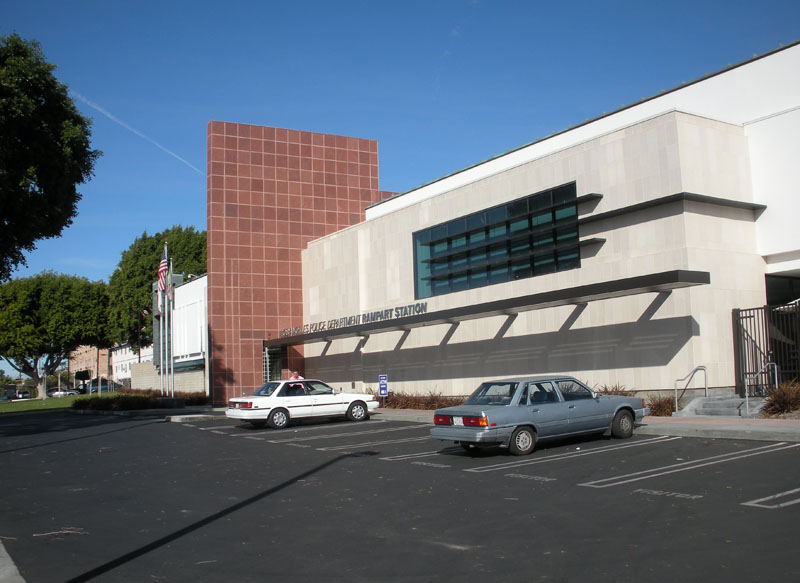
After 40 years of wear and tear, the time came to replace the original station on Temple St. A decision was made to build the new station on the site where the aging Central Receiving Hospital was then located. The new Rampart Community Police Station, located at 1401 W. 6th St., opened its doors on July 25, 2008, under the command of Captain III John Egan and Captain I Paul Hernandez. It was assigned approximately 275 Police Officers, 55 Detectives, and 50 civilian personnel. The new station re-united Rampart Patrol and Detectives under one roof again, serving approximately 375,000 people in an 8-square-mile (21 km2) area.
Soon after the new Rampart Station opened, the LAPD created a new Division, the Olympic Area (#20). On January 4, 2009, Olympic Community Police Station opened its doors and assumed responsibility for a portion of what was formerly the west side of Rampart Division, from Normandie to Hoover Street. Currently, Rampart Division has about 330 personnel that provide service to approximately 164,961 inhabitants in a compact 5.54-square-mile (14.3 km2) area. The population density of the Rampart Area is similar to Manhattan Island. It serves the communities of Angeleno Heights, Echo Park, Silver Lake, Historic Filipinotown, Korea Town, Lafayette Park, MacArthur Park, Pico-Union, Temple-Beaudry, Virgil Village, and Westlake.
The Rampart CPAB remains active with committees addressing specific issues such as traffic, crime, youth programs, and membership. Each member is independently active in the community and has the ability to relay information to thousands of community members. CPAB members provide an extremely valuable service to the Rampart Area as they are able to relay the pulse and sentiment of the community at any given time.
Community-Police Advisory Boards (C-PABs) were created in 1993 to provide community members with an opportunity to provide information and advice to their respective Area and to take information from the police department back to the community. Each of the 21 geographic Areas (community police stations) throughout Los Angeles has its own C-PAB. These advisory groups meet monthly to discuss crime and quality of life issues. Each C-PAB has two co-chairs, one of the Area commanding officers while the second is a civilian member voted on by the membership. Recently, many C-PABs have formed subcommittees in addition to the general group to tackle specific crime and quality of life problems. Examples of C-PAB subcommittees include Graffiti, Youth, Homeless Outreach and Traffic.
Through a network of Neighborhood Councils, the City of Los Angeles promotes public participation in government and works to improve government responsiveness to local concerns.
Hub AI
LAPD Rampart Division AI simulator
(@LAPD Rampart Division_simulator)
LAPD Rampart Division
The Rampart Division of the Los Angeles Police Department (LAPD) serves communities to the west of Downtown Los Angeles (DTLA) including Silver Lake, Echo Park, Pico-Union and Westlake, all together designated as the Rampart patrol area. Its name is derived from Rampart Boulevard, one of the principal thoroughfares in its patrol area. The original station opened in 1966, located at 2710 West Temple Street. In 2008, the staff moved southeast to a newer facility located at 1401 West 6th Street. With 164,961 residents occupying a 5.4-square-mile (14 km2) area, Rampart is one of Los Angeles's most densely populated communities.
The Los Angeles Police Department's (LAPD) Rampart Division (#02) was created in October 1966. It was formed from portions of LAPD's Central, Wilshire, University (now Southwest), and Hollywood Areas. William H. Parker was the Chief of Police at the time, and he stated that the new Rampart Division was needed to decrease the span between the Metropolitan, Hollywood, and Wilshire Areas. Several locations for the original station were considered before the Rampart Heights area was finally chosen in 1961. In 1963, the property at the southwest corner of Temple St and Benton Way was obtained, and construction began in December 1964. The total cost of the site, design, construction, equipment and furnishings was $1,419,397.
The LAPD Rampart Division Station, located at 2710 West Temple Street officially opened on October 23, 1966, under the command of Captain R. O. Bradley. Rampart Area spanned approximately 13.7 square miles (35 km2) and served approximately 200,000 citizens. Its borders at the time were: Normandie Ave on the west; Santa Monica Bl, Hyperion Ave, and the Los Angeles River to the North; the 110-Pasadena/Harbor Freeway to the east; and the 10-Santa Monica Freeway to the south. As the population grew and more personnel were needed to serve the area, space became an issue. Detective functions were eventually relocated to a separate building, located at 303 S. Union Avenue.
After 40 years of wear and tear, the time came to replace the original station on Temple St. A decision was made to build the new station on the site where the aging Central Receiving Hospital was then located. The new Rampart Community Police Station, located at 1401 W. 6th St., opened its doors on July 25, 2008, under the command of Captain III John Egan and Captain I Paul Hernandez. It was assigned approximately 275 Police Officers, 55 Detectives, and 50 civilian personnel. The new station re-united Rampart Patrol and Detectives under one roof again, serving approximately 375,000 people in an 8-square-mile (21 km2) area.
Soon after the new Rampart Station opened, the LAPD created a new Division, the Olympic Area (#20). On January 4, 2009, Olympic Community Police Station opened its doors and assumed responsibility for a portion of what was formerly the west side of Rampart Division, from Normandie to Hoover Street. Currently, Rampart Division has about 330 personnel that provide service to approximately 164,961 inhabitants in a compact 5.54-square-mile (14.3 km2) area. The population density of the Rampart Area is similar to Manhattan Island. It serves the communities of Angeleno Heights, Echo Park, Silver Lake, Historic Filipinotown, Korea Town, Lafayette Park, MacArthur Park, Pico-Union, Temple-Beaudry, Virgil Village, and Westlake.
The Rampart CPAB remains active with committees addressing specific issues such as traffic, crime, youth programs, and membership. Each member is independently active in the community and has the ability to relay information to thousands of community members. CPAB members provide an extremely valuable service to the Rampart Area as they are able to relay the pulse and sentiment of the community at any given time.
Community-Police Advisory Boards (C-PABs) were created in 1993 to provide community members with an opportunity to provide information and advice to their respective Area and to take information from the police department back to the community. Each of the 21 geographic Areas (community police stations) throughout Los Angeles has its own C-PAB. These advisory groups meet monthly to discuss crime and quality of life issues. Each C-PAB has two co-chairs, one of the Area commanding officers while the second is a civilian member voted on by the membership. Recently, many C-PABs have formed subcommittees in addition to the general group to tackle specific crime and quality of life problems. Examples of C-PAB subcommittees include Graffiti, Youth, Homeless Outreach and Traffic.
Through a network of Neighborhood Councils, the City of Los Angeles promotes public participation in government and works to improve government responsiveness to local concerns.