
Recent from talks
LGV Nord
Knowledge base stats:
Talk channels stats:
Members stats:
LGV Nord
The Ligne à Grande Vitesse Nord (English: North High-Speed Line), typically shortened to LGV Nord, is a French 333-kilometre-long (207 mi) high-speed rail line, opened in 1993, that connects Paris to the Belgian border and the Channel Tunnel via Lille.
With a maximum speed of 300 kilometres per hour (190 mph), the line appreciably shortened rail journeys between Paris and Lille. Its extensions to the north (Belgium, the Channel Tunnel) and the south (via the LGV Interconnexion Est) have reduced journey times to Great Britain and Benelux and for inter-regional trips between the Nord (Pas de Calais) region and the southeast and southwest of France. Its route is twinned with the A1 for 130 kilometres (81 mi), which is why it was given its official nickname, the A1 Highway. As it is mostly built in flat areas, the maximum incline is 25 metres per kilometre (2.5‰).
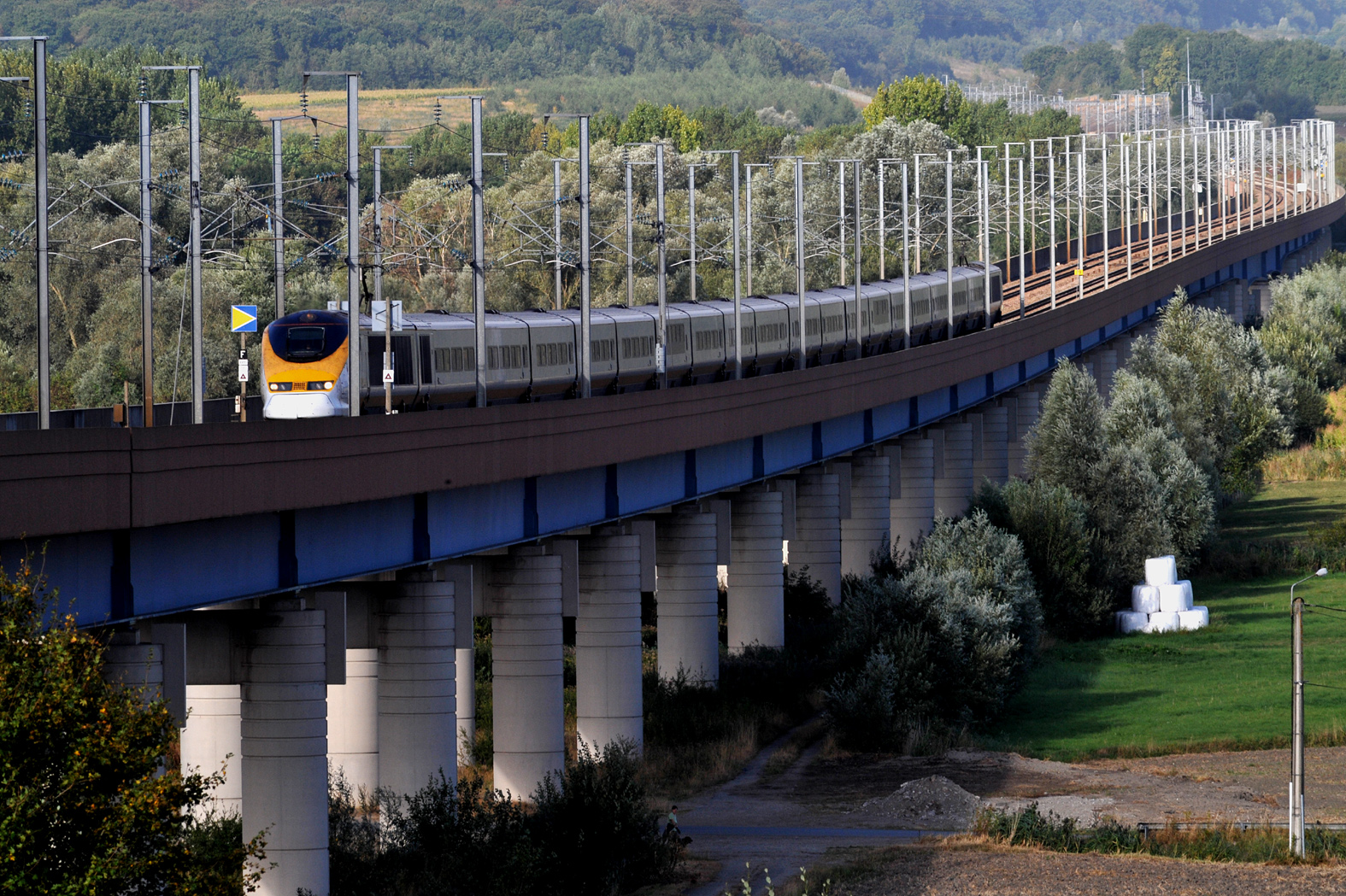
Of all French high-speed lines, the LGV Nord sees the widest variety of high-speed rolling stock: the Alstom-made TGV POS, TGV Réseau, TGV Atlantique, TGV Duplex, Eurostar e300, Thalys PBA and PBKA and the Siemens Velaro-derived Eurostar e320, as well as rolling stock on local trains. Traffic is controlled by the Lille rail traffic centre.
The LGV Nord begins at Arnouville-lès-Gonesse, 16.6 kilometres (10.3 mi) from the Gare du Nord on the Paris–Lille railway line. At Vémars, the LGV Interconnexion Est joins it via a triangular junction, leading to Charles de Gaulle Airport and Marne-la-Vallée-Chessy; this enables direct trains from London and Amsterdam to Disneyland Paris, as well as the southern destinations (Lyon, Avignon and Marseille)
After passing east of the forest of Ermenonville over the viaduc de Verberie, it joins the A1 around Chevrières and accompanies it to the Lille suburbs.
At Ablaincourt-Pressoir (Somme), a new station, Gare TGV Haute-Picardie, is served only by inter-regional TGVs. At Croisilles, Pas-de-Calais, a junction leads to the Agny link towards Arras. The LGV crosses the A1 autoroute at Seclin (Nord).
At Fretin, a triangular junction links the LGV to the Lille-Brussels HSL 1 high-speed line eastwards, crossing the border at Wannehain and joining the conventional network at Lembeek, south of Brussels. After the Fretin junction, the LGV has a connection to the conventional network at Lezennes, near Lille. This junction is used for TGVs terminating at Lille, which use Lille-Flandres. TGVs that continue beyond Lille, as well as some Eurostar services, stop at Lille-Europe instead. Non-stop Eurostars pass through a tunnel under the city of Lille at 200 kilometres per hour (120 mph).
The line passes south of Armentières and north of Hazebrouck. At Cassel, a link provides a connection with Dunkirk. The LGV continues west, crossing the A26 autoroute at Zouafques and ends at Calais-Fréthun, at the Eurotunnel terminal. This enables TGV service to Calais and Eurostars through the Channel Tunnel to London. The TGVs continue to Calais-Ville or reverse in either Calais stations and go on to Boulogne-sur-Mer and Étaples-Le Touquet and Rang-du-Fliers-Verton. The route was much criticised, particularly by those in the Picardy region. The LGV crosses the region without a stop; Amiens in particular would have liked to have been on the line. The government judged a route via Amiens to be impracticable, as the Lille route demanded a straight line between Paris and Lille in order to give a reasonable Paris-Lille-London journey time. The LGV Picardie project would address this issue by serving Amiens, and would reduce the Paris–London journey time to less than 2 hours.
Hub AI
LGV Nord AI simulator
(@LGV Nord_simulator)
LGV Nord
The Ligne à Grande Vitesse Nord (English: North High-Speed Line), typically shortened to LGV Nord, is a French 333-kilometre-long (207 mi) high-speed rail line, opened in 1993, that connects Paris to the Belgian border and the Channel Tunnel via Lille.
With a maximum speed of 300 kilometres per hour (190 mph), the line appreciably shortened rail journeys between Paris and Lille. Its extensions to the north (Belgium, the Channel Tunnel) and the south (via the LGV Interconnexion Est) have reduced journey times to Great Britain and Benelux and for inter-regional trips between the Nord (Pas de Calais) region and the southeast and southwest of France. Its route is twinned with the A1 for 130 kilometres (81 mi), which is why it was given its official nickname, the A1 Highway. As it is mostly built in flat areas, the maximum incline is 25 metres per kilometre (2.5‰).
Of all French high-speed lines, the LGV Nord sees the widest variety of high-speed rolling stock: the Alstom-made TGV POS, TGV Réseau, TGV Atlantique, TGV Duplex, Eurostar e300, Thalys PBA and PBKA and the Siemens Velaro-derived Eurostar e320, as well as rolling stock on local trains. Traffic is controlled by the Lille rail traffic centre.
The LGV Nord begins at Arnouville-lès-Gonesse, 16.6 kilometres (10.3 mi) from the Gare du Nord on the Paris–Lille railway line. At Vémars, the LGV Interconnexion Est joins it via a triangular junction, leading to Charles de Gaulle Airport and Marne-la-Vallée-Chessy; this enables direct trains from London and Amsterdam to Disneyland Paris, as well as the southern destinations (Lyon, Avignon and Marseille)
After passing east of the forest of Ermenonville over the viaduc de Verberie, it joins the A1 around Chevrières and accompanies it to the Lille suburbs.
At Ablaincourt-Pressoir (Somme), a new station, Gare TGV Haute-Picardie, is served only by inter-regional TGVs. At Croisilles, Pas-de-Calais, a junction leads to the Agny link towards Arras. The LGV crosses the A1 autoroute at Seclin (Nord).
At Fretin, a triangular junction links the LGV to the Lille-Brussels HSL 1 high-speed line eastwards, crossing the border at Wannehain and joining the conventional network at Lembeek, south of Brussels. After the Fretin junction, the LGV has a connection to the conventional network at Lezennes, near Lille. This junction is used for TGVs terminating at Lille, which use Lille-Flandres. TGVs that continue beyond Lille, as well as some Eurostar services, stop at Lille-Europe instead. Non-stop Eurostars pass through a tunnel under the city of Lille at 200 kilometres per hour (120 mph).
The line passes south of Armentières and north of Hazebrouck. At Cassel, a link provides a connection with Dunkirk. The LGV continues west, crossing the A26 autoroute at Zouafques and ends at Calais-Fréthun, at the Eurotunnel terminal. This enables TGV service to Calais and Eurostars through the Channel Tunnel to London. The TGVs continue to Calais-Ville or reverse in either Calais stations and go on to Boulogne-sur-Mer and Étaples-Le Touquet and Rang-du-Fliers-Verton. The route was much criticised, particularly by those in the Picardy region. The LGV crosses the region without a stop; Amiens in particular would have liked to have been on the line. The government judged a route via Amiens to be impracticable, as the Lille route demanded a straight line between Paris and Lille in order to give a reasonable Paris-Lille-London journey time. The LGV Picardie project would address this issue by serving Amiens, and would reduce the Paris–London journey time to less than 2 hours.
Recent media