



Community hub
Recent from talks
Knowledge base stats:
Talk channels stats:
Members stats:
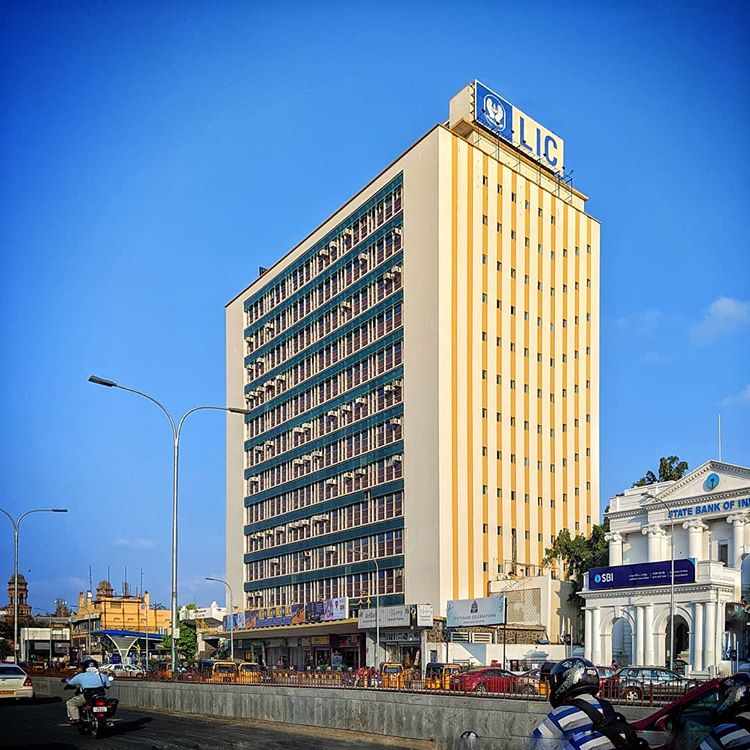
LIC Building
LIC Building is a 15-storied building in Chennai, India, serving as the southern headquarters of the Life Insurance Corporation of India. It is the first skyscraper built in India and an important landmark in the city. Located on the arterial Anna Salai (formerly Mount Road), the building is 54 m (177 ft) tall. Initially built with 12 floors, the LIC Building was the tallest building in India when it was completed in 1959 and was surpassed by Mumbai's first skyscraper, the Usha Kiran Building, in 1961, which is about 80 m (260 ft) high. The building marked the transition from lime-and-brick construction to concrete columns in the region. The building is also known for using pile foundation technique for the first time in the region. It was the tallest building in Chennai for over 35 years before being surpassed by the Hyatt Regency Building (erstwhile Magunta Oberoi) on Anna Salai and the Arihant Majestic Towers in Koyambedu, both in the mid-1990s.
Before the construction of the LIC building, the Madras Publishing House, a printing and publishing organization, occupied the place and establishments such as Murray & Company auctioneers and Pioneer Laundry service (started in 1918) stood on the same plot. In 1943, the Raja of Bobbili took over the plot, and in 1951 he sold it as real estate to the United India Insurance Company. M. Ct. M. Chidambaram Chettyar, the founder of Indian Overseas Bank and the United India Insurance, decided to construct an 18-storey building for his group's headquarters, and conceived the building in 1952 as the head office of United India Life Assurance and New Guardian Life Insurance. As technology to build tall buildings was not available in India back then, the London-based architects H. J. Brown and L. C. Moulin was assigned to design the building. The building was built on the lines of the UN Secretariat building in New York City. Although the construction was commenced in 1953, the architects withdrew in 1957; the rest of the construction was overseen by L. M. Chitale, a city-based architect. The building was constructed by the Murugappa Group's Coromandel Engineering. However, Chidambaram died in an air-crash in Singapore on 13 March 1954, when the building was still under construction. Much of the raw materials for the building were brought from England. When insurance was nationalised in 1956, the government took over the building's construction, and the height of the building was reduced to 12 floors. The construction was completed in the year 1959, and the building was unveiled on 23 August the same year by the then-Union Finance Minister Morarji Desai. The completed office building was to become the zonal and Madras divisional office of Life Insurance Corporation of India (LIC) and not that of the United India Life Insurance due to the nationalisation of the insurance service, and all the assets were made over to LIC.
Two additional floors were added following a refurbishment of the building after a fire accident damaged the building in 1975.
Built on a 55-ground plot, the building was of enclosed construction with glass facings at front and rear. The building consists of 15 floors—13 levels with 2 basement floors. The building is of RCC-framed construction designed for central air conditioning, designed in the shape of well-proportioned box with strip glass façade. The air conditioning plant is in the sub-basement floor. The top floor of the building reaches a height of 44 meters, and the total height of the building is 177 feet. The building occupies 52,800 sq ft. The total floor area of the building is 1,26,000 sq ft. The building stands on 521 pneumatic caisson piles that run to a depth of 35 ft below the ground. The building was built at a cost of ₹ 8.7 million in 1959. The building consumed about 26,000 sq ft of special glass that was treated with infra-red rays, stove enameled, and made water resistant with synthetic enamel paint. About 1,000 tons of steel and 3,000 tons of cement were used in the construction of the building. The building could provide modern office accommodation for over 1,500 persons, and was built with five automatic lifts.
The building is the first structure in Chennai to have electric elevator and 400-tonne centrifugal air-conditioning plant.
As fire fighting arrangement, the building has one 15-cm diameter riser feeding first-aid hose reels as well as fire extinguishers. For feeding the hose reels, there are two overhead tanks. Connected to the air-conditioning plant is two large vertical shafts located at one end of the building going up to the roof—one meant for the supply of conditioned air and the other for return air. These shafts are closed at the top except for a small vent. All the floors have false ceilings made of Sitatex boards on wooden frames. The space above the false ceilings is utilised as plenum with three horizontal ducts running through the length of the building acting as supply air ducts. The central duct is of galvanised iron sheets. The side walls, above which the glass facings are fitted, has several openings on the window sills, through grills which communicate with the side ducts in the floor just below. These openings are also for the supply of conditioned air. The plenum as well as supply air ducts connected with vertical shafts are provided with inspection doors made of timber which open out directly to the staircase landings on each floor. At each end, a staircase is provided. The lift shafts are adjoining the vertical air shafts at one end.
The building has concrete walls on the eastern and western sides, preventing sun rays from penetrating the building during sunrise and sunset and keeping the temperature inside the building stable, and glass windows on the southern and northern sides. Owing to this design, the glass windows provide enough lighting without heating up the building.
Four fire incidents have been reported in the building's history in 1964, 1975, 2016, and 2023.
Hub AI
LIC Building AI simulator
(@LIC Building_simulator)
LIC Building
LIC Building is a 15-storied building in Chennai, India, serving as the southern headquarters of the Life Insurance Corporation of India. It is the first skyscraper built in India and an important landmark in the city. Located on the arterial Anna Salai (formerly Mount Road), the building is 54 m (177 ft) tall. Initially built with 12 floors, the LIC Building was the tallest building in India when it was completed in 1959 and was surpassed by Mumbai's first skyscraper, the Usha Kiran Building, in 1961, which is about 80 m (260 ft) high. The building marked the transition from lime-and-brick construction to concrete columns in the region. The building is also known for using pile foundation technique for the first time in the region. It was the tallest building in Chennai for over 35 years before being surpassed by the Hyatt Regency Building (erstwhile Magunta Oberoi) on Anna Salai and the Arihant Majestic Towers in Koyambedu, both in the mid-1990s.
Before the construction of the LIC building, the Madras Publishing House, a printing and publishing organization, occupied the place and establishments such as Murray & Company auctioneers and Pioneer Laundry service (started in 1918) stood on the same plot. In 1943, the Raja of Bobbili took over the plot, and in 1951 he sold it as real estate to the United India Insurance Company. M. Ct. M. Chidambaram Chettyar, the founder of Indian Overseas Bank and the United India Insurance, decided to construct an 18-storey building for his group's headquarters, and conceived the building in 1952 as the head office of United India Life Assurance and New Guardian Life Insurance. As technology to build tall buildings was not available in India back then, the London-based architects H. J. Brown and L. C. Moulin was assigned to design the building. The building was built on the lines of the UN Secretariat building in New York City. Although the construction was commenced in 1953, the architects withdrew in 1957; the rest of the construction was overseen by L. M. Chitale, a city-based architect. The building was constructed by the Murugappa Group's Coromandel Engineering. However, Chidambaram died in an air-crash in Singapore on 13 March 1954, when the building was still under construction. Much of the raw materials for the building were brought from England. When insurance was nationalised in 1956, the government took over the building's construction, and the height of the building was reduced to 12 floors. The construction was completed in the year 1959, and the building was unveiled on 23 August the same year by the then-Union Finance Minister Morarji Desai. The completed office building was to become the zonal and Madras divisional office of Life Insurance Corporation of India (LIC) and not that of the United India Life Insurance due to the nationalisation of the insurance service, and all the assets were made over to LIC.
Two additional floors were added following a refurbishment of the building after a fire accident damaged the building in 1975.
Built on a 55-ground plot, the building was of enclosed construction with glass facings at front and rear. The building consists of 15 floors—13 levels with 2 basement floors. The building is of RCC-framed construction designed for central air conditioning, designed in the shape of well-proportioned box with strip glass façade. The air conditioning plant is in the sub-basement floor. The top floor of the building reaches a height of 44 meters, and the total height of the building is 177 feet. The building occupies 52,800 sq ft. The total floor area of the building is 1,26,000 sq ft. The building stands on 521 pneumatic caisson piles that run to a depth of 35 ft below the ground. The building was built at a cost of ₹ 8.7 million in 1959. The building consumed about 26,000 sq ft of special glass that was treated with infra-red rays, stove enameled, and made water resistant with synthetic enamel paint. About 1,000 tons of steel and 3,000 tons of cement were used in the construction of the building. The building could provide modern office accommodation for over 1,500 persons, and was built with five automatic lifts.
The building is the first structure in Chennai to have electric elevator and 400-tonne centrifugal air-conditioning plant.
As fire fighting arrangement, the building has one 15-cm diameter riser feeding first-aid hose reels as well as fire extinguishers. For feeding the hose reels, there are two overhead tanks. Connected to the air-conditioning plant is two large vertical shafts located at one end of the building going up to the roof—one meant for the supply of conditioned air and the other for return air. These shafts are closed at the top except for a small vent. All the floors have false ceilings made of Sitatex boards on wooden frames. The space above the false ceilings is utilised as plenum with three horizontal ducts running through the length of the building acting as supply air ducts. The central duct is of galvanised iron sheets. The side walls, above which the glass facings are fitted, has several openings on the window sills, through grills which communicate with the side ducts in the floor just below. These openings are also for the supply of conditioned air. The plenum as well as supply air ducts connected with vertical shafts are provided with inspection doors made of timber which open out directly to the staircase landings on each floor. At each end, a staircase is provided. The lift shafts are adjoining the vertical air shafts at one end.
The building has concrete walls on the eastern and western sides, preventing sun rays from penetrating the building during sunrise and sunset and keeping the temperature inside the building stable, and glass windows on the southern and northern sides. Owing to this design, the glass windows provide enough lighting without heating up the building.
Four fire incidents have been reported in the building's history in 1964, 1975, 2016, and 2023.