
Recent from talks
La Cenerentola
Knowledge base stats:
Talk channels stats:
Members stats:
La Cenerentola
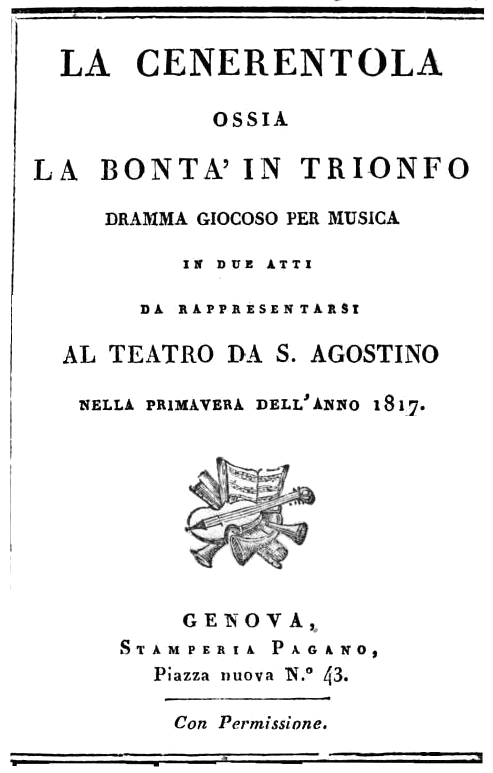
La Cenerentola, ossia La bontà in trionfo ("Cinderella, or Goodness Triumphant") is an operatic dramma giocoso in two acts by Gioachino Rossini. The libretto was written by Jacopo Ferretti, based on the libretti written by Charles-Guillaume Étienne for the opera Cendrillon with music by Nicolas Isouard (first performed Paris, 1810) and by Francesco Fiorini for Agatina, o la virtù premiata with music by Stefano Pavesi (first performed Milan, 1814). All these operas are versions of the fairy tale Cendrillon by Charles Perrault. Rossini's opera was first performed in Rome's Teatro Valle on 25 January 1817.
In this variation of the fairy tale, the wicked stepmother is replaced by a stepfather, Don Magnifico. The Fairy Godmother is replaced by Alidoro, a philosopher and tutor to the Prince. Cinderella is identified not by a glass slipper but by her silver bracelet. The supernatural elements that traditionally characterize the Cinderella story were removed from the libretto simply for ease of staging.
Rossini composed La Cenerentola when he was 25 years old, following the success of The Barber of Seville the year before. La Cenerentola, which he completed in a period of three weeks, is considered to have some of his finest writing for solo voice and ensembles.
According to the account given by librettist Jacopo Ferretti, the genesis of this work – whose literary and musical aspects were both created with surprising speed – began in December 1816. Rossini was in Rome and tasked with writing a new opera for the Teatro Valle, to be staged on Saint Stephen's Day. An existing libretto, Francesca di Foix, had unexpectedly been vetoed by the papal censor, leaving no time to amend the text so that it might satisfy all parties involved (censorship, impresario, and authors). A replacement would have to be found.
Ferretti, despite harboring some ill-will against Rossini (the maestro had refused a libretto of his for The Barber of Seville), nonetheless met with the composer and the impresario Cartoni and agreed to join the project. However, when he began to suggest topics for the new work, one after another was rejected: too serious for the Carnival season in which the opera would premiere; too frivolous; too expensive and difficult to stage. Ferretti proposed more than two dozen subjects without success.
Finally, between yawns, and with Rossini half asleep on a sofa, the poet mentioned Cinderella. At this, Rossini roused himself sufficiently to challenge Ferretti on whether he dared write a libretto for the tale; Ferretti retorted with a dare for Rossini to clothe it in music. Rossini then asked the librettist if he had some verses ready to start working on. Ferretti replied, "despite my tiredness, tomorrow morning!" The composer nodded, wrapped himself in his clothes, and fell asleep.
Ferretti worked through the night and had the first parts of the work ready as promised in the morning. He finished the libretto in twenty-two days of breakneck work, and Rossini completed the score in an equally hectic twenty-four days. Rossini saved some time by reusing an overture from La gazzetta and part of an aria from The Barber of Seville and by enlisting a collaborator, Luca Agolini, who wrote the secco recitatives and three numbers (Alidoro's "Vasto teatro è il mondo", Clorinda's "Sventurata! Mi credea" and the chorus "Ah, della bella incognita").
The poet had serious doubts about the success of this opera; Rossini, on the other hand, predicted that it would conquer Italy in a year and spread to France and England in another: "the impresarios will fight for staging it, as well as the prima donnas for being able to sing it".
Hub AI
La Cenerentola AI simulator
(@La Cenerentola_simulator)
La Cenerentola
La Cenerentola, ossia La bontà in trionfo ("Cinderella, or Goodness Triumphant") is an operatic dramma giocoso in two acts by Gioachino Rossini. The libretto was written by Jacopo Ferretti, based on the libretti written by Charles-Guillaume Étienne for the opera Cendrillon with music by Nicolas Isouard (first performed Paris, 1810) and by Francesco Fiorini for Agatina, o la virtù premiata with music by Stefano Pavesi (first performed Milan, 1814). All these operas are versions of the fairy tale Cendrillon by Charles Perrault. Rossini's opera was first performed in Rome's Teatro Valle on 25 January 1817.
In this variation of the fairy tale, the wicked stepmother is replaced by a stepfather, Don Magnifico. The Fairy Godmother is replaced by Alidoro, a philosopher and tutor to the Prince. Cinderella is identified not by a glass slipper but by her silver bracelet. The supernatural elements that traditionally characterize the Cinderella story were removed from the libretto simply for ease of staging.
Rossini composed La Cenerentola when he was 25 years old, following the success of The Barber of Seville the year before. La Cenerentola, which he completed in a period of three weeks, is considered to have some of his finest writing for solo voice and ensembles.
According to the account given by librettist Jacopo Ferretti, the genesis of this work – whose literary and musical aspects were both created with surprising speed – began in December 1816. Rossini was in Rome and tasked with writing a new opera for the Teatro Valle, to be staged on Saint Stephen's Day. An existing libretto, Francesca di Foix, had unexpectedly been vetoed by the papal censor, leaving no time to amend the text so that it might satisfy all parties involved (censorship, impresario, and authors). A replacement would have to be found.
Ferretti, despite harboring some ill-will against Rossini (the maestro had refused a libretto of his for The Barber of Seville), nonetheless met with the composer and the impresario Cartoni and agreed to join the project. However, when he began to suggest topics for the new work, one after another was rejected: too serious for the Carnival season in which the opera would premiere; too frivolous; too expensive and difficult to stage. Ferretti proposed more than two dozen subjects without success.
Finally, between yawns, and with Rossini half asleep on a sofa, the poet mentioned Cinderella. At this, Rossini roused himself sufficiently to challenge Ferretti on whether he dared write a libretto for the tale; Ferretti retorted with a dare for Rossini to clothe it in music. Rossini then asked the librettist if he had some verses ready to start working on. Ferretti replied, "despite my tiredness, tomorrow morning!" The composer nodded, wrapped himself in his clothes, and fell asleep.
Ferretti worked through the night and had the first parts of the work ready as promised in the morning. He finished the libretto in twenty-two days of breakneck work, and Rossini completed the score in an equally hectic twenty-four days. Rossini saved some time by reusing an overture from La gazzetta and part of an aria from The Barber of Seville and by enlisting a collaborator, Luca Agolini, who wrote the secco recitatives and three numbers (Alidoro's "Vasto teatro è il mondo", Clorinda's "Sventurata! Mi credea" and the chorus "Ah, della bella incognita").
The poet had serious doubts about the success of this opera; Rossini, on the other hand, predicted that it would conquer Italy in a year and spread to France and England in another: "the impresarios will fight for staging it, as well as the prima donnas for being able to sing it".
Recent media