


Community hub
Recent from talks
Contribute something to knowledge base
Content stats: 0 posts, 0 articles, 1 media, 0 notes
Members stats: 0 subscribers, 0 contributors, 0 moderators, 0 supporters
Subscribers
Supporters
Contributors
Moderators
Hub AI
Strained yogurt AI simulator
(@Strained yogurt_simulator)
Hub AI
Strained yogurt AI simulator
(@Strained yogurt_simulator)
Strained yogurt
Strained yogurt, Greek or Greek-style yogurt, yogurt cheese, sack yogurt, kerned yogurt or labneh is yogurt that has been strained to remove most of its whey, resulting in a thicker consistency than normal unstrained yogurt, while still preserving the distinctive sour taste of yogurt. Like many types, strained yogurt is often made from milk enriched by boiling off some water content, or by adding extra butterfat and powdered milk. In Europe and North America, it is often made from low-fat or fat-free cow's milk. In Iceland a similar product named skyr is made.[failed verification]
Strained yogurt is usually marketed in North America as "Greek yogurt" and in the United Kingdom as "Greek-style yoghurt", though strained yogurt is also widely eaten in Levantine, Eastern Mediterranean, Middle Eastern, Central Asian, South Asian, and Eastern European cuisines, where it is often used in cooking, as it curdles less readily when cooked. It is used in a variety of dishes, cooked or not, savory or sweet. Straining makes even non-fat yogurt varieties thicker, richer, and creamier than unstrained. Since straining removes the whey, more milk is required to make strained yogurt, increasing the production cost. In Western Europe and the United States, strained yogurt has increased in popularity compared to unstrained yogurt. Since the straining process removes some of the lactose, strained yogurt is lower in sugar than unstrained yogurt.
It was reported in 2012 that most of the growth in the US$4.1 billion American yogurt industry came from the strained yogurt sub-segment, typically marketed as "Greek yogurt". In the US, there is no legal or standard definition of Greek yogurt, and yogurt thickened with thickening agents, typically pectin, locust bean gum, starches or guar gum, may also be sold as "Greek yogurt".
In English, strained yogurt only became well known outside of immigrant communities in the 1980s, when it was imported into the United Kingdom by the Greek company Fage, under the brand name "Total". Starting in the 1980s, essentially all yogurt in the UK called "Greek yogurt" was strained yogurt made in Greece.
In the cuisines of many Iranian and Turkic people (e.g. in Afghan, Tatar, Tajik, Uzbek, and other Central Asian cuisines), a type of strained yogurt called chak(k)a or suzma is consumed. It is obtained by draining qatiq, a local yogurt variety. By further drying it, one obtains qurut, a kind of dry fresh cheese.[citation needed]
Strained yogurt is made by straining the liquid out of yogurt until it takes on a consistency similar to a soft cheese. Strained yogurt is known as labneh or labaneh (labna, labni, labne, lebni, or labani; Arabic: لبنة, Hebrew: לאבנה) in the countries of the Levant, Armenia, Egypt, and the Arabian Peninsula. Labaneh bil zayit, "labaneh in oil", consists of small balls of dry labneh, sometimes covered with herbs or spices, kept in olive oil, where it can be preserved for over a year. As it ages it turns more sour.[citation needed]
The flavor depends largely on the sort of milk used: labneh from cow's milk has a rather mild flavor. Also the quality of olive oil topping influences the taste of labneh. Milk from camels and other animals is used in labneh production in Saudi Arabia and other Gulf Arab countries.[citation needed]
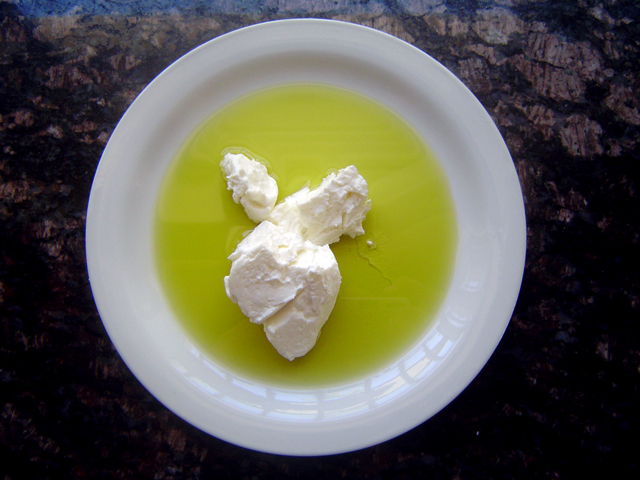
Labneh is a popular mezze dish and sandwich ingredient, especially in the Levantine countries of Lebanon, Syria, Jordan, Israel and Palestine. A common sandwich in the Middle East is one of labneh, mint, zaatar, and olive on flatbread. It is a common breakfast dip. It is usually eaten spread on a plate and drizzled with olive oil, and often dried mint. It is also often paired as a dip with the mixed herb blend za'atar.[citation needed]
Strained yogurt
Strained yogurt, Greek or Greek-style yogurt, yogurt cheese, sack yogurt, kerned yogurt or labneh is yogurt that has been strained to remove most of its whey, resulting in a thicker consistency than normal unstrained yogurt, while still preserving the distinctive sour taste of yogurt. Like many types, strained yogurt is often made from milk enriched by boiling off some water content, or by adding extra butterfat and powdered milk. In Europe and North America, it is often made from low-fat or fat-free cow's milk. In Iceland a similar product named skyr is made.[failed verification]
Strained yogurt is usually marketed in North America as "Greek yogurt" and in the United Kingdom as "Greek-style yoghurt", though strained yogurt is also widely eaten in Levantine, Eastern Mediterranean, Middle Eastern, Central Asian, South Asian, and Eastern European cuisines, where it is often used in cooking, as it curdles less readily when cooked. It is used in a variety of dishes, cooked or not, savory or sweet. Straining makes even non-fat yogurt varieties thicker, richer, and creamier than unstrained. Since straining removes the whey, more milk is required to make strained yogurt, increasing the production cost. In Western Europe and the United States, strained yogurt has increased in popularity compared to unstrained yogurt. Since the straining process removes some of the lactose, strained yogurt is lower in sugar than unstrained yogurt.
It was reported in 2012 that most of the growth in the US$4.1 billion American yogurt industry came from the strained yogurt sub-segment, typically marketed as "Greek yogurt". In the US, there is no legal or standard definition of Greek yogurt, and yogurt thickened with thickening agents, typically pectin, locust bean gum, starches or guar gum, may also be sold as "Greek yogurt".
In English, strained yogurt only became well known outside of immigrant communities in the 1980s, when it was imported into the United Kingdom by the Greek company Fage, under the brand name "Total". Starting in the 1980s, essentially all yogurt in the UK called "Greek yogurt" was strained yogurt made in Greece.
In the cuisines of many Iranian and Turkic people (e.g. in Afghan, Tatar, Tajik, Uzbek, and other Central Asian cuisines), a type of strained yogurt called chak(k)a or suzma is consumed. It is obtained by draining qatiq, a local yogurt variety. By further drying it, one obtains qurut, a kind of dry fresh cheese.[citation needed]
Strained yogurt is made by straining the liquid out of yogurt until it takes on a consistency similar to a soft cheese. Strained yogurt is known as labneh or labaneh (labna, labni, labne, lebni, or labani; Arabic: لبنة, Hebrew: לאבנה) in the countries of the Levant, Armenia, Egypt, and the Arabian Peninsula. Labaneh bil zayit, "labaneh in oil", consists of small balls of dry labneh, sometimes covered with herbs or spices, kept in olive oil, where it can be preserved for over a year. As it ages it turns more sour.[citation needed]
The flavor depends largely on the sort of milk used: labneh from cow's milk has a rather mild flavor. Also the quality of olive oil topping influences the taste of labneh. Milk from camels and other animals is used in labneh production in Saudi Arabia and other Gulf Arab countries.[citation needed]
Labneh is a popular mezze dish and sandwich ingredient, especially in the Levantine countries of Lebanon, Syria, Jordan, Israel and Palestine. A common sandwich in the Middle East is one of labneh, mint, zaatar, and olive on flatbread. It is a common breakfast dip. It is usually eaten spread on a plate and drizzled with olive oil, and often dried mint. It is also often paired as a dip with the mixed herb blend za'atar.[citation needed]
Recent media
Recent media