



Community hub
Recent from talks
Contribute something
Nothing was collected or created yet.
Lag operator
View on Wikipedia | This article includes a list of general references, but it lacks sufficient corresponding inline citations. (January 2011) |
In time series analysis, the lag operator (L) or backshift operator (B) operates on an element of a time series to produce the previous element. For example, given some time series

then
- for all


or similarly in terms of the backshift operator B: for all . Equivalently, this definition can be represented as
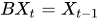
- for all


The lag operator (as well as backshift operator) can be raised to arbitrary integer powers so that
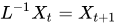
and
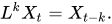
Lag polynomials
[edit]Polynomials of the lag operator can be used, and this is a common notation for ARMA (autoregressive moving average) models. For example,

specifies an AR(p) model.
A polynomial of lag operators is called a lag polynomial so that, for example, the ARMA model can be concisely specified as

where and respectively represent the lag polynomials


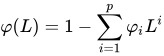
and
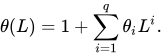
Polynomials of lag operators follow similar rules of multiplication and division as do numbers and polynomials of variables. For example,

means the same thing as

As with polynomials of variables, a polynomial in the lag operator can be divided by another one using polynomial long division. In general dividing one such polynomial by another, when each has a finite order (highest exponent), results in an infinite-order polynomial.
An annihilator operator, denoted , removes the entries of the polynomial with negative power (future values).
![{\displaystyle [\ ]_{+}}](https://wikimedia.org/api/rest_v1/media/math/render/svg/992881bf3cb310791e15cbc7acba599bda5e34f3)
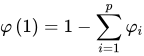
Note that denotes the sum of coefficients:

Difference operator
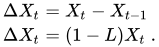
[edit]In time series analysis, the first difference operator :

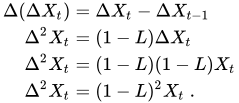
Similarly, the second difference operator works as follows:
The above approach generalises to the i-th difference operator

Conditional expectation
[edit]It is common in stochastic processes to care about the expected value of a variable given a previous information set. Let be all information that is common knowledge at time t (this is often subscripted below the expectation operator); then the expected value of the realisation of X, j time-steps in the future, can be written equivalently as:

![{\displaystyle E[X_{t+j}|\Omega _{t}]=E_{t}[X_{t+j}].}](https://wikimedia.org/api/rest_v1/media/math/render/svg/0834937cce8e77b24deab11db341f444c9d5efda)
With these time-dependent conditional expectations, there is the need to distinguish between the backshift operator (B) that only adjusts the date of the forecasted variable and the Lag operator (L) that adjusts equally the date of the forecasted variable and the information set:
![{\displaystyle L^{n}E_{t}[X_{t+j}]=E_{t-n}[X_{t+j-n}],}](https://wikimedia.org/api/rest_v1/media/math/render/svg/d41871114290a3444e022ae552afe8847b54d006)
![{\displaystyle B^{n}E_{t}[X_{t+j}]=E_{t}[X_{t+j-n}].}](https://wikimedia.org/api/rest_v1/media/math/render/svg/d8f16a7034f484634558e8e5c6cc00ebe901f6dc)
See also
[edit]References
[edit]- Hamilton, James Douglas (1994). Time Series Analysis. Princeton University Press. ISBN 0-691-04289-6.
- Verbeek, Marno (2008). A Guide to Modern Econometrics. John Wiley and Sons. ISBN 0-470-51769-7.
- Weisstein, Eric. "Wolfram MathWorld". WolframMathworld: Difference Operator. Wolfram Research. Retrieved 10 November 2017.
- Box, George E. P.; Jenkins, Gwilym M.; Reinsel, Gregory C.; Ljung, Greta M. (2016). Time Series Analysis: Forecasting and Control (5th ed.). New Jersey: Wiley. ISBN 978-1-118-67502-1.
Lag operator
View on GrokipediaFundamentals
Definition
The lag operator, denoted by , is a fundamental mathematical tool in time series analysis that shifts a time series backward by one period. For a discrete-time series , where indexes time, the action of the lag operator is defined as , effectively replacing the current value with the previous one.[1][2] This operation represents a one-period backward shift, preserving the structure of the series while delaying its values. The lag operator extends naturally to higher powers for multiple-period shifts. Specifically, for any positive integer , , indicating a shift backward by periods.[1][2] The inverse of the lag operator, known as the lead operator and denoted , shifts the series forward by one period, such that . More generally, for , .[4] This bidirectional capability allows the operator to model both past dependencies and future expectations in time-indexed data. The lag operator applies to discrete-time stochastic processes, such as random walks or autoregressive series, as well as deterministic sequences like arithmetic progressions.[5][6] For illustration, consider the deterministic sequence , where each term is the time index itself; applying the lag operator yields , demonstrating a uniform shift without changing the linear functional form.[2] The notation is equivalent to the backshift operator , with details on conventions provided elsewhere.[5]Notation and Conventions
The lag operator is primarily denoted by the symbol , defined such that for a time series , . This notation facilitates compact representation of lagged values and polynomials in time series analysis. In many econometric contexts, the lag operator is interchangeably referred to as the backshift operator and denoted by , satisfying the same relation .[7][5] Although and perform identical shifts, the choice of symbol can reflect disciplinary emphasis; is often favored in econometric literature to highlight the backward-shifting nature of the operation, while underscores the general lagging concept. This convention traces its origins to the Box-Jenkins methodology for ARIMA modeling, introduced in the seminal 1970 text Time Series Analysis: Forecasting and Control, where lag operator notation was employed to simplify the expression of autoregressive and moving average structures.[8][1] Field-specific variations further distinguish the notation: in time series econometrics, (or ) remains standard for discrete-time shifts, whereas in digital signal processing, the analogous unit delay is conventionally represented by within the z-transform framework, reflecting a frequency-domain perspective on discrete signals.[9] In practical implementations, statistical software packages numerically realize this operator; for instance, R'slag() function in the stats package shifts a time series backward by a specified number of periods, and MATLAB's lag() method for timetables performs equivalent time shifts on data arrays.[10][11]