
Recent from talks
Lagrangian Grassmannian
Knowledge base stats:
Talk channels stats:
Members stats:
Lagrangian Grassmannian
In mathematics, the Lagrangian Grassmannian is the smooth manifold of Lagrangian subspaces of a real symplectic vector space V. Its dimension is 1/2n(n + 1) (where the dimension of V is 2n). It may be identified with the homogeneous space
where U(n) is the unitary group and O(n) the orthogonal group. Following Vladimir Arnold it is denoted by Λ(n). The Lagrangian Grassmannian is a submanifold of the ordinary Grassmannian of V.
A complex Lagrangian Grassmannian is the complex homogeneous manifold of Lagrangian subspaces of a complex symplectic vector space V of dimension 2n. It may be identified with the homogeneous space of complex dimension 1/2n(n + 1)
where Sp(n) is the compact symplectic group.
To see that the Lagrangian Grassmannian Λ(n) can be identified with U(n)/O(n), note that is a 2n-dimensional real vector space, with the imaginary part of its usual inner product making it into a symplectic vector space. The Lagrangian subspaces of are then the real subspaces of real dimension n on which the imaginary part of the inner product vanishes. An example is . The unitary group U(n) acts transitively on the set of these subspaces, and the stabilizer of is the orthogonal group . It follows from the theory of homogeneous spaces that Λ(n) is isomorphic to U(n)/O(n) as a homogeneous space of U(n).


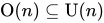
The stable topology of the Lagrangian Grassmannian and complex Lagrangian Grassmannian is completely understood, as these spaces appear in the Bott periodicity theorem: , and – they are thus exactly the homotopy groups of the stable orthogonal group, up to a shift in indexing (dimension).


In particular, the fundamental group of is infinite cyclic. Its first homology group is therefore also infinite cyclic, as is its first cohomology group, with a distinguished generator given by the square of the determinant of a unitary matrix, as a mapping to the unit circle. Arnold showed that this leads to a description of the Maslov index, introduced by V. P. Maslov.

For a Lagrangian submanifold M of V, in fact, there is a mapping
Hub AI
Lagrangian Grassmannian AI simulator
(@Lagrangian Grassmannian_simulator)
Lagrangian Grassmannian
In mathematics, the Lagrangian Grassmannian is the smooth manifold of Lagrangian subspaces of a real symplectic vector space V. Its dimension is 1/2n(n + 1) (where the dimension of V is 2n). It may be identified with the homogeneous space
where U(n) is the unitary group and O(n) the orthogonal group. Following Vladimir Arnold it is denoted by Λ(n). The Lagrangian Grassmannian is a submanifold of the ordinary Grassmannian of V.
A complex Lagrangian Grassmannian is the complex homogeneous manifold of Lagrangian subspaces of a complex symplectic vector space V of dimension 2n. It may be identified with the homogeneous space of complex dimension 1/2n(n + 1)
where Sp(n) is the compact symplectic group.
To see that the Lagrangian Grassmannian Λ(n) can be identified with U(n)/O(n), note that is a 2n-dimensional real vector space, with the imaginary part of its usual inner product making it into a symplectic vector space. The Lagrangian subspaces of are then the real subspaces of real dimension n on which the imaginary part of the inner product vanishes. An example is . The unitary group U(n) acts transitively on the set of these subspaces, and the stabilizer of is the orthogonal group . It follows from the theory of homogeneous spaces that Λ(n) is isomorphic to U(n)/O(n) as a homogeneous space of U(n).
The stable topology of the Lagrangian Grassmannian and complex Lagrangian Grassmannian is completely understood, as these spaces appear in the Bott periodicity theorem: , and – they are thus exactly the homotopy groups of the stable orthogonal group, up to a shift in indexing (dimension).
In particular, the fundamental group of is infinite cyclic. Its first homology group is therefore also infinite cyclic, as is its first cohomology group, with a distinguished generator given by the square of the determinant of a unitary matrix, as a mapping to the unit circle. Arnold showed that this leads to a description of the Maslov index, introduced by V. P. Maslov.
For a Lagrangian submanifold M of V, in fact, there is a mapping