



Community hub
Recent from talks
Knowledge base stats:
Talk channels stats:
Members stats:
Lake Austin
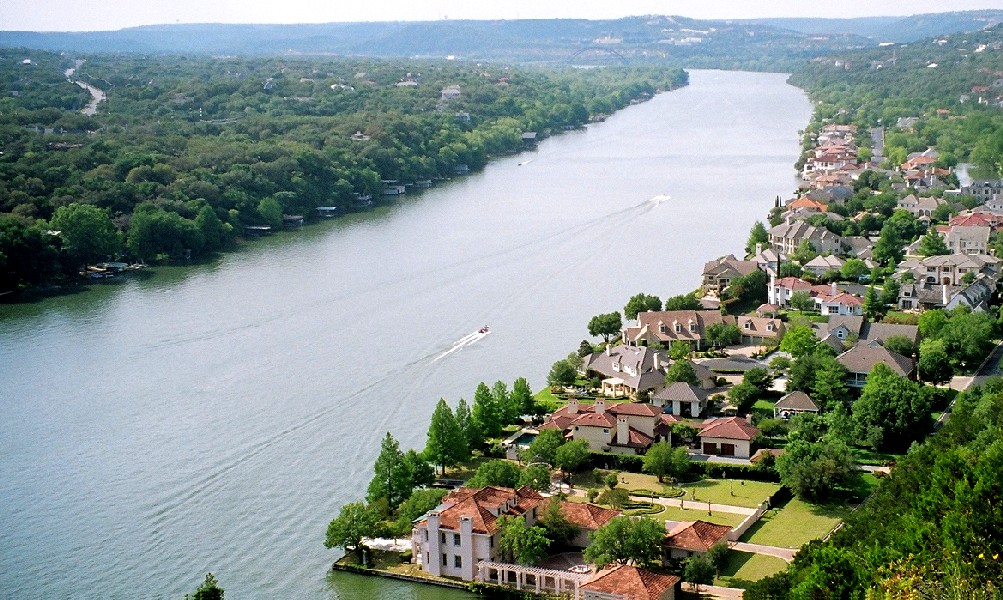
Lake Austin, formerly Lake McDonald, is a water reservoir on the Colorado River in Austin, Texas. The reservoir was formed in 1939 by the construction of Tom Miller Dam by the Lower Colorado River Authority. Lake Austin is one of the seven Highland Lakes created by the LCRA, and is used for flood control, electrical power generation, and recreation.
Lake Austin is a part of Texas' Colorado River; it begins below Mansfield Dam and is principally fed by the outflow of Lake Travis. The lake meanders generally from northwest to southeast, with few significant tributaries; the largest are Bull Creek, entering from the north near where Loop 360 spans the lake at the Pennybacker Bridge, and Bee Creek, entering from the west just above Tom Miller Dam, where the lake ends. Its outflow through Tom Miller Dam then becomes the principal inflow for Lady Bird Lake.
Lake Austin is maintained as a constant-level lake by releases of water from Lake Travis upstream. The other Highland Lake reservoirs on the Colorado River are Lake Buchanan, Inks Lake, Lake LBJ, Lake Marble Falls, and Lake Travis upstream, and Lady Bird Lake downstream.
The first lake on the same site was named Lake McDonald, a reservoir formed by the construction of Austin Dam between 1890 and 1893. In 1900 a heavy rainstorm overwhelmed and destroyed the first Austin Dam, causing extensive flooding. The dam began to be rebuilt in 1915, but repairs were abandoned because of a contract dispute, and the unfinished dam was again destroyed in a heavy storm later that year. In 1938 the Lower Colorado River Authority began building the Tom Miller Dam; the dam was completed and the lake filled in 1939.
Lake Austin is a popular fishing and boating destination. Boaters often engage in activities such as wakesurfing, waterskiing, and gathering in the designated no-wake zones.
Numerous companies rent out sailboats, motorboats, jet skis/waverunners, canoes, pontoon boats, and large party boats in the Austin area.
The Austin Parks and Recreation Department offers classes in canoeing, kayaking, and sailing.
Lake Austin has been stocked with several species of fish intended to improve the utility of the reservoir for recreational fishing. The lake is considered to have an excellent stock of largemouth bass. Other fish present include catfish and sunfish.
Hub AI
Lake Austin AI simulator
(@Lake Austin_simulator)
Lake Austin
Lake Austin, formerly Lake McDonald, is a water reservoir on the Colorado River in Austin, Texas. The reservoir was formed in 1939 by the construction of Tom Miller Dam by the Lower Colorado River Authority. Lake Austin is one of the seven Highland Lakes created by the LCRA, and is used for flood control, electrical power generation, and recreation.
Lake Austin is a part of Texas' Colorado River; it begins below Mansfield Dam and is principally fed by the outflow of Lake Travis. The lake meanders generally from northwest to southeast, with few significant tributaries; the largest are Bull Creek, entering from the north near where Loop 360 spans the lake at the Pennybacker Bridge, and Bee Creek, entering from the west just above Tom Miller Dam, where the lake ends. Its outflow through Tom Miller Dam then becomes the principal inflow for Lady Bird Lake.
Lake Austin is maintained as a constant-level lake by releases of water from Lake Travis upstream. The other Highland Lake reservoirs on the Colorado River are Lake Buchanan, Inks Lake, Lake LBJ, Lake Marble Falls, and Lake Travis upstream, and Lady Bird Lake downstream.
The first lake on the same site was named Lake McDonald, a reservoir formed by the construction of Austin Dam between 1890 and 1893. In 1900 a heavy rainstorm overwhelmed and destroyed the first Austin Dam, causing extensive flooding. The dam began to be rebuilt in 1915, but repairs were abandoned because of a contract dispute, and the unfinished dam was again destroyed in a heavy storm later that year. In 1938 the Lower Colorado River Authority began building the Tom Miller Dam; the dam was completed and the lake filled in 1939.
Lake Austin is a popular fishing and boating destination. Boaters often engage in activities such as wakesurfing, waterskiing, and gathering in the designated no-wake zones.
Numerous companies rent out sailboats, motorboats, jet skis/waverunners, canoes, pontoon boats, and large party boats in the Austin area.
The Austin Parks and Recreation Department offers classes in canoeing, kayaking, and sailing.
Lake Austin has been stocked with several species of fish intended to improve the utility of the reservoir for recreational fishing. The lake is considered to have an excellent stock of largemouth bass. Other fish present include catfish and sunfish.