


Community hub
Recent from talks
Contribute something
Nothing was collected or created yet.
Lake Travis
View on Wikipedia

Key Information


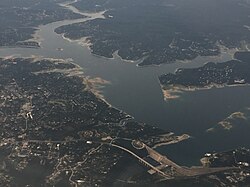
Lake Travis is a reservoir on the Colorado River in central Texas in the United States. It is named in honor of William B. Travis.[1]
Serving principally as a flood-control reservoir, Lake Travis' historical minimum to maximum water height change is nearly 100 feet.[2] Following the 2018 Llano River flood, Lake Travis saw a 20-foot depth increase within a single 24-hour period of time.[3] With 30 square miles of surface area, Lake Travis has the largest storage capacity of the seven reservoirs known as the Highland Lakes, and stretches 65 miles (105 km) upriver from western Travis County (near Lago Vista, Texas) in a highly serpentine course into southern Burnet County to Max Starcke Dam, southwest of the town of Marble Falls. Besides being used for flood control and as a water supply, the lake is also used for electrical power generation and recreation.
The Pedernales River, a major tributary of the Colorado River, flows into the lake from southwestern Travis County.
History
[edit]Creation
[edit]The reservoir was formed in 1942 by the construction of Mansfield Dam on the western edge of Austin, Texas, by the Lower Colorado River Authority (LCRA), and was built specifically to contain floodwaters in a flash-flood prone region. During its construction, after a severe flood in July 1938, the height of the dam was raised to add storage capacity for floodwaters.[4][5]
Ferry service
[edit]Regularly scheduled ferry service between Point Venture and the south side of Hurst Creek began in April 1971, operated by Point Venture Development Co. The trip took 20 minutes and was the only inland ferry service in Texas at the time.[6][7]
September 2020 boat sinkings
[edit]On September 5, 2020, a boat parade took place in support of Donald Trump. The Travis County Sheriff's office reported that they had received multiple calls involving boats in distress, and that several boats had sunk.[8][9][10] The weather was calm, but the boats generated significant wake as they began to move together, which subsequently sank at least five boats.[11] The hashtag #dumbkirk trended on Twitter following the incident.[12]
Recreational uses
[edit]Lake Travis is well known for its outdoor recreation opportunities, including fishing, boating, swimming, scuba diving, picnicking, camping, and zip lining.[13] Hippie Hollow Park, located near the eastern end of Lake Travis, is the only legal clothing optional park in Texas. Lake Travis is generally considered one of the clearest lakes in Texas. It is a vital water supply for the nearby city of Austin, Texas, and the surrounding metropolitan area.
Fatality rankings
[edit]In a ranking of Texas lakes by accidental fatalities, Lake Travis was in first place in 2011 and tied for second place for total deaths from 2000 to 2015.[14][15]
Six people drowned in Lake Travis in 2018, out of 29 total boating deaths reported across Texas that year.[16]
Fish populations
[edit]Lake Travis has been stocked with several species of fish intended to improve the utility of the reservoir for recreational fishing. Fish present in Lake Travis include largemouth bass, guadalupe bass, white bass, striped bass, catfish and sunfish. Lake Travis is a popular fishing destination for anglers in Texas not only because of its stocked inventory but because of the convenient boating services and marinas in the area.
In spring 2008 there were several reports of leeches residing in Lake Travis. The leeches are generally harmless to humans but can be a nuisance.[17]
Lake levels
[edit]
Lake Travis is considered "full" (at maximum desired capacity) when the lake's water level is at 681 feet (208 m) above mean sea level (msl). Above 681 feet (208 m), flood control gates at Mansfield Dam are opened under the direction of the U.S. Army Corps of Engineers.[18]
The level of the lake can vary dramatically—with an over 96-foot range between its historical high and low—depending on the amount of rainfall in the Colorado River basin upstream.[19] The historic high level on the lake was 710.4 feet (216.5 m) above msl on December 25, 1991, a little less than four feet below the dam's top/spillway at 714 feet (218 m) above msl. The historic low was 614.2 feet (187.2 m) above msl on August 14, 1951.
Droughts
[edit]The extreme drought of 2008–2009 brought the lake to its fourth lowest level at 626.09 feet (190.83 m) above msl in November 2009. The second lowest level was 615.02 feet (187.46 m) above msl on November 8, 1963.[20] During the 2010–13 Southern United States drought, levels went as low as 618 feet, making it the third lowest level ever.[21] The LCRA, a public utility whose responsibilities include the management of Lake Travis, makes water level reports available on the internet.[22] In April 2016, the lake returned to its full capacity at 681 ft.
Floods
[edit]Lake Travis serves as the primary flood control reservoir of the Highland Lake chain. The LCRA, under advisement from the U.S. Army Corps of Engineers, is responsible for floodgate operations at Mansfield Dam. Ideally, this is done in a time-delayed fashion after a major rainfall so as to either mitigate or outright prevent downstream flooding which otherwise would have been both immediate and extreme without the dam's presence. As Lake Travis levels increase during major floods, floodgate operations are conducted to protect property around Lake Travis as well as the dam itself.
While the dam's physical design assists in its own protection during floods, extensive spillway operations, a worst-case scenario which has not happened in the lake's history, could undermine the dam's base and affect its overall integrity. Under such conditions, operations are primarily intended to protect the dam, and lake water may be released to the dam's full, 24-floodgate capacity—regardless of downstream effects—to prevent the catastrophic loss of the dam.[23] Including its hydroelectric generators but not the spillway, at 681 feet above msl the dam's total maximum discharge capacity is more than 130,000 cubic feet per second (cfs); a bit under one million gallons per second.[24] Rates of discharge increase as water levels/pressures increase.
2025 flood impact and reopening
[edit]In July 2025, Lake Travis was affected by severe flooding following heavy storms over the July 4 weekend in Central Texas. On July 11, Travis County Judge Andy Brown issued an executive order temporarily closing the entire lake to recreational, commercial, and navigational activities. The closure cited safety concerns due to submerged debris, damaged buoys, unsafe roads, and elevated bacteria levels.[25]
The county updated the order on July 13, reopening most of the lake to boating and other recreational activities, with the exception of Sandy Creek Park and the area upstream of mile marker 36, which remained closed due to ongoing hazards.[26]
Officials advised boaters to take safety precautions, including avoiding nighttime travel, swimming only in visible areas, and maintaining low speeds. Violators of the remaining restrictions could face Class C misdemeanor charges, including fines of up to $1,000 or six months in jail.[27]
Travis County officials credited the reopening to the ongoing cleanup and recovery efforts by county staff, volunteers, and partner agencies.[28]
As of July 20, 2025, Lake Travis was reported to be 90.0% full, following significant rainfall and inflows earlier in the month.[29] The lake reopened fully on July 24th for all recreation, without any restrictions.
See also
[edit]References
[edit]- ^ Smyrl, Vivian (September 29, 2020). "Travis County". Texas State Historical Association (TSHA). Retrieved May 30, 2023.
- ^ "Historical Lake Levels | LCRA". www.lcra.org. Archived from the original on September 10, 2020. Retrieved September 7, 2020.
- ^ "Lake Travis Water Level". Go Lake Travis. October 16–17, 2018. Retrieved October 18, 2018.
- ^ "Mansfield Dam and Lake Travis". www.lcra.org.
- ^ "Flood Operations Report". Lower Colorado River Authority.
- ^ Dadamo, Amy Rae (July 11, 2019). "Historic Lake Travis ferry once transported residents, cars between communities". impact. Archived from the original on September 8, 2020. Retrieved September 8, 2020.
- ^ "The Story of Point Venture... Where Every Day's A Holiday". pointventure.com. Archived from the original on October 20, 2020. Retrieved September 8, 2020.
- ^ "Multiple boats sink during Trump Boat Parade on Lake Travis". CBS Austin. September 5, 2020. Retrieved September 5, 2020.
- ^ "Lake Travis: Several boats sink at pro-Trump parade in Texas". September 6, 2020. Retrieved October 18, 2024.
- ^ Murphy, Paul P. (September 7, 2020). "The wake of other boats in a pro-Trump parade in Texas caused 5 boats to sink, sheriff's office says". CNN. Retrieved October 18, 2024.
- ^ "5 boats sink at Trump boat parade on Texas' Lake Travis". www.cbsnews.com. Retrieved September 8, 2020.
- ^ "'We're gonna need a bigger vote': How #Dumbkirk swamped the internet".
- ^ Dembe, Noah. "Shaky Pale | Lake Travis Boat Rentals". Shaky Pale Marine. Retrieved March 19, 2022.
- ^ ...SportsDayDFW.com (May 18, 2013). "Sasser: Boating safety is made simpler if you take these five steps..." The Dallas Morning News. Archived from the original on October 22, 2020. Retrieved August 17, 2016.
- ^ "Lake Conroe deadliest for Texas boaters since 2000". Associated. Press. Retrieved August 19, 2020.
- ^ Bradshaw, Kelsey. "Watch out for lurking hazards, unsafe boaters in Lake Travis, authorities warn". The Statesman. Retrieved October 21, 2019.
- ^ "The Highland Lakes". Archived from the original on June 2, 2008. Retrieved June 14, 2008.
- ^ "Mansfield Dam Fact Sheet". LCRA.org. Retrieved September 20, 2021.
- ^ "Lake Travis Water Level". www.golaketravis.com. Retrieved September 7, 2020.
- ^ The lake rose to 642.39 feet above msl as of October 25, 2009 due to significant rains in September and October 2009. This places the level at 24 feet below normal level for October. "River Report" LCRA. Archived 2009-07-05 at the Wayback Machine
- ^ "Lowest Lake Travis Elevations".
- ^ River Operations Report
- ^ "Key elevations for Lake Travis during floods | LCRA". www.lcra.org. Retrieved September 7, 2020.
- ^ "Mansfield Dam and Lake Travis". Lower Colorado River Authority. Archived from the original on August 31, 2016. Retrieved August 17, 2016.
- ^ "Travis County updates disaster declaration connected with Lake Travis use". KXAN. July 13, 2025. Retrieved July 16, 2025.
- ^ "Lake Travis partially reopens for boat traffic, officials urge caution". Austin American-Statesman. July 13, 2025. Retrieved July 16, 2025.
- ^ "Lake Travis ban lifted, recreational and commercial use now granted". MySanAntonio. July 13, 2025. Retrieved July 16, 2025.
- ^ "Travis County updates disaster declaration connected with Lake Travis use". KXAN. July 13, 2025. Retrieved July 16, 2025.
- ^ "Texas Water Dashboard". Water Data for Texas. Texas Water Development Board. Retrieved July 20, 2025.
External links
[edit]
- Key Water Levels for Lake Travis During Floods
- "Lake Travis". Texas Parks and Wildlife. June 18, 2009. Retrieved September 3, 2009.
- "Mansfield Dam and Lake Travis". Lower Colorado River Authority. August 28, 2009. Archived from the original on September 25, 2009. Retrieved September 3, 2009.
- Lake Travis from the Handbook of Texas Online
| Central city | | ||||
|---|---|---|---|---|---|
| Satellite cities | |||||
| Other communities | |||||
| Counties |
| ||||
| Parks and preserves | |||||
| Geography | |||||
| Bodies of water | |||||
| Transportation | |||||


Lake Travis
View on GrokipediaPhysical Characteristics
Location and Geography
Lake Travis is a reservoir on the Colorado River in central Texas, spanning primarily Travis and Burnet counties, with its dam located approximately 13 miles northwest of Austin.[4] The lake extends northward into the Texas Hill Country, forming the largest of the seven Highland Lakes managed by the Lower Colorado River Authority.[2] Its approximate central coordinates are 30°23′ N, 97°55′ W.[1] Geographically, Lake Travis occupies a rugged portion of the Edwards Plateau ecoregion, characterized by steep limestone hillsides, canyons, and karst features derived from Cretaceous-era carbonate rocks.[8] [9] The surrounding terrain includes dramatic cliffs and boulder-strewn shorelines, with elevations rising from the reservoir's basin to plateaus covered in juniper and oak woodlands.[10] This landscape contributes to the lake's irregular shoreline, which measures over 270 miles when full, and supports diverse hydrological interactions with local aquifers.[11] The reservoir's elongated form, stretching about 65 miles upstream from Mansfield Dam, reflects the incised valleys of the pre-impoundment Colorado River, adapting to the dissected plateau topography of the region.[1]Dimensions and Hydrology
Lake Travis covers a surface area of 18,930 acres at full conservation pool elevation, with a shoreline extending 270 miles. The reservoir measures approximately 65 miles in length from Mansfield Dam upstream and reaches a maximum width of 4.5 miles. Its average depth is 62 feet, while the maximum depth attains 210 feet near the dam between Volente and Hudson Bend.[12][13] The conservation pool, allocated for water supply and hydroelectric generation, holds about 1.1 million acre-feet at 681 feet above mean sea level (msl), marking the elevation for full storage under normal operations. Above this lies the flood control pool, extending to 714 feet msl with an additional capacity of roughly 778,000 acre-feet, yielding a total reservoir volume of approximately 1.9 million acre-feet; the dam's top stands at 750 feet msl to accommodate extreme events up to a maximum design elevation of 745 feet.[14][3][4] Hydrological dynamics are governed by inflows from the upstream Colorado River—primarily regulated releases from Lake Buchanan—supplemented by tributaries like the Pedernales River and direct rainfall, averaging variable annual volumes influenced by Texas's semi-arid climate. Outflows through Mansfield Dam support hydropower (up to 240 megawatts capacity), municipal and industrial diversions, and flood releases via eight low-level gates and spillway, with rates adjustable from minimal to over 50,000 cubic feet per second during peaks. Evaporation constitutes a major loss, estimated at 5-7 feet annually across the surface due to high solar exposure and winds, exacerbating declines during droughts; for instance, levels dropped below 620 feet msl in 2011-2015 amid prolonged dry conditions, while floods in 1935 (pre-dam) and post-impoundment events like 1981 pushed hypothetical elevations over 710 feet. The Lower Colorado River Authority (LCRA) maintains operations per U.S. Army Corps of Engineers guidelines, prioritizing flood attenuation and supply reliability, with combined Buchanan-Travis system storage informing release decisions.[4]Construction and Engineering
Historical Context and Planning
The planning of Mansfield Dam, which impounds Lake Travis, was driven by the need to mitigate recurrent flooding on the Colorado River in Central Texas, exacerbated by a severe 1935 flood that devastated Austin following a prolonged drought. The Lower Colorado River Authority (LCRA), established by the Texas Legislature on November 24, 1934, was tasked with managing river resources for flood control, water supply, and hydroelectric power generation to serve rural electrification and urban needs.[15] Proposals for a dam at Marshall Ford site, advocated by LCRA leaders including Alvin Wirtz, faced early federal resistance due to cost and engineering debates but gained traction post-1935 as empirical evidence of flood risks mounted. Federal authorization came via the Rivers and Harbors Act of 1936, enabling LCRA to initiate construction in 1937 across a deep canyon at Marshall Ford, with primary objectives centered on storing floodwaters to protect downstream areas like Austin while providing ancillary benefits in power and irrigation. A July 1938 flood, occurring amid ongoing work, underscored the urgency and prompted design modifications to increase dam height from an initial 185 feet to 278 feet, enhancing storage capacity to approximately 1.1 million acre-feet for flood detention.[16] These adjustments reflected causal priorities: empirical flood data over pre-flood drought assumptions, balancing local authority with U.S. Army Corps of Engineers oversight on regulation plans. The project, completed in 1942 at a cost exceeding $10 million (equivalent to over $200 million in 2023 dollars), marked LCRA's expansion of a multi-dam system, including upstream Buchanan Dam, to address the region's hydrologic volatility without relying on unsubstantiated projections. Initial impoundment began that year, forming Lake Travis, though full operational integration with federal flood protocols evolved through subsequent agreements emphasizing data-driven releases over political expediency.[14]Dam Design and Building Process
The Mansfield Dam, which impounds Lake Travis, is a concrete gravity structure flanked by earthen embankments and saddle dikes, engineered to withstand high flood loads through its mass and weight distribution. The central concrete section reaches a maximum height of 278 feet above the riverbed and extends 2,423 feet in length, forming part of the overall dam length of approximately 7,089 feet; this design prioritizes stability against uplift and overturning forces inherent in the site's deep canyon geology at Marshall Ford on the Colorado River.[17][18] The structure incorporates a concrete overflow spillway, foundation drains, and grout curtains to address seepage risks and ensure long-term integrity, reflecting adaptations from initial plans for a lower 190-foot dam height based on refined flood risk evaluations.[18][19] Construction was a joint effort by the Lower Colorado River Authority (LCRA) and the U.S. Bureau of Reclamation, commencing on February 19, 1937, amid the Great Depression's economic pressures that facilitated labor mobilization. Site preparation involved excavating the canyon foundation, followed by systematic concrete placement in monolithic blocks to minimize thermal cracking, with on-site batch plants like the Shaker Plant supplying aggregates via river dredging and rail transport.[2][20][21] Workers poured substantial concrete volumes—up to 80,000 cubic yards in peak periods—employing cableways and cranes for material handling across the challenging terrain, while upstream dams like Buchanan provided staged flood protection during building.[22] The process faced delays from funding disputes and World War II material shortages, yet progressed to completion in May 1942, with the dam renamed from Marshall Ford to Mansfield that year in honor of Representative J.J. Mansfield. Post-completion assessments confirmed the structure's capacity to store over 1.1 million acre-feet for flood control, validating the design's empirical basis in regional hydrology data despite wartime accelerations that prioritized functionality over minor refinements.[20][18][2]Initial Impoundment
Deliberate impoundment of Lake Travis began in September 1940, during the ongoing construction of Mansfield Dam by the Lower Colorado River Authority (LCRA).[4] This phase marked the initial storage of Colorado River water behind the partially completed dam structure, which had been elevated following the severe July 1938 flood to enhance flood control capacity.[2] The process utilized the emerging reservoir's flood pool to manage inflows, with controlled releases conducted over extended periods to prevent downstream overflow while construction continued. The first hydroelectric power generation unit at Mansfield Dam commenced operation on January 27, 1941, indicating that sufficient water had accumulated to enable initial power production amid the filling process.[4] Impoundment progressed incrementally, supporting the dam's primary objectives of flood mitigation, water storage, and eventual hydropower, with the reservoir reaching operational levels as construction advanced. Full dam completion occurred in May 1942, after which Lake Travis achieved its designed conservation pool capacity of approximately 1,113,000 acre-feet, though initial filling focused on stabilizing the structure and testing flood storage.[4] This phased approach minimized risks associated with rapid filling on the untested embankment and gravity sections.[2]Primary Functions
Flood Control Mechanisms
Lake Travis primarily functions as a flood control reservoir by capturing and temporarily storing excess runoff from the 38,000-square-mile Colorado River basin during intense rainfall, thereby reducing peak discharge rates downstream and mitigating risks to communities along the lower Colorado River, including Austin. The reservoir's dedicated flood storage pool operates above the conservation elevation of 681 feet above mean sea level (msl), extending up to a maximum flood pool of 714.6 feet msl, which equates to approximately 33 vertical feet of storage capacity designed specifically for flood attenuation.[14][4] Mansfield Dam's flood control operations are regulated by the U.S. Army Corps of Engineers (USACE) under the Flood Control Act of 1944, with the Lower Colorado River Authority (LCRA) executing releases per the USACE-approved Water Control Manual for Mansfield Dam and Lake Travis. Inflow forecasting from upstream gauges triggers actions when lake levels surpass 681 feet msl; controlled outflows are then routed through three hydroelectric turbines (totaling about 7,580 cfs capacity) and 24 spillway gates (23 radial gates each exceeding 5,250 cfs and one variable jet-flow gate at 2,290 cfs), enabling maximum discharges up to roughly 130,000 cubic feet per second to safely evacuate stored volumes without overwhelming downstream channels.[23][2] This storage-release dynamic has proven effective in major events, such as the December 1991 basin-wide flood, which filled the reservoir to near-capacity and required sustained gate operations to avert greater downstream inundation, and the October 2018 event, where 24 feet of rapid rise was managed via full gate openings without breaching safety thresholds. Coordination with upstream Highland Lakes dams, like Buchanan, further enhances basin-wide flood routing by sequencing releases to avoid compounding peaks.[23][24]Water Supply and Hydroelectric Power
Lake Travis functions as a key reservoir for water supply in Central Texas, storing water primarily for municipal, industrial, agricultural, and irrigation needs under the management of the Lower Colorado River Authority (LCRA).[25] Its conservation storage pool reaches full capacity at 681 feet above mean sea level, holding approximately 1.1 million acre-feet dedicated to non-flood uses.[2] The total reservoir storage, including the flood control pool up to 714.6 feet above mean sea level, provides up to 1,921,731 acre-feet.[4] LCRA coordinates releases from Lake Travis to meet contractual demands downstream while optimizing inflows, reducing evaporative losses, and supporting regional users such as Austin and surrounding areas.[26] Water allocations from Lake Travis are governed by long-term contracts, with domestic use rates set at $165 per acre-foot annually, equivalent to 325,851 gallons.[27] Historical operations have prioritized supply reliability, with overall Highland Lakes withdrawals decreasing by 25% in periods of increased run-of-river availability to preserve reservoir levels.[28] During droughts, LCRA adjusts operations to extend available storage, though growing demand from new contracts has strained capacities in recent years.[29] In addition to water supply, Mansfield Dam at Lake Travis supports hydroelectric power generation through an integrated powerhouse located 278 feet below the dam crest.[2] The facility has a generating capacity of 108 megawatts, harnessing energy from controlled water releases via turbines.[2] Power production is secondary to flood control and water supply priorities, as outlined in operational manuals, with generation subordinated during high-priority storage or release events. This contributes to Texas's limited hydroelectric output, which accounts for less than 0.5% of the state's total generating capacity despite the dam's role in regional energy infrastructure.[30]Operational Management by LCRA
The Lower Colorado River Authority (LCRA) operates Lake Travis as part of the six-reservoir Highland Lakes system on the Colorado River, with primary responsibilities encompassing water storage, release scheduling, flood mitigation, and integration with hydroelectric generation at Mansfield Dam.[25] Established under Texas law in 1934, LCRA's authority derives from state-granted powers to manage the river basin for public benefit, including adherence to federal flood control protocols set by the U.S. Army Corps of Engineers (USACE).[14] Operations prioritize balancing water supply demands, environmental flow requirements downstream, and risk reduction, guided by the state-approved 2020 Water Management Plan for Lakes Buchanan and Travis.[31] Under the Water Management Plan, LCRA divides operations into zones based on combined storage levels in Lakes Buchanan and Travis, with decisions keyed to dates like March 1 and July 1 for agricultural cycles.[31] Firm water commitments to municipalities and industries receive absolute priority, while interruptible supplies for agriculture are curtailed during droughts to preserve reservoir levels and Matagorda Bay inflows; for instance, interruptible water was suspended for the 2025 season amid ongoing dry conditions.[26] Releases from Lake Travis occur to replenish downstream reservoirs like Lake Austin, meet customer allocations, and sustain minimum environmental flows, such as subsistence levels from July to October.[26] Lake levels are actively managed to capture seasonal inflows, minimizing evaporative losses—estimated at significant volumes given the reservoir's surface area—while avoiding unnecessary drawdowns.[26] The conservation pool tops out at 681 feet mean sea level (msl), above which flood storage activates.[32] Flood operations at Mansfield Dam integrate with routine management through USACE-mandated protocols, including a Letter of Understanding and Water Control Agreement.[14] Releases commence when projections exceed 681 feet msl, escalating by volume: up to 7,500 cubic feet per second (cfs) between 681–683 feet, rising to 90,000 cfs above 714 feet via 24 floodgates and hydroelectric turbines, with adjustments for downstream gauge readings at Austin, Bastrop, and Columbus to prevent localized flooding.[14] The spillway engages at 714 feet, and operations above 722 feet prioritize dam integrity over downstream constraints.[14] Hydroelectric releases often serve dual purposes, generating power while passing floodwaters, with LCRA's system producing variable output based on flow rates and head.[14] LCRA maintains real-time oversight via the Hydromet network of over 275 gauges tracking river stage, inflows, rainfall, and lake elevations, feeding into daily River Operations Reports with forecasts.[33] This data-driven approach enables proactive adjustments, such as holding releases during low-inflow periods to build storage or accelerating them post-flood to restore balance.[26] The reservoirs' fluctuating design—rising in wet years and declining in dry—reflects engineered trade-offs for multi-use functionality, with Lake Travis historically reaching full capacity in events like July 2019 and early 2025 floods.[25]Recreational Utilization
Popular Activities
Boating dominates recreational use at Lake Travis, with visitors operating powerboats, personal watercraft, sailboats, kayaks, and houseboats across its 18,930-acre surface area.[12] Multiple public boat ramps, such as those at Mansfield Dam Park and Wilson Park managed by the Lower Colorado River Authority (LCRA), facilitate access, while private marinas provide rentals and launches.[34] Water sports including waterskiing, wakeboarding, and tubing are common, leveraging the reservoir's 62-foot average depth and coves for calmer conditions.[13] Fishing ranks as a primary draw, particularly for largemouth bass that suspend over points and drop-offs, targeted with topwater lures, jerkbaits, or spinnerbaits near the surface.[35] Texas Parks and Wildlife Department surveys from 2020-2022 document robust populations of bass, striped bass, and white bass, with electrofishing yielding high catch rates in spring and fall.[36] Anglers also pursue catfish and crappie, often from shorelines or chartered boats. Swimming and beach activities occur at designated areas in county and LCRA parks, such as Pace Bend Park's cliffs and shores or Bob Wentz Park's waterfront, where water temperatures average 70°F in May and rise into the 80s°F during summer peaks.[37] [38] Picnicking, grilling, and primitive camping complement these, with sites offering Hill Country views but requiring adherence to no-alcohol rules in some zones to mitigate overcrowding.[38] Hiking and mountain biking trails span parks like Muleshoe Bend Recreation Area and Grelle Recreation Area, providing over 10 miles of paths through rugged terrain for non-water-based exploration.[39] [40] These activities peak in warmer months, drawing crowds to the reservoir's 270-mile shoreline despite variable lake levels influencing accessibility.[12]Infrastructure and Accessibility
Lake Travis is primarily accessible by automobile via major roadways such as Texas State Highway 71, which spans the 7,098-foot crest of Mansfield Dam and connects Austin to the west, and Ranch to Market Road 620, providing direct entry to southern shore areas including marinas and parks.[4] Additional routes like U.S. Highway 183 and various county roads facilitate access from northern and eastern points, with the lake situated approximately 20 miles northwest of downtown Austin.[34] Public transportation options are limited, rendering personal vehicles or charters the dominant mode for visitors, though proximity to Austin-Bergstrom International Airport, about 40 miles southeast, supports regional travel.[2] Public infrastructure centers on recreational facilities managed by the Lower Colorado River Authority (LCRA) and Travis County Parks, encompassing over 17 parks with amenities like picnic areas, restrooms, and shoreline access.[41] Key sites include Mansfield Dam Park, featuring a four-lane boat ramp—the deepest and most accessible on the lake—with wheelchair-accessible courtesy docks, and Pace Bend Park, which offers multiple ramps and camping overlooking coves.[42] [37] LCRA-operated parks such as Camp Creek Park and Narrows Recreation Area provide additional entry points, including 24/7 ramps at Gloster Bend, supporting boating, fishing, and hiking.[34] These facilities are maintained to ensure usability, though closures occur during low water levels; for instance, as of late 2024, ramps at Arkansas Bend Park were shuttered due to drought conditions, highlighting vulnerability to hydrological variability.[43] Boating infrastructure includes more than 15 public ramps distributed around the 270-mile shoreline, enabling launches for motorized and non-motorized vessels, alongside private marinas like Lake Travis Marina and Hurst Harbor-Marina Del Lago, which collectively permit around 5,000 slips for docking, fueling, and repairs.[43] [34] Mansfield Dam itself integrates flood control with transit, featuring 24 floodgates and hydroelectric turbines beneath the roadway, while ancillary features like courtesy docks and breakwaters at marinas enhance safety and convenience.[14] Accessibility for diverse users is prioritized in select areas, with ramps designed for varying lake elevations down to 620 feet above mean sea level, though steep terrain in the Hill Country limits universal trail access without accommodations.[42]Economic Impacts
Lake Travis supports substantial economic activity in Central Texas, primarily through recreation, tourism, and associated property development, generating an estimated $207.1 million annually in state and local revenues as of 2011 assessments, including real estate taxes, sales taxes, hotel occupancy taxes, and mixed beverage taxes.[44] This figure encompasses contributions from visitor spending on boating, fishing, and waterfront amenities, which sustain approximately 1,916 jobs and add $112.6 million in local economic value through direct expenditures averaging $69.4 million in wages.[45] The lake's role in flood control and water storage indirectly bolsters regional stability, enabling consistent municipal water supplies for Austin-area industries and agriculture, though specific quantified values for these functions remain tied to broader Lower Colorado River Authority (LCRA) operations. Recreational utilization drives a significant portion of the economy, with annual revenues from boating, marinas, and party boat services exceeding $112 million in related sales, visitor spending, and equipment purchases during typical conditions.[46] These activities attract tourists, supporting local businesses such as restaurants, rental operators, and hospitality venues, with the party boat industry alone fostering job creation and increased tourism inflows to Lake Travis and Austin.[47] Property development around the lake has resulted in over $8.4 billion in assessed values, funding public services like schools, emergency response, and infrastructure maintenance through ad valorem taxes.[48] Water level fluctuations exert a direct causal influence on economic outcomes, with prolonged droughts reducing tourism and eroding property values; for instance, each 6-foot decline in lake elevation correlates to a 3.5% drop in waterfront home prices, as observed during the 2011-2015 low-water period.[49] Low levels in 2022 led to documented losses including $1.7 million in sales tax revenue, $45,000 in hotel receipts, and $120,000 from fewer visitors, totaling $21.9 million in foregone fiscal impacts for Travis County.[50] Recovery to near-full capacity, as in August 2025 when levels reached 90.3%, has conversely stabilized real estate markets and boosted waterfront appreciation rates, with some communities seeing up to 195.9% gains amid broader economic trends.[51] These dynamics underscore the lake's sensitivity to hydrological variability, where sustained higher levels maximize fiscal returns while deficits amplify business contractions in dependent sectors.Safety and Incidents
Boating and Drowning Statistics
Lake Travis experiences a notable incidence of drownings associated with recreational boating, often involving factors such as alcohol impairment, failure to wear life jackets, and vessel overcrowding in popular coves.[52] These incidents contribute significantly to Travis County's annual drowning toll, which averaged 14 unintentional drownings per year from 2007 to 2016, with males comprising 71% of victims.[53] In 2021, Lake Travis recorded 10 drownings, the highest annual figure in its history, amid heightened recreational use during the COVID-19 period.[54] Earlier years saw 7 drownings in 2018 and 8 in 2011, reflecting persistent risks from boating mishaps like falls overboard.[55] Within Devil's Cove, a congested party boating area, the Travis County Sheriff's Department documented 7 fatalities since 2010, underscoring localized hazards from dense vessel traffic and impaired judgment.[52] Boating accidents on the lake include collisions between vessels and personal watercraft, such as a 2024 jet ski-boat incident injuring three people, including two children, and propeller strikes leading to fatalities.[56] Statewide data from the Texas Parks and Wildlife Department indicate drowning as the primary cause of boating fatalities, accounting for 50% in 2024 (12 of 24 total) and 57.2% in 2023, with Lake Travis incidents aligning with these patterns due to high traffic volumes exceeding 1 million visitors annually.[57][58] Local enforcement by the Travis County Sheriff's Office and Texas Game Wardens responds to hundreds of calls yearly, including rescues during storms, though comprehensive lake-specific boating crash aggregates remain derived from incident reports rather than centralized tallies.[59]Notable Accidents
On October 7, 2017, a woman attending a bachelorette party sustained critical injuries when a boat propeller severed her right arm while she was in the water near Lake Travis; bystanders pulled her from the lake and applied a tourniquet before emergency responders arrived, enabling her survival despite the loss of the limb.[60] During Labor Day weekend on September 3, 2016, multiple incidents unfolded: a 2-year-old girl drowned after falling from a dock into Lake Travis, a boat collision ejected occupants requiring the rescue of 10 people from the water, and a biplane crashed into the lake with the pilot surviving the impact.[61] In Devil's Cove, a popular party area, seven drownings linked to party barges have occurred since 2010, when Travis County Sheriff's Office began detailed tracking, often involving falls from crowded vessels amid alcohol consumption and rough waters.[52] A boat-jet ski collision on August 13, 2023, killed one person and injured five others on Lake Travis, highlighting risks during peak summer traffic.[62] In early July 2025, a New Jersey man died after being struck in the head by an out-of-control jet ski operated by renters from Lakeway Marina, prompting a $1 million wrongful death lawsuit against the marina and involved parties for alleged failures in supervision and safety compliance.[63]Mitigation Efforts
The Lower Colorado River Authority (LCRA) implements the Be LakeWise water safety campaign, launched in 2022, to promote awareness of hazards on Lake Travis and other Highland Lakes through social media posts, flyers, and branded items distributed at events, emphasizing practices such as wearing life jackets and avoiding swimming alone.[64][65] This initiative, which received the 2023 Community Impact Award from the National Hydropower Association, collaborates with the Travis County Sheriff's Office to enforce Texas Water Safety Act provisions, including boater education requirements and restrictions on vessel operation near swimmers or in no-wake zones marked by buoys.[65][66] Texas Parks and Wildlife Department (TPWD) mandates boater education certification for operators born on or after September 1, 1993, and for those under 18 piloting personal watercraft, with courses covering navigation rules, safety equipment, and state boating laws available online or in-person.[67][68] State law requires wearable life jackets on recreational vessels under 26 feet, with children under 13 wearing them at all times on deck unless below deck or in an enclosed cabin, a measure aimed at reducing drownings in open-water environments like Lake Travis where sudden drop-offs and currents pose risks.[69][70] LCRA supplements these with seasonal advisories, such as post-flood warnings to avoid the lake due to submerged debris, fast currents, and elevated bacteria levels, as issued after the July 2025 event, and year-round recommendations to refrain from night boating and to inspect for hidden underwater hazards.[71][72] LCRA regulations further limit boat speeds in designated areas and require adherence to buoyed no-wake zones to prevent collisions, though the agency has prioritized digital outreach over additional physical signage.[66][64] Game wardens from TPWD patrol the lake to enforce these rules and conduct rescues, contributing to broader efforts that have not eliminated incidents but align with empirical data showing life jacket use as the primary drowning preventer.[73][70]Environmental Considerations
Ecosystem Alterations
The impoundment of Lake Travis by Mansfield Dam, completed in 1942, converted approximately 65 miles of the Colorado River and adjacent valleys into a deep, steep-sided reservoir basin, displacing riverine habitats and terrestrial ecosystems in favor of lacustrine conditions with limited shallow littoral zones. This alteration reduced natural seasonal flooding downstream, which historically supported riparian vegetation and sediment deposition, while stabilizing water levels for storage but introducing artificial fluctuations driven by operational releases and droughts.[25] Thermal and chemical stratification occurs seasonally in Lake Travis, a monomictic reservoir, with warmer surface waters from April to November limiting oxygen exchange to deeper layers and promoting nutrient layering that can exacerbate algal blooms during turnover events. Extreme water level variations, such as drops below 630 feet mean sea level during prolonged droughts (e.g., 2011-2015), dewater coves and expose substrates, disrupting fish spawning grounds and benthic communities while favoring resilient prey species like threadfin shad and gizzard shad.[74][75] The establishment of invasive zebra mussels (Dreissena polymorpha) in 2017 has further modified the ecosystem by filtering plankton, increasing water clarity, and colonizing hard substrates, potentially reducing food availability for native filter-feeders and altering periphyton communities, though direct impacts on sport fish populations like largemouth bass remain under monitoring with no significant declines observed as of 2022. Management efforts by the Lower Colorado River Authority target nuisance aquatic plants like hydrilla (Hydrilla verticillata), which can form dense mats displacing native vegetation, though Lake Travis's deep profile limits widespread submerged plant growth compared to shallower downstream reservoirs. Fish communities have adapted to reservoir conditions, with introduced striped bass persisting after stocking ceased in 2017 and native sunfishes providing stable forage, but ongoing zebra mussel proliferation risks biofouling and secondary ecological shifts.[76][36][77][75]Water Quality Challenges
Lake Travis experiences periodic harmful algal blooms (HABs), predominantly involving cyanobacteria, which produce cyanotoxins posing risks to human and animal health, including skin irritation, gastrointestinal illness, and neurotoxic effects in severe exposures.[7] [78] These blooms thrive under conditions of elevated nutrient levels—such as phosphorus and nitrogen from agricultural runoff, urban stormwater, and septic systems—combined with warm water temperatures and stagnant flows during low-water periods.[7] [79] The Lower Colorado River Authority (LCRA) monitors cyanotoxin levels across multiple sites in Lake Travis and adjacent Highland Lakes, with detections reported at 10 locations in March 2021, prompting advisories against pet contact.[7] [78] Eutrophication contributes to reduced dissolved oxygen and increased turbidity, heightening bloom susceptibility, as observed during droughts when reservoir stratification limits mixing.[79] A 2023 analysis ranked Lake Travis among U.S. lakes with elevated toxic algae risks, attributing persistence to anthropogenic nutrient loading despite regulatory efforts.[80] Nonpoint source pollution, including sediment and contaminants from surrounding development, has been a focus of LCRA ordinances since the 1990s, mandating best management practices like vegetated buffers to curb runoff; a 1990s study linked excessive algal growth in coves to nutrient enrichment from upstream sources.[81] [82] Austin Water's routine testing near Lake Travis intakes has detected no cyanotoxin levels exceeding drinking water thresholds as of April 2025, enabling safe treatment via filtration and disinfection, though raw water quality fluctuations necessitate ongoing vigilance.[83] USGS modeling from 1984–2018 data underscores climate variability's role in bloom frequency, projecting increases with warming trends absent mitigation of nutrient inputs.[84] Recreational advisories during blooms emphasize avoiding ingestion or prolonged skin contact, with LCRA's Colorado River Watch Network providing citizen-reported early warnings to supplement professional sampling of parameters like pH, conductivity, and chlorophyll-a.[85]Balancing Conservation and Use
The Lower Colorado River Authority (LCRA) manages Lake Travis as part of a multi-objective system that balances water supply for municipal and agricultural users, hydroelectric power generation, flood control, recreation, and environmental protection under a state-approved Water Management Plan.[31] This plan prioritizes capturing inflows to maximize storage while releasing water for downstream environmental needs, such as maintaining river flows that support aquatic habitats in the Colorado River basin.[31] As of October 2025, Lakes Travis and Buchanan hold approximately 1.75 million acre-feet of water, reflecting ongoing adjustments to drought and flood conditions to sustain these competing demands.[25] To protect ecological integrity amid intensive recreational use, which includes boating and shoreline development, the LCRA enforces the Highland Lakes Watershed Ordinance, regulating land development to control stormwater runoff and prevent nutrient pollution that could degrade water quality.[86] Complementary efforts include the LCRA Soil and Water Stewardship Program, which provides technical and financial assistance to landowners for practices like erosion control and riparian buffer establishment, reducing sediment delivery to the lake and enhancing habitat stability.[87] Travis County supplements these through groundwater protection, stormwater management plans, and enforcement against illicit discharges, aiming to mitigate impacts from urban expansion around the reservoir.[88] Tensions arise during low-water periods, where mandatory environmental flow releases from Lake Travis—intended to preserve downstream ecosystems—can strain municipal supplies, prompting local governments like Lago Vista to advocate for policy revisions that reduce outflows when combined storage in Lakes Travis and Buchanan falls below critical thresholds.[89] [90] These releases, averaging thousands of acre-feet annually, support fish spawning and wetland health but have been criticized by water users for exacerbating shortages, as evidenced by debates in 2025 over LCRA's drought response strategies.[91] Following the July 2025 flood, officials emphasized enhanced conservation measures, including voluntary reductions in water use, to rebuild storage without compromising ecological minimums.[92] Such balancing reflects causal trade-offs: prioritizing storage preserves reservoir levels for human use, while flows prevent irreversible habitat loss, with empirical monitoring by LCRA guiding adaptive decisions.[31]Water Level Fluctuations
Drought Periods and Low Levels
The most severe historical drought affecting Lake Travis occurred in the early 1950s, when reservoir levels reached the all-time low of 614.18 feet mean sea level (msl) on August 14, 1951, amid prolonged dry conditions in Central Texas that limited inflows from the Colorado River basin.[93][94] This period, known as the drought of record for the region, reduced the lake's storage capacity significantly, impacting early water allocations for downstream users and highlighting the reservoir's vulnerability to extended low precipitation and high evaporation rates typical of Texas summers.[94] Another notable low-water episode took place in 1963, with levels dropping to 615.02 feet msl on November 8, driven by multi-year deficits in rainfall and upstream inflows, which strained the Lower Colorado River Authority's (LCRA) management of the Highland Lakes system for municipal, agricultural, and industrial demands.[93] The 2011–2015 drought represented the most significant modern challenge, exacerbated by record heat and minimal rainfall, pushing Lake Travis to its third-lowest level of 618.64 feet msl on September 20, 2013, and 622.65 feet msl on November 15, 2014; combined storage in Lakes Travis and Buchanan fell to as low as 32% of capacity at the peak.[93][95][96] During this time, the LCRA implemented curtailments on interruptible agricultural water supplies, including cuts to rice irrigation in 2012, to preserve firm commitments for over one million downstream users, while hydropower generation declined due to insufficient head pressure and exposed turbine intakes.[94] Low levels also revealed previously submerged hazards like rock formations and debris, complicating boating and exposing ancient archaeological sites along the shoreline.[95]| Rank | Date | Elevation (ft msl) |
|---|---|---|
| 1 | August 14, 1951 | 614.18 |
| 2 | November 8, 1963 | 615.02 |
| 3 | September 20, 2013 | 618.64 |
| 4 | November 15, 2014 | 622.65 |
Flood Events and High Levels
Lake Travis, managed by the Lower Colorado River Authority (LCRA), experiences periodic high water levels during intense rainfall events in the Colorado River basin, which can cause rapid inflows exceeding outflows through Mansfield Dam. The reservoir's conservation pool tops out at 681 feet above mean sea level (msl), but flood control operations allow levels to rise higher to mitigate downstream flooding, with releases via spillways and floodgates when necessary. These events often submerge shoreline infrastructure, such as docks and boat ramps, and alter recreational access, though the dam's design has prevented catastrophic downstream breaches since its completion in 1942.[2][32] Major flood peaks have occurred in response to regional deluges, with the highest recorded levels stemming from prolonged or extreme precipitation. For instance, the Christmas 1991 flood, triggered by heavy rains across Central Texas, pushed Lake Travis to its all-time record of 710.44 feet msl on December 25, 1991, necessitating maximum releases to control downstream impacts. Similarly, in May 1957, early reservoir history saw a peak of 707.38 feet msl amid widespread flooding. The June 1997 event reached 705.11 feet msl, while February 1992 levels hit 704.68 feet msl during the tail end of the 1991-1992 wet period. Other notable highs include 696.70 feet msl on November 24, 2004, following Tropical Storm Matthew's remnants, and 693.48 feet msl on June 14, 1987, from spring storms.[98][93][2] The following table summarizes the top historical flood peaks based on LCRA and hydrological records:| Rank | Date | Elevation (ft msl) |
|---|---|---|
| 1 | December 25, 1991 | 710.44 |
| 2 | May 18, 1957 | 707.38 |
| 3 | June 25, 1997 | 705.11 |
| 4 | February 9, 1992 | 704.68 |
| 5 | October 18, 1998 | ~700 (approximate) |
| 6 | November 24, 2004 | 696.70 |
| 7 | June 14, 1987 | 693.48 |
| 8 | July 7, 2002 | 693.47 |
| 9 | June 7, 2016 | 692.70 |
| 10 | Other events | Varies |