Recent from talks
Nothing was collected or created yet.
Lake Copais
View on Wikipedia
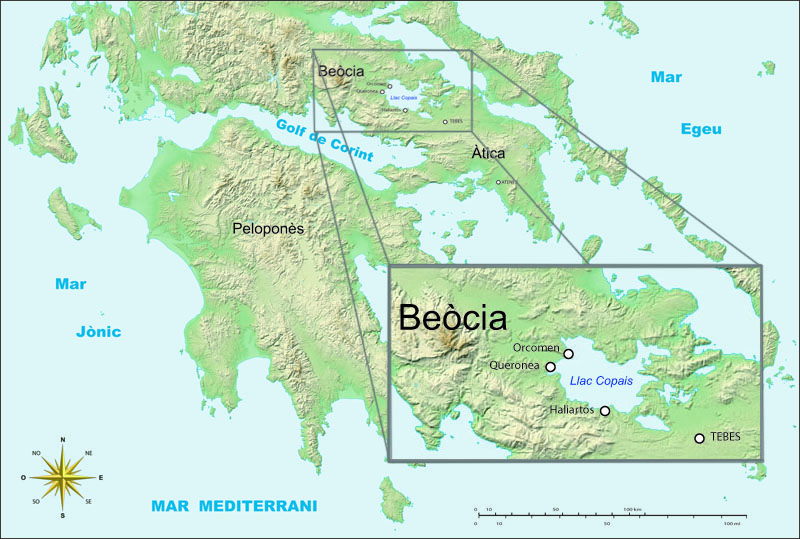
Lake Copais, also spelled Kopais or Kopaida (Ancient Greek: Κωπαΐς; Greek: Κωπαΐδα), was a lake in the centre of Boeotia, Greece, west of Thebes. It was first drained in the Bronze Age,[1][2][3] and drained again in the late 19th century. It is now flat dry land and is still known as Kopaida. A one-time island in the lake was modified in ancient times into a megalithic citadel, now called Gla. Lake Copais is also featured in Ubisoft's Assassin's Creed Odyssey (2018).
Drainage
[edit]
When the lake existed, the towns of Haliartus, Orchomenus, and Chaeronea were on its shores. Rivers feeding the lake included the Cephissus, Termessus and Triton. The lake was (and is) surrounded by fertile land, but the lake increasingly encroached on the surrounding land because of inadequate drainage.[citation needed]
The first modern, though abortive, plans to drain the lake were made in 1834-1838.[4] In 1865 a French company, Montferrier and Bonnair, signed a contract with the Greek government to drain the lake.[4] But in 1873 after having drained the lake partially, the company went bankrupt and drainage of the lake was halted until 1880, when a new contract was signed with another French company.[4] Though massive drainage works took place between 1882 and 1886, the attempt was unsuccessful: The organic material accumulated on the lake bottom was set ablaze, which caused the lake bed recede by ca. 4 m (13 ft) lower than the drainage canal and by 1887 the lake was filled again.[4] This time a British company, Lake Copais Co Ltd., was contracted to continue the project, and the company successfully finished draining the lake by 1931 and recovering 241 km2 (93 sq mi) of land.[4][5] The Greek government expropriated the recovered area in 1953, and redistributed it to landless farmers.[4]
The Kopais Lake Agency was created in 1957 to supervise the draining of the lake and building of a new road. The task was completed that same year, but the agency with full-time staff of 30 (including a driver for the president of the agency) still existed until 2010.[6][7]
Before this the lake drained into the sea by numerous subterranean channels. Some of these channels were artificial, as the 1st century geographer Strabo recorded.[8] Modern excavation has found enormous channels dug in the 14th century BC which drained water into the sea to the northeast;[9] Strabo mentions work being done on these channels by an engineer named Crates of Chalcis in the time of Alexander the Great.
Drainage in antiquity
[edit]Several attempts at partial or complete drainage of lake Copais were made in antiquity. First during the Bronze Age,[2][3] and later during the Roman Times.[3]
During the Bronze Age, the Mycenaeans drained the lake partially by diverting a portion of water volume feeding it towards natural sinkholes situated near the eastern end of the lake and through them eventually to the sea.[2][3] The Bronze Age draining attempts happened at least in two phases. First attempt was made by building low earth dams totalling in length to ca. 22 km (14 mi) to gain land from the lake.[2][1] Excavated remains indicate that up to 400,000,000 m3 of stone and roughly 200,000,000 m3 of earth were moved to build the dams.[10] However, after the dams failed another, apparently more successful, attempt was made by constructing a ca. 25 km (16 mi) long canal conveying water from the lake basin towards natural sinkholes northeast of the lake.[2][3] At this point the lake basin was divided into two, one north and another south of the levee, leading to partial reclamation of the southern part of the basin.[2] An incomplete tunnel with planned length of 2.2 km (1.4 mi) at Kephalari, close to the sinkholes, leading water rivers Cephissus and Melas to a small torrent leading eventually to the Euboean Gulf may also be a Bronze Age work;[2] however, currently there is no consensus about the matter and some researchers date the tunnel much later,[1] perhaps during the Hellenistic period.[3][5] The drainage system collapsed during the Late Helladic IIIB or Late Helladic IIIC at the latest.[5]
In the Roman Times, two drainage attempts are documented. The first attempt is attributed to a local Epameinondas Epameinondou, and the second to the Emperor Hadrian.[3]
Lake Copais in ancient literature and mythology
[edit]
There was a legend that the lake came into being when the hero Heracles flooded the area by digging out a river, the Cephissus, which poured into the basin.[11] Polyaenus explains that he did this because he was fighting the Minyans of Orchomenus: they were dangerous horseback fighters, and Heracles dug the lake in order to unhorse them.[12] Another story has the lake overflow in the mythical time of Ogyges, resulting in the Ogygian deluge.[13]
The travel writer Pausanias and the 5th century BC comic playwright Aristophanes record that in antiquity Lake Copais was known for its fish, especially the eels.[14]
References
[edit]- ^ a b c Koutsoyiannis, Demetris; Angelakis, A. N. (2004). "Agricultural hydraulic works in ancient Greece.". The Encyclopedia of Water Science. New York: Marcel Dekker, Inc.
- ^ a b c d e f g Mamassis, N.; Moustakas, S.; Zarkadoulas, N. (2015). "The operation of ancient reclamation works at Lake Copais in Greece". Water History. 7 (2015): 271–287. doi:10.1007/s12685-015-0126-x.
- ^ a b c d e f g Kountouri, E.; Petrochilos, N.; Liaros, N.; Oikonomou, V.; Koutsoyiannis, D.; Mamassis, N.; Zarkadoulas, N.; Vött, A.; Hadler, H.; Henning, P.; Willershäuser, T. (2013). "The Mycenaean drainage works of north Kopais, Greece: a new project incorporating surface surveys, geophysical research and excavation". Water Science and Technology: Water Supply. 13.3 (2013): 710–718. doi:10.2166/ws.2013.110.
- ^ a b c d e f Koutras, Nikolaos. "Aliartos". Encyclopedia of the Hellenic World, Boeotia. Archived from the original on 2022-05-23. Retrieved 2024-11-04.
- ^ a b c Ghembaza, Therese; Windell, David (2021). "Mysteries of Lake Copais: The Drainage – Massive Bronze Age and Hellenistic Hydraulic Engineering Work" (PDF). Open Journal for Studies in History. 4 (2021): 67–84. doi:10.32591/coas.ojsh.0402.03067g.
- ^ "The 'Atimorisia' Illness: Greece's Toothless Battle against Corruption". Spiegel Online. Retrieved 11 April 2012.
- ^ Manolopoulos, Jason (2011). Greece's 'Odious' Debt: The Looting of the Hellenic Republic by the Euro, the Political Elite and the Investment Community. Anthem Press. p. 288. ISBN 978-0-85728-771-7.
- ^ Strabo 9.2.18.
- ^ "Buildings of the Installations of Copais Company", Hellenic Ministry of Culture, accessed 12/2011; "Technology in Ancient Greece", accessed 12/2011.
- ^ Simpson, R. Hope (2006). Mycenaean fortifications, highways, dams and canals. D. K. Hagel. Sävedalen: Paul Åströms Förlag. ISBN 91-7081-212-8. OCLC 70207931.
- ^ Diodorus Siculus 4.18.7; Pausanias 9.38.7.
- ^ Polyaenus Strategemata 1.3.5.
- ^ Entry "Ogyges" in Oskar Seyffert, A Dictionary of Classical Antiquities, Revised and edited by Henry Nettleship and J.E. Sandys, New York: Meridian Books, 1956.
- ^ Pausanias 9.24.2; Aristophanes Acharnians 880
External links
[edit]- Ghembaza, Therese (2012). "The Mysteries of Lake Copias and the Island of Gla". Therese Ghembaza.
- Strabo. "Geography". Perseus website. see especially 9.2.16-27 (translated by H.L. Jones, 1924)
- Pausanias. "Description of Greece". Perseus website. (translated W.H.S. Jones and H.A. Ormerod, 1918)
- Google Earth air view of the Lake Copais plain
- Google Earth ground view across the Lake Copais plain from the south
- Google Earth ground view across the Lake Copais plain from the east
- Google Earth ground view in the middle of the Lake Copais plain
- Wikimedia Commons
Lake Copais
View on GrokipediaGeography
Location and extent
Lake Copais is situated in central Boeotia, Greece, approximately 100 km northwest of Athens and west of the city of Thebes. Its central coordinates are approximately 38°27′N 23°03′E.[5][6] Historically, Lake Copais was the largest lake in Greece, covering an area of about 250 km² before modern drainage efforts. It was bordered by several ancient towns, including Haliartus to the southwest, Orchomenus to the west, and Chaeronea to the north.[7][8] In the modern era, the lake has been fully drained, transforming it into the flat, dry Kopaida plain, which is primarily used for agriculture. The drainage project, completed by the British Lake Copais Company in 1931, reclaimed a total area of 241 km².[9][10] Topographically, the former lake occupies a basin surrounded by hills and mountains to the north, west, and south, serving as a natural catchment for regional rivers such as the Kephissos, Melas, and Herkyne.[7][11]Hydrology and ecology
Lake Copais, a shallow endorheic basin in central Greece, received its primary inflows from the Cephissus (Kifissos), Termessus, and Triton rivers, which originated from surrounding mountains including Mount Helicon and contributed to seasonal flooding during wet periods.[12] These rivers carried sediments and nutrients into the lake, exacerbating its marshy character and periodic expansions, with water levels fluctuating based on annual rainfall and longer cycles.[3] The lake's natural drainage occurred through karstic sinkholes known as katavothra, located along its northern and eastern edges, where water percolated underground through limestone formations and eventually reached the Gulf of Euboea approximately 3 km away.[3] This subterranean system, comprising both natural fissures and possibly enhanced channels, prevented complete stagnation but limited outflow capacity during heavy floods, leading to the lake's reputation as a expansive wetland.[13] Ecologically, Lake Copais supported a rich aquatic and riparian habitat, notably abundant eels that were prized in ancient Greek cuisine and referenced in classical texts for their size and flavor. The surrounding marshlands fostered diverse flora and fauna, providing fertile conditions that transitioned into productive agricultural zones after drainage, with the former lake bed yielding high soil fertility from accumulated alluvial deposits. Following its complete drainage in the late 19th and early 20th centuries, the Kopaida plain experienced significant hydrological shifts, including declining groundwater levels due to intensive extraction for irrigation, with piezometric surfaces dropping amid overexploitation.[14] Modern irrigation relies on pumped groundwater and artificial channels, supporting intensive cultivation of crops like onions, potatoes, and carrots, making the area one of Greece's most productive agricultural basins despite challenges from negative water balances.[14]Drainage history
Ancient drainage
During the Late Bronze Age, around the 13th century BCE, the Mycenaeans implemented a vast hydraulic engineering project to drain Lake Copais, diverting floodwaters from the Cephissus River and other tributaries into natural sinkholes known as katavothra. This system included approximately 22 km of earthen dams and dikes reinforced with cyclopean masonry walls up to 3 m high and 30 m wide in places, alongside a primary 25 km canal that channeled water northeastward to the sinkholes, reclaiming over 95 km² of arable land and establishing Europe's largest prehistoric water management network.[15] These works also featured a network of main canals totaling 40-50 km in length, with widths of 40-80 m, designed to isolate polder-like fields from seasonal flooding while enabling irrigation for agriculture.[16] Central to this endeavor was the citadel of Gla, constructed contemporaneously on a low island in the northern basin, spanning 23.5 hectares with extensive fortifications and storage facilities. Positioned near key sinkholes, Gla functioned as an administrative and logistical hub for coordinating labor-intensive maintenance of the drainage infrastructure, overseeing crop storage in its granaries, and supporting settlement expansion in the newly fertile plain, which boosted regional productivity and population density.[15][11] Archaeological evidence from surface surveys, geophysical prospections, and excavations underscores the sophistication and scale of these efforts, including remnants of stone-lined channels and levees preserved up to 2 m high and 10 m wide, as well as partially completed tunnels (e.g., a 400 m section of a planned 2.2 km conduit with a capacity of 7 m³/s). These features, mapped using digital terrain models, illustrate how the drainage transformed marshy lowlands into viable farmland, fostering Mycenaean palatial economies but ultimately failing around 1200 BCE, possibly due to seismic activity that reflooded the basin.[15][11] Subsequent ancient initiatives built on this legacy, with an incomplete Hellenistic drainage attempt in the late 4th century BCE, during the time of Alexander the Great, involving canal expansions by engineers like Crates of Chalcis to mitigate reflooding.[17] In the Roman era, Emperor Hadrian oversaw major partial reclamations around 125 CE, including dike reinforcements and irrigation enhancements to combat persistent flooding, as evidenced by inscriptions on grey marble blocks unearthed near Koroneia in 1920, now in the National Archaeological Museum in Athens, detailing imperial directives to local authorities.[2] These later works, while less extensive than the Mycenaean system, sustained agricultural output in the region until renewed silting necessitated modern interventions.Modern drainage
The modern drainage of Lake Copais was initiated through a concession granted to the French firm Montferrier and Bonnair in 1865, which began preliminary works using steam-powered pumps but went bankrupt in 1873. A second French company acquired rights in 1880 and conducted significant works from 1882 to 1886 before the project stalled.[9] In 1887, the British Lake Copais Company Ltd., founded by engineer John Cockburn Francis Lee with £1 million in capital, acquired the rights and resumed operations on an industrial scale, employing advanced steam pumps and constructing over 100 kilometers of canals and embankments to redirect floodwaters from the Melas River and other tributaries toward the Gulf of Euboea.[18][19] By 1895, the company had achieved substantial progress, reducing the lake's surface area significantly and enabling initial agricultural reclamation, though intermittent flooding posed ongoing challenges that required reinforced dikes and additional pumping stations.[10] Full drainage was completed in 1931, transforming approximately 240 km² of marshland into arable plain suitable for intensive cotton and wheat cultivation, which markedly increased regional agricultural productivity and supported Greece's export economy during the interwar period.[7] Early technical failures, such as pump breakdowns during heavy rains and silt accumulation in canals, delayed progress and incurred high costs, but the project's success ultimately yielded economic returns through land leasing and crop yields that exceeded initial investments.[20] In 1953, the Greek government expropriated the reclaimed lands from the Lake Copais Company, redistributing parcels to landless farmers as part of post-World War II agrarian reforms to promote equitable rural development.[18] The Kopais Organization, established in 1953 under state oversight, assumed responsibility for maintaining the irrigation infrastructure, drainage canals, and flood control measures, ensuring the sustainability of the fertile basin.[9] This long-term management mitigated recurrent water management issues, sustaining the area's transformation into a key agricultural zone.[10]Cultural significance
Ancient literature
In the Iliad, Homer's Catalogue of Ships in Book 2 (lines 494–510) enumerates over twenty Boeotian towns situated around the shores of Lake Copais, portraying them as contributors to the Greek forces against Troy and underscoring the region's collective military significance in epic tradition. This listing highlights the lake's central role in Boeotian geography, grouping settlements like Hyle, Peteon, and Ocalea under the leadership of figures such as Ajax and Leitus, which reflects its integration into broader narratives of regional identity and warfare.[5] Strabo, in his Geography (Book 9.2.18–40), provides a detailed account of Lake Copais as a vast, marshy expanse approximately 380 stadia in circumference, fed primarily by the Cephissus River and characterized by fertile alluvial soils that supported agriculture around its edges. He notes the lake's partial drainage through natural sinkholes known as katavothres, which swallowed excess water, and emphasizes its economic value in producing reeds for flutes and its position as a key feature in Boeotia's landscape, influencing trade routes and settlement patterns. Similarly, Herodotus references the lake in Histories (8.135) while describing the oracle at Mount Ptoum overlooking Copais during the Persian invasion of 480 BCE, illustrating its strategic visibility in military contexts amid regional conflicts involving Theban and Boeotian territories. Pausanias, in Description of Greece (9.24.2), describes the eels of the Cephisian Lake—another name for Copais—as exceptionally large and flavorful, distinguishing them from typical lake fish and noting local customs around their harvest that tied into Boeotian dietary practices. Aristophanes echoes this in his comedies, such as Acharnians (lines 880–885) and Peace (lines 1004–1005), where Copais eels are celebrated as a luxurious delicacy smuggled during wartime embargoes, symbolizing Boeotia's commercial ties with Athens despite political tensions. These references in geographical and comedic texts collectively portray Lake Copais as a vital element in ancient Boeotia's strategic and economic framework, facilitating both defensive positions in warfare and vital trade in goods like fish and reeds.[21]Mythology and legends
In Greek mythology, Lake Copais is prominently associated with the hero Heracles, who is said to have flooded the region surrounding Orchomenus as an act of warfare against the Minyans. According to ancient traditions, Heracles diverted the waters of the Cephissus River or blocked the lake's natural sinkholes (katavothres) to inundate the lands of his enemies, thereby crippling their agricultural power and mounted forces. This legend reflects the hero's role in Boeotian conflicts, with some variants portraying him instead as the drainer of the lake by clearing obstructions, symbolizing mastery over chaotic waters.[22][7] The lake also features in the Ogygian deluge, one of the earliest flood myths in Greek lore, where it represents a site of divine retribution during the reign of the primordial king Ogyges in Boeotia. This cataclysmic event, described as an overflow of Copais that submerged the surrounding plains and valleys, is linked to the renaming of Boeotia as Ogygia and serves as a precursor to later deluges like that of Deucalion. Ancient geographer Strabo recounts the flood as covering the Cephissus valley from Thebes to Chalcis, attributing it possibly to blocked drainage channels, underscoring the lake's perilous volatility in mythological narratives.[23][7] Boeotian legends further connect Lake Copais to twin hero figures, emphasizing themes of construction and oracular wisdom near its shores. Trophonius and Agamedes, twin sons of Erginus, king of Orchomenus, were renowned builders who constructed the temple of Apollo at Delphi and the treasury of King Hyrieus; in one tale, after Agamedes was trapped in the treasury, Trophonius severed his brother's head and fled to Lebadea, where the earth swallowed him, establishing his chthonic oracle by the Hercyna River adjacent to the lake. This myth parallels other Boeotian twin pairs, such as Amphion and Zethus of Thebes, who fortified their city with music and labor, suggesting a regional motif of divine twins associated with sacred architecture and the taming of watery landscapes.[24][7] Symbolically, Lake Copais embodied the dual forces of destruction and fertility in Boeotian traditions, often tied to deities like Poseidon, whose cult at Onchestos near the lake invoked control over seismic and aquatic perils. These myths portray the waters as a liminal space where heroic intervention averts chaos, mirroring broader Greek narratives of human struggle against primordial floods and monsters, though specific local tales emphasize agricultural renewal over monstrous confrontations.[7][25]References
- https://www.wikidata.org/wiki/Q1234240
