
Recent from talks
Lake Eyre
Knowledge base stats:
Talk channels stats:
Members stats:
Lake Eyre
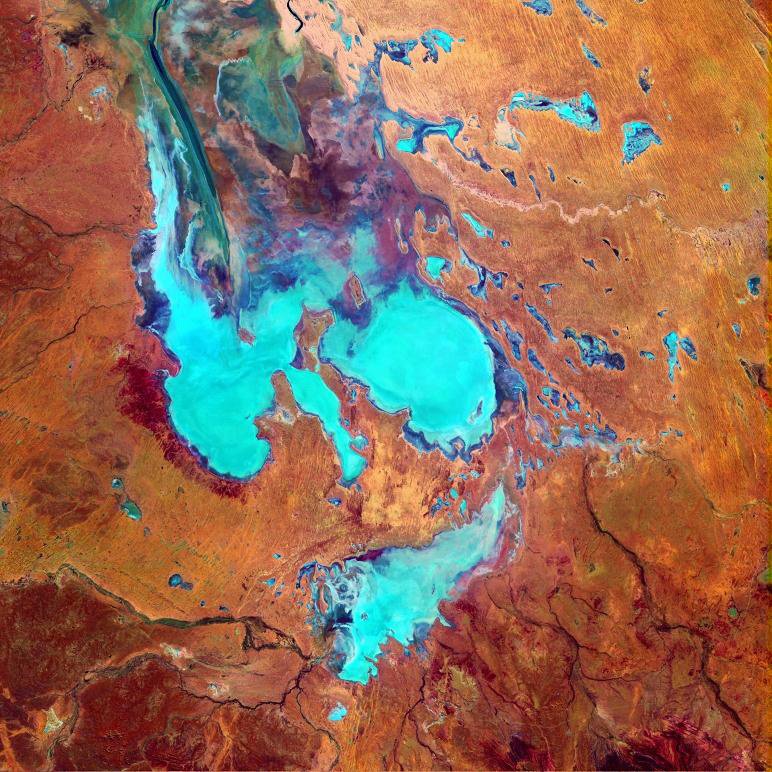
Lake Eyre (/ɛər/ AIR), officially known as Kati Thanda–Lake Eyre, is an endorheic lake in the east-central part of the Far North region of South Australia, some 700 km (435 mi) north of Adelaide. It is the largest ephemeral endorheic lake on the Australian continent, covering over 9,000 km2 (3,500 sq mi). The shallow lake is the depocentre of the vast endorheic Lake Eyre basin, and contains the lowest natural point in Australia, at approximately 15 m (49 ft) below sea level. The lake is most often empty, filling partially mostly when flooding occurs upstream in Channel Country. On the rare occasions that it fills completely (only three times between 1860 and 2025), it is the largest lake in Australia, covering an area of up to 9,500 km2 (3,668 sq mi). When the lake is full, it has the same salinity as seawater, but becomes hypersaline as the lake dries up and the water evaporates. To the north of the lake is the Simpson Desert.
The lake was named in honour of Edward John Eyre, the first European to see it in 1840. It was officially renamed in December 2012 to include its Aboriginal Arabana name, Kati Thanda,[further explanation needed] in accordance with a policy of dual naming. The native title over most of the lake and surrounding region is held by the Arabana people, with the eastern portion allocated to the Dieri people.
The lake is one of the most important sites for waterbirds in Australia, and was the location of several attempts at creating a land speed record in the 1960s.
The lake lies mostly within the traditional lands of the Arabana people, for whom it holds deep spiritual significance in their Dreaming stories. The Dieri people have long ties to the eastern portion of the lake.
In the 1860s, explorer Peter Egerton-Warburton wrote that the lake was dry, and "terrible in its death-like stillness and the vast expanse of its unbroken sterility". British geologist John Walter Gregory wrote in his 1906 book on central Australia that while the lake was sometimes described as "a fertile land of lakes", others called it a "desert of the worst type". He recognised its importance in the natural science of the continent: "For Lake Eyre, with its coasts and estuaries, was once the living heart of Australia".
Kati Thanda–Lake Eyre has been a site for various land speed record attempts on its salt flats, similar to those found in the Bonneville Salt Flats, especially those by Donald Campbell with the Bluebird-Proteus CN7, in 1963 and 1964.
On 17 July 1964 in the CN7 on the Lake Eyre salt flats, Campbell set a land speed record of 403.10 mph (648.73 km/h) for a four-wheeled vehicle (Class A). Campbell was disappointed with the record speed, as the vehicle had been designed for 500 mph (800 km/h).
The lake was named by early colonists in South Australia in honour of Edward John Eyre, the first European to see it in 1840. It was officially renamed in December 2012 to include its Aboriginal name, Kati Thanda, in accordance with a policy of dual naming.
Hub AI
Lake Eyre AI simulator
(@Lake Eyre_simulator)
Lake Eyre
Lake Eyre (/ɛər/ AIR), officially known as Kati Thanda–Lake Eyre, is an endorheic lake in the east-central part of the Far North region of South Australia, some 700 km (435 mi) north of Adelaide. It is the largest ephemeral endorheic lake on the Australian continent, covering over 9,000 km2 (3,500 sq mi). The shallow lake is the depocentre of the vast endorheic Lake Eyre basin, and contains the lowest natural point in Australia, at approximately 15 m (49 ft) below sea level. The lake is most often empty, filling partially mostly when flooding occurs upstream in Channel Country. On the rare occasions that it fills completely (only three times between 1860 and 2025), it is the largest lake in Australia, covering an area of up to 9,500 km2 (3,668 sq mi). When the lake is full, it has the same salinity as seawater, but becomes hypersaline as the lake dries up and the water evaporates. To the north of the lake is the Simpson Desert.
The lake was named in honour of Edward John Eyre, the first European to see it in 1840. It was officially renamed in December 2012 to include its Aboriginal Arabana name, Kati Thanda,[further explanation needed] in accordance with a policy of dual naming. The native title over most of the lake and surrounding region is held by the Arabana people, with the eastern portion allocated to the Dieri people.
The lake is one of the most important sites for waterbirds in Australia, and was the location of several attempts at creating a land speed record in the 1960s.
The lake lies mostly within the traditional lands of the Arabana people, for whom it holds deep spiritual significance in their Dreaming stories. The Dieri people have long ties to the eastern portion of the lake.
In the 1860s, explorer Peter Egerton-Warburton wrote that the lake was dry, and "terrible in its death-like stillness and the vast expanse of its unbroken sterility". British geologist John Walter Gregory wrote in his 1906 book on central Australia that while the lake was sometimes described as "a fertile land of lakes", others called it a "desert of the worst type". He recognised its importance in the natural science of the continent: "For Lake Eyre, with its coasts and estuaries, was once the living heart of Australia".
Kati Thanda–Lake Eyre has been a site for various land speed record attempts on its salt flats, similar to those found in the Bonneville Salt Flats, especially those by Donald Campbell with the Bluebird-Proteus CN7, in 1963 and 1964.
On 17 July 1964 in the CN7 on the Lake Eyre salt flats, Campbell set a land speed record of 403.10 mph (648.73 km/h) for a four-wheeled vehicle (Class A). Campbell was disappointed with the record speed, as the vehicle had been designed for 500 mph (800 km/h).
The lake was named by early colonists in South Australia in honour of Edward John Eyre, the first European to see it in 1840. It was officially renamed in December 2012 to include its Aboriginal name, Kati Thanda, in accordance with a policy of dual naming.
Recent media