


Community hub
Recent from talks
Contribute something to knowledge base
Content stats: 0 posts, 0 articles, 1 media, 0 notes
Members stats: 0 subscribers, 0 contributors, 0 moderators, 0 supporters
Subscribers
Supporters
Contributors
Moderators
Hub AI
Lake Van AI simulator
(@Lake Van_simulator)
Hub AI
Lake Van AI simulator
(@Lake Van_simulator)
Lake Van
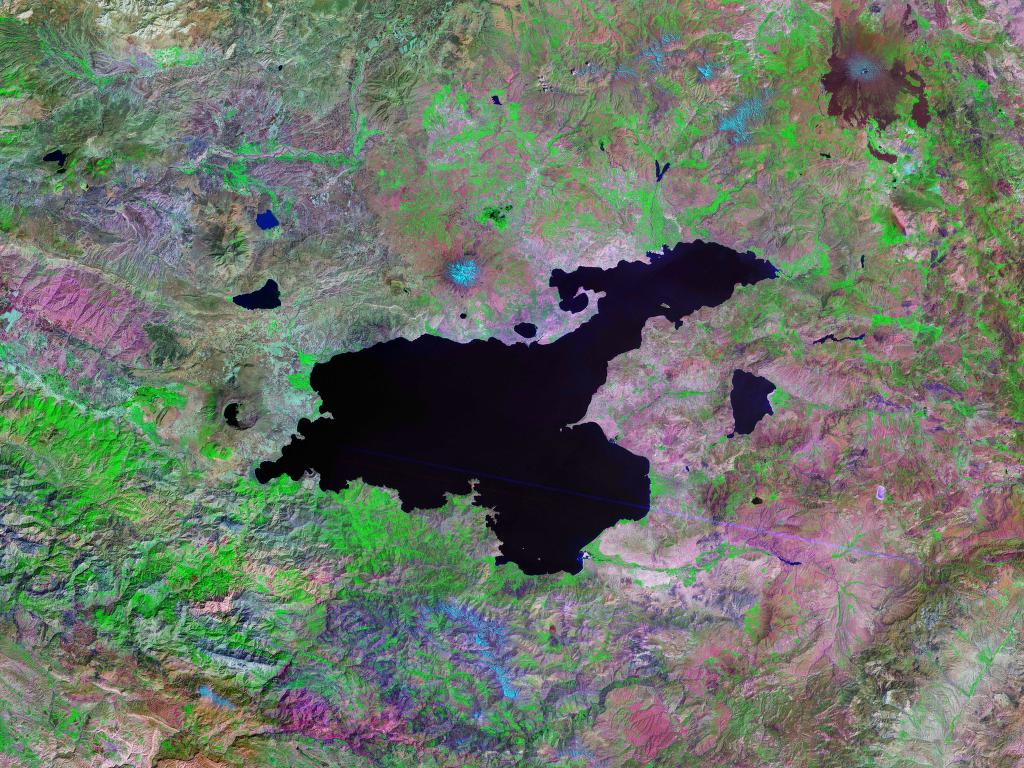
Lake Van (Turkish: Van Gölü; Armenian: Վանա լիճ, romanized: Vana lič̣; Kurdish: Gola Wanê) is the largest lake in Turkey. It lies in the Eastern Anatolia region of Turkey in the provinces of Van and Bitlis, in the Armenian highlands. It is a saline soda lake, receiving water from many small streams that descend from the surrounding mountains. It is one of the world's few endorheic lakes (a lake having no outlet) of size greater than 3,000 square kilometres (1,200 sq mi) and has 38% of the country's surface water (including rivers). A volcanic eruption blocked its original outlet in prehistoric times. It is situated at 1,640 m (5,380 ft) above sea level. Despite the high altitude and winter averages below 0 °C (32 °F), high salinity usually prevents it from freezing; the shallow northern section can freeze, but rarely.
Lake Van is 119 kilometres (74 mi) across at its widest point. It averages 171 metres (561 ft) deep. Its greatest known depth is 451 metres (1,480 ft). The surface lies 1,640 metres (5,380 ft) above sea level and the shore length is 430 kilometres (270 mi). It covers 3,755 km2 (1,450 sq mi) and contains (has a volume of) 607 cubic kilometres (146 cu mi).
The western portion of the lake is deepest, with a large basin deeper than 400 m (1,300 ft) lying northeast of Tatvan and south of Ahlat. The eastern arms of the lake are shallower. The Van-Ahtamar portion shelves gradually, with a maximum depth of about 250 m (820 ft) on its northwest side where it joins the rest of the lake. The Erciş arm is much shallower, mostly less than 50 m (160 ft), with a maximum depth of about 150 m (490 ft).
The lake water is strongly alkaline (pH 9.7–9.8) and rich in sodium carbonate and other salts. Some is extracted in salt evaporation ponds alongside, used in or as detergents.
Lake Van is primarily a tectonic lake, formed more than 600,000 years ago by the gradual subsidence of a large block of the Earth's crust due to movement on several major faults that run through this portion of Eastern Anatolia. The lake's southern margin demarcates: a metamorphic rock zone of the Bitlis Massif and volcanic strata of the Neogene and Quaternary periods. The deep, western portion of the lake is an antidome basin in a tectonic depression. This was formed by normal and strike-slip faulting and thrusting.
The lake's proximity to the Karlıova triple junction has led to molten fluids of the Earth's mantle accumulating in the strata beneath, still driving gradual change. Dominating the lake's northern shore is the stratovolcano Mount Süphan. The broad crater of a second, dormant volcano, Mount Nemrut, is close to the western tip of the lake. There is hydrothermal activity throughout the region.
For much of its history, until the Pleistocene, Lake Van has had an outlet towards the southwest (into the Murat River and eventually into the Euphrates river). However, the level of this threshold has varied over time, as the lake has been blocked by successive lava flows from Nemrut volcano westward towards the Muş Plain. This threshold has then been lowered at times by erosion.
The first acoustic survey of Lake Van was performed in 1974.
Lake Van
Lake Van (Turkish: Van Gölü; Armenian: Վանա լիճ, romanized: Vana lič̣; Kurdish: Gola Wanê) is the largest lake in Turkey. It lies in the Eastern Anatolia region of Turkey in the provinces of Van and Bitlis, in the Armenian highlands. It is a saline soda lake, receiving water from many small streams that descend from the surrounding mountains. It is one of the world's few endorheic lakes (a lake having no outlet) of size greater than 3,000 square kilometres (1,200 sq mi) and has 38% of the country's surface water (including rivers). A volcanic eruption blocked its original outlet in prehistoric times. It is situated at 1,640 m (5,380 ft) above sea level. Despite the high altitude and winter averages below 0 °C (32 °F), high salinity usually prevents it from freezing; the shallow northern section can freeze, but rarely.
Lake Van is 119 kilometres (74 mi) across at its widest point. It averages 171 metres (561 ft) deep. Its greatest known depth is 451 metres (1,480 ft). The surface lies 1,640 metres (5,380 ft) above sea level and the shore length is 430 kilometres (270 mi). It covers 3,755 km2 (1,450 sq mi) and contains (has a volume of) 607 cubic kilometres (146 cu mi).
The western portion of the lake is deepest, with a large basin deeper than 400 m (1,300 ft) lying northeast of Tatvan and south of Ahlat. The eastern arms of the lake are shallower. The Van-Ahtamar portion shelves gradually, with a maximum depth of about 250 m (820 ft) on its northwest side where it joins the rest of the lake. The Erciş arm is much shallower, mostly less than 50 m (160 ft), with a maximum depth of about 150 m (490 ft).
The lake water is strongly alkaline (pH 9.7–9.8) and rich in sodium carbonate and other salts. Some is extracted in salt evaporation ponds alongside, used in or as detergents.
Lake Van is primarily a tectonic lake, formed more than 600,000 years ago by the gradual subsidence of a large block of the Earth's crust due to movement on several major faults that run through this portion of Eastern Anatolia. The lake's southern margin demarcates: a metamorphic rock zone of the Bitlis Massif and volcanic strata of the Neogene and Quaternary periods. The deep, western portion of the lake is an antidome basin in a tectonic depression. This was formed by normal and strike-slip faulting and thrusting.
The lake's proximity to the Karlıova triple junction has led to molten fluids of the Earth's mantle accumulating in the strata beneath, still driving gradual change. Dominating the lake's northern shore is the stratovolcano Mount Süphan. The broad crater of a second, dormant volcano, Mount Nemrut, is close to the western tip of the lake. There is hydrothermal activity throughout the region.
For much of its history, until the Pleistocene, Lake Van has had an outlet towards the southwest (into the Murat River and eventually into the Euphrates river). However, the level of this threshold has varied over time, as the lake has been blocked by successive lava flows from Nemrut volcano westward towards the Muş Plain. This threshold has then been lowered at times by erosion.
The first acoustic survey of Lake Van was performed in 1974.
Recent media
Recent media