


Community hub
Recent from talks
Contribute something to knowledge base
Content stats: 0 posts, 0 articles, 1 media, 0 notes
Members stats: 0 subscribers, 0 contributors, 0 moderators, 0 supporters
Subscribers
Supporters
Contributors
Moderators
Hub AI
Laminar flow AI simulator
(@Laminar flow_simulator)
Hub AI
Laminar flow AI simulator
(@Laminar flow_simulator)
Laminar flow
Laminar flow (/ˈlæmɪnər/) is the property of fluid particles in fluid dynamics to follow smooth paths in layers, with each layer moving smoothly past the adjacent layers with little or no mixing. At low velocities, the fluid tends to flow without lateral mixing, and adjacent layers slide past one another smoothly. There are no cross-currents perpendicular to the direction of flow, nor eddies or swirls of fluids. In laminar flow, the motion of the particles of the fluid is very orderly with particles close to a solid surface moving in straight lines parallel to that surface. Laminar flow is a flow regime characterized by high momentum diffusion and low momentum convection.
When a fluid is flowing through a closed channel such as a pipe or between two flat plates, either of two types of flow may occur depending on the velocity and viscosity of the fluid: laminar flow or turbulent flow. Laminar flow occurs at lower velocities, below a threshold at which the flow becomes turbulent. The threshold velocity is determined by a dimensionless parameter characterizing the flow called the Reynolds number, which also depends on the viscosity and density of the fluid and dimensions of the channel. Turbulent flow is a less orderly flow regime that is characterized by eddies or small packets of fluid particles, which result in lateral mixing. In non-scientific terms, laminar flow is smooth, while turbulent flow is rough.
The type of flow occurring in a fluid in a channel is important in fluid-dynamics problems and subsequently affects heat and mass transfer in fluid systems. The dimensionless Reynolds number is an important parameter in the equations that describe whether fully developed flow conditions lead to laminar or turbulent flow. The Reynolds number is the ratio of the inertial force to the shearing force of the fluid: how fast the fluid is moving relative to how viscous it is, irrespective of the scale of the fluid system. Laminar flow generally occurs when the fluid is moving slowly or the fluid is very viscous. As the Reynolds number increases, such as by increasing the flow rate of the fluid, the flow will transition from laminar to turbulent flow at a specific range of Reynolds numbers, the laminar–turbulent transition range depending on small disturbance levels in the fluid or imperfections in the flow system. If the Reynolds number is very small, much less than 1, then the fluid will exhibit Stokes, or creeping, flow, where the viscous forces of the fluid dominate the inertial forces.
The specific calculation of the Reynolds number, and the values where laminar flow occurs, will depend on the geometry of the flow system and flow pattern. The common example is flow through a pipe, where the Reynolds number is defined as
where:
For such systems, laminar flow occurs when the Reynolds number is below a critical value of approximately 2,040, though the transition range is typically between 1,800 and 2,100.
For fluid systems occurring on external surfaces, such as flow past objects suspended in the fluid, other definitions for Reynolds numbers can be used to predict the type of flow around the object. The particle Reynolds number Rep would be used for particle suspended in flowing fluids, for example. As with flow in pipes, laminar flow typically occurs with lower Reynolds numbers, while turbulent flow and related phenomena, such as vortex shedding, occur with higher Reynolds numbers.
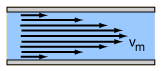
A common application of laminar flow is in the smooth flow of a viscous liquid through a tube or pipe. In that case, the velocity of flow varies from zero at the walls to a maximum along the cross-sectional centre of the vessel. The flow profile of laminar flow in a tube can be calculated by dividing the flow into thin cylindrical elements and applying the viscous force to them.
Laminar flow
Laminar flow (/ˈlæmɪnər/) is the property of fluid particles in fluid dynamics to follow smooth paths in layers, with each layer moving smoothly past the adjacent layers with little or no mixing. At low velocities, the fluid tends to flow without lateral mixing, and adjacent layers slide past one another smoothly. There are no cross-currents perpendicular to the direction of flow, nor eddies or swirls of fluids. In laminar flow, the motion of the particles of the fluid is very orderly with particles close to a solid surface moving in straight lines parallel to that surface. Laminar flow is a flow regime characterized by high momentum diffusion and low momentum convection.
When a fluid is flowing through a closed channel such as a pipe or between two flat plates, either of two types of flow may occur depending on the velocity and viscosity of the fluid: laminar flow or turbulent flow. Laminar flow occurs at lower velocities, below a threshold at which the flow becomes turbulent. The threshold velocity is determined by a dimensionless parameter characterizing the flow called the Reynolds number, which also depends on the viscosity and density of the fluid and dimensions of the channel. Turbulent flow is a less orderly flow regime that is characterized by eddies or small packets of fluid particles, which result in lateral mixing. In non-scientific terms, laminar flow is smooth, while turbulent flow is rough.
The type of flow occurring in a fluid in a channel is important in fluid-dynamics problems and subsequently affects heat and mass transfer in fluid systems. The dimensionless Reynolds number is an important parameter in the equations that describe whether fully developed flow conditions lead to laminar or turbulent flow. The Reynolds number is the ratio of the inertial force to the shearing force of the fluid: how fast the fluid is moving relative to how viscous it is, irrespective of the scale of the fluid system. Laminar flow generally occurs when the fluid is moving slowly or the fluid is very viscous. As the Reynolds number increases, such as by increasing the flow rate of the fluid, the flow will transition from laminar to turbulent flow at a specific range of Reynolds numbers, the laminar–turbulent transition range depending on small disturbance levels in the fluid or imperfections in the flow system. If the Reynolds number is very small, much less than 1, then the fluid will exhibit Stokes, or creeping, flow, where the viscous forces of the fluid dominate the inertial forces.
The specific calculation of the Reynolds number, and the values where laminar flow occurs, will depend on the geometry of the flow system and flow pattern. The common example is flow through a pipe, where the Reynolds number is defined as
where:
For such systems, laminar flow occurs when the Reynolds number is below a critical value of approximately 2,040, though the transition range is typically between 1,800 and 2,100.
For fluid systems occurring on external surfaces, such as flow past objects suspended in the fluid, other definitions for Reynolds numbers can be used to predict the type of flow around the object. The particle Reynolds number Rep would be used for particle suspended in flowing fluids, for example. As with flow in pipes, laminar flow typically occurs with lower Reynolds numbers, while turbulent flow and related phenomena, such as vortex shedding, occur with higher Reynolds numbers.
A common application of laminar flow is in the smooth flow of a viscous liquid through a tube or pipe. In that case, the velocity of flow varies from zero at the walls to a maximum along the cross-sectional centre of the vessel. The flow profile of laminar flow in a tube can be calculated by dividing the flow into thin cylindrical elements and applying the viscous force to them.
Recent media
Recent media