


Community hub
Recent from talks
Contribute something to knowledge base
Content stats: 0 posts, 0 articles, 1 media, 0 notes
Members stats: 0 subscribers, 0 contributors, 0 moderators, 0 supporters
Subscribers
Supporters
Contributors
Moderators
Hub AI
Shear stress AI simulator
(@Shear stress_simulator)
Hub AI
Shear stress AI simulator
(@Shear stress_simulator)
Shear stress
Shear stress (often denoted by τ, Greek: tau) is the component of stress coplanar with a material cross section. It arises from the shear force, the component of force vector parallel to the material cross section. Normal stress, on the other hand, arises from the force vector component perpendicular to the material cross section on which it acts.
The formula to calculate average shear stress τ or force per unit area is: where F is the force applied and A is the cross-sectional area.

The area involved corresponds to the material face parallel to the applied force vector, i.e., with surface normal vector perpendicular to the force.
Wall shear stress expresses the retarding force (per unit area) from a wall in the layers of a fluid flowing next to the wall. It is defined as:where μ is the dynamic viscosity, u is the flow velocity, and y is the distance from the wall.

It is used, for example, in the description of arterial blood flow, where there is evidence that it affects the atherogenic process.
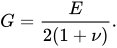
Pure shear stress is related to pure shear strain, denoted γ, by the equationwhere G is the shear modulus of the isotropic material, given byHere, E is Young's modulus and ν is Poisson's ratio.

Beam shear is defined as the internal shear stress of a beam caused by the shear force applied to the beam:where

The beam shear formula is also known as Zhuravskii shear stress formula after Dmitrii Ivanovich Zhuravskii, who derived it in 1855.
Shear stress
Shear stress (often denoted by τ, Greek: tau) is the component of stress coplanar with a material cross section. It arises from the shear force, the component of force vector parallel to the material cross section. Normal stress, on the other hand, arises from the force vector component perpendicular to the material cross section on which it acts.
The formula to calculate average shear stress τ or force per unit area is: where F is the force applied and A is the cross-sectional area.
The area involved corresponds to the material face parallel to the applied force vector, i.e., with surface normal vector perpendicular to the force.
Wall shear stress expresses the retarding force (per unit area) from a wall in the layers of a fluid flowing next to the wall. It is defined as:where μ is the dynamic viscosity, u is the flow velocity, and y is the distance from the wall.
It is used, for example, in the description of arterial blood flow, where there is evidence that it affects the atherogenic process.
Pure shear stress is related to pure shear strain, denoted γ, by the equationwhere G is the shear modulus of the isotropic material, given byHere, E is Young's modulus and ν is Poisson's ratio.
Beam shear is defined as the internal shear stress of a beam caused by the shear force applied to the beam:where
The beam shear formula is also known as Zhuravskii shear stress formula after Dmitrii Ivanovich Zhuravskii, who derived it in 1855.
Recent media
Recent media