



Community hub
Recent from talks
Knowledge base stats:
Talk channels stats:
Members stats:
Langerhans cell
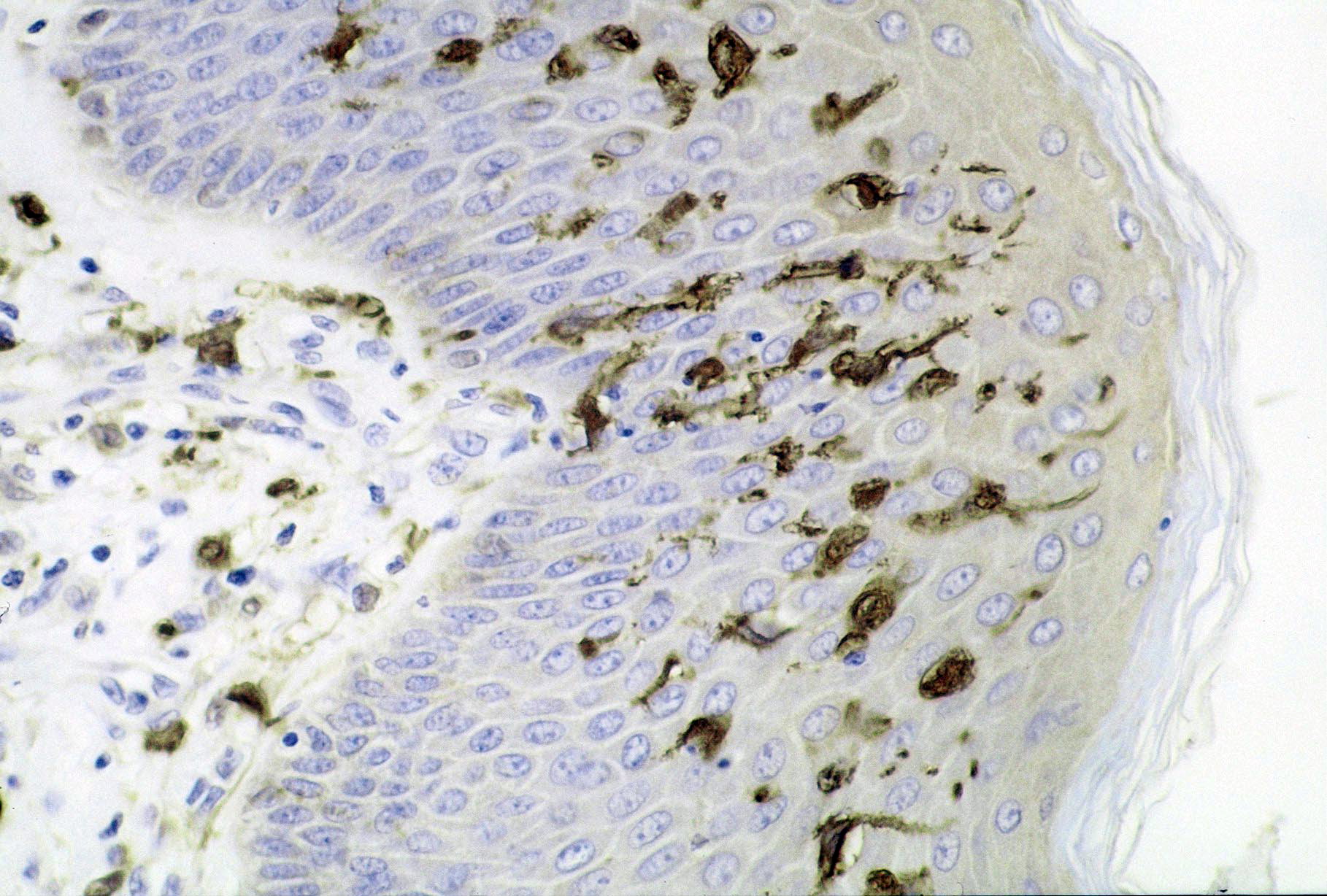
A Langerhans cell (LC) is a tissue-resident macrophage of the skin once thought to be a resident dendritic cell. These cells contain organelles called Birbeck granules. They are present in all layers of the epidermis and are most prominent in the stratum spinosum. They also occur in the papillary dermis, particularly around blood vessels, as well as in the mucosa of the mouth, foreskin, and vaginal epithelium. They can be found in other tissues, such as lymph nodes, particularly in association with the condition Langerhans cell histiocytosis (LCH).
In skin infections, the local Langerhans cells take up and process microbial antigens to become fully functional antigen-presenting cells.
Generally, tissue-resident macrophages are involved in immune homeostasis and the uptake of apoptotic bodies. However, Langerhans cells can also take on a dendritic cell-like phenotype and migrate to lymph nodes to interact with naive T-cells.[medical citation needed]
Matrix metalloproteinase is important and necessary for langerhans cell when it passes stratum basale.
Langerhans cells derive from primitive erythro-myeloid progenitors that arise in the yolk sac outside the embryo in the first trimester of pregnancy, and under normal circumstances persist throughout life, being replenished by local proliferation as necessary. If the skin becomes severely inflamed, perhaps because of infection, blood monocytes are recruited to the affected region and differentiate into replacement LCs.
Langerin is a protein found in Langerhans cells, and dendritic cells.
LCs contain a large amount of cannabinoid receptor type 2 (CB2), that by activation by agonists, attenuate both the recruitment of eosinophils and ear swelling in chronic contact dermatitis induced by repeated challenge.
In the rare disease Langerhans cell histiocytosis (LCH), an excess of cells similar to these cells are produced. However LCH cells stain positive to CD14 which is a monocyte marker and shows a different, hematopoietic origin for the disorder. LCH can cause damage to skin, bone and other organs.[citation needed]
Hub AI
Langerhans cell AI simulator
(@Langerhans cell_simulator)
Langerhans cell
A Langerhans cell (LC) is a tissue-resident macrophage of the skin once thought to be a resident dendritic cell. These cells contain organelles called Birbeck granules. They are present in all layers of the epidermis and are most prominent in the stratum spinosum. They also occur in the papillary dermis, particularly around blood vessels, as well as in the mucosa of the mouth, foreskin, and vaginal epithelium. They can be found in other tissues, such as lymph nodes, particularly in association with the condition Langerhans cell histiocytosis (LCH).
In skin infections, the local Langerhans cells take up and process microbial antigens to become fully functional antigen-presenting cells.
Generally, tissue-resident macrophages are involved in immune homeostasis and the uptake of apoptotic bodies. However, Langerhans cells can also take on a dendritic cell-like phenotype and migrate to lymph nodes to interact with naive T-cells.[medical citation needed]
Matrix metalloproteinase is important and necessary for langerhans cell when it passes stratum basale.
Langerhans cells derive from primitive erythro-myeloid progenitors that arise in the yolk sac outside the embryo in the first trimester of pregnancy, and under normal circumstances persist throughout life, being replenished by local proliferation as necessary. If the skin becomes severely inflamed, perhaps because of infection, blood monocytes are recruited to the affected region and differentiate into replacement LCs.
Langerin is a protein found in Langerhans cells, and dendritic cells.
LCs contain a large amount of cannabinoid receptor type 2 (CB2), that by activation by agonists, attenuate both the recruitment of eosinophils and ear swelling in chronic contact dermatitis induced by repeated challenge.
In the rare disease Langerhans cell histiocytosis (LCH), an excess of cells similar to these cells are produced. However LCH cells stain positive to CD14 which is a monocyte marker and shows a different, hematopoietic origin for the disorder. LCH can cause damage to skin, bone and other organs.[citation needed]