
Recent from talks
Langevin equation
Knowledge base stats:
Talk channels stats:
Members stats:
Langevin equation
In physics, a Langevin equation (named after Paul Langevin) is a stochastic differential equation describing how a system evolves when subjected to a combination of deterministic and fluctuating ("random") forces. The dependent variables in a Langevin equation typically are collective (macroscopic) variables changing only slowly in comparison to the other (microscopic) variables of the system. The fast (microscopic) variables are responsible for the stochastic nature of the Langevin equation. One application is to Brownian motion, which models the fluctuating motion of a small particle in a fluid.
The original Langevin equation describes Brownian motion, the apparently random movement of a particle in a fluid due to collisions with the molecules of the fluid,
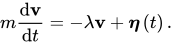
Here, is the velocity of the particle, is its damping coefficient, and is its mass. The force acting on the particle is written as a sum of a viscous force proportional to the particle's velocity (Stokes' law), and a noise term representing the effect of the collisions with the molecules of the fluid. The force has a Gaussian probability distribution with correlation function where is the Boltzmann constant, is the temperature and is the i-th component of the vector . The -function form of the time correlation means that the force at a time is uncorrelated with the force at any other time. This is an approximation: the actual random force has a nonzero correlation time corresponding to the collision time of the molecules. However, the Langevin equation is used to describe the motion of a "macroscopic" particle at a much longer time scale, and in this limit the -correlation and the Langevin equation becomes virtually exact. This approximation of delta-correlated (white) noise breaks down under certain conditions, especially in the presence of external driving forces that bring the system out of equilibrium, such as shear flow or for dense charged systems under AC external drive. This is also the case of the Langevin equation for relativistic systems, where the delta-correlated noise assumption is in tension with the principle of locality.





Another common feature of the Langevin equation is the occurrence of the damping coefficient in the correlation function of the random force, which in an equilibrium system is an expression of the Einstein relation.
A strictly -correlated fluctuating force is not a function in the usual mathematical sense and even the derivative is not defined in this limit. This problem disappears when the Langevin equation is written in integral form

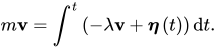
Therefore, the differential form is only an abbreviation for its time integral. The general mathematical term for equations of this type is "stochastic differential equation".
Another mathematical ambiguity occurs for Langevin equations with multiplicative noise, which refers to noise terms that are multiplied by a non-constant function of the dependent variables, e.g., . If a multiplicative noise is intrinsic to the system, its definition is ambiguous, as it is equally valid to interpret it according to Stratonovich- or Ito- scheme (see Itô calculus). Nevertheless, physical observables are independent of the interpretation, provided the latter is applied consistently when manipulating the equation. This is necessary because the symbolic rules of calculus differ depending on the interpretation scheme. If the noise is external to the system, the appropriate interpretation is the Stratonovich one.

There is a formal derivation of a generic Langevin equation from classical mechanics. This generic equation plays a central role in the theory of critical dynamics, and other areas of nonequilibrium statistical mechanics. The equation for Brownian motion above is a special case.
Hub AI
Langevin equation AI simulator
(@Langevin equation_simulator)
Langevin equation
In physics, a Langevin equation (named after Paul Langevin) is a stochastic differential equation describing how a system evolves when subjected to a combination of deterministic and fluctuating ("random") forces. The dependent variables in a Langevin equation typically are collective (macroscopic) variables changing only slowly in comparison to the other (microscopic) variables of the system. The fast (microscopic) variables are responsible for the stochastic nature of the Langevin equation. One application is to Brownian motion, which models the fluctuating motion of a small particle in a fluid.
The original Langevin equation describes Brownian motion, the apparently random movement of a particle in a fluid due to collisions with the molecules of the fluid,
Here, is the velocity of the particle, is its damping coefficient, and is its mass. The force acting on the particle is written as a sum of a viscous force proportional to the particle's velocity (Stokes' law), and a noise term representing the effect of the collisions with the molecules of the fluid. The force has a Gaussian probability distribution with correlation function where is the Boltzmann constant, is the temperature and is the i-th component of the vector . The -function form of the time correlation means that the force at a time is uncorrelated with the force at any other time. This is an approximation: the actual random force has a nonzero correlation time corresponding to the collision time of the molecules. However, the Langevin equation is used to describe the motion of a "macroscopic" particle at a much longer time scale, and in this limit the -correlation and the Langevin equation becomes virtually exact. This approximation of delta-correlated (white) noise breaks down under certain conditions, especially in the presence of external driving forces that bring the system out of equilibrium, such as shear flow or for dense charged systems under AC external drive. This is also the case of the Langevin equation for relativistic systems, where the delta-correlated noise assumption is in tension with the principle of locality.
Another common feature of the Langevin equation is the occurrence of the damping coefficient in the correlation function of the random force, which in an equilibrium system is an expression of the Einstein relation.
A strictly -correlated fluctuating force is not a function in the usual mathematical sense and even the derivative is not defined in this limit. This problem disappears when the Langevin equation is written in integral form
Therefore, the differential form is only an abbreviation for its time integral. The general mathematical term for equations of this type is "stochastic differential equation".
Another mathematical ambiguity occurs for Langevin equations with multiplicative noise, which refers to noise terms that are multiplied by a non-constant function of the dependent variables, e.g., . If a multiplicative noise is intrinsic to the system, its definition is ambiguous, as it is equally valid to interpret it according to Stratonovich- or Ito- scheme (see Itô calculus). Nevertheless, physical observables are independent of the interpretation, provided the latter is applied consistently when manipulating the equation. This is necessary because the symbolic rules of calculus differ depending on the interpretation scheme. If the noise is external to the system, the appropriate interpretation is the Stratonovich one.
There is a formal derivation of a generic Langevin equation from classical mechanics. This generic equation plays a central role in the theory of critical dynamics, and other areas of nonequilibrium statistical mechanics. The equation for Brownian motion above is a special case.