


Community hub
0 subscribers8 pages, 0 posts
Recent from talks
All channels
Be the first to start a discussion here.
Be the first to start a discussion here.
Be the first to start a discussion here.
Be the first to start a discussion here.
Contribute something
Welcome to the community hub built to collect knowledge and have discussions related to Langres cheese.
Nothing was collected or created yet.
Langres cheese
View on Wikipediafrom Wikipedia
Not found
Langres cheese
View on Grokipediafrom Grokipedia
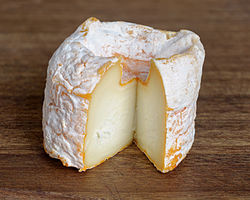
Langres is a soft cheese with a washed rind made exclusively from cow's milk, originating from the Langres plateau in the Haute-Marne department of northeastern France, where all stages of its production occur within a defined geographical area spanning parts of the Bassigny pastures and the plateau itself.[1] Characterized by its cylindrical to slightly conical shape—available in three sizes: small (70–80 mm diameter), medium (90–100 mm), and large (160–200 mm), typically weighing 180–250 g—with a distinctive top depression called the fontaine or cuvette at least 5 mm deep, it features a rind that ranges from light yellow to reddish-brown after maturation, enclosing a creamy, ivory-white paste.[2] Protected by the Appellation d'Origine Protégée (AOP, or PDO in English) designation since 1991, Langres must be crafted using milk from cows grazed on local pastures, with the cheese undergoing washing and ripening in humid cellars without being turned, resulting in its unique uneven top and flavors that evolve from mild and fruity in younger wheels to more pungent and complex notes of earth and nuts as it ages for 4 to 12 weeks or longer.[3]
The cheese's history traces back to the Middle Ages, with early mentions in the municipal accounts of Langres and records of feudal successions, reflecting its longstanding role in the region's culinary heritage between Champagne and Burgundy.[1] Traditionally produced on farms using warm milk poured into terracotta molds and dried on plane tree leaves, modern production adheres to strict AOP specifications, involving coagulation with animal rennet, cutting and molding the curd without pressing, salting, and repeated rind washing with a brine solution often tinted with annatto for its characteristic orange hue.[3] As of 2020, around 622 tons were marketed annually by 22 milk producers, one farmhouse operation, and two dairy facilities, underscoring Langres's status as a niche, artisanal product celebrated for its rich, savory profile and versatility in pairings with Champagne, Burgundy wines, or fresh baguette.[3]