
Recent from talks
Lanterloo
Knowledge base stats:
Talk channels stats:
Members stats:
Lanterloo
Lanterloo or loo is a 17th-century trick taking game of the trump family of which many varieties are recorded. It belongs to a line of card games including Nap and rams.
Under various spellings, like the French forms Lenterne, Lenturlu, Looterlu (meaning "fiddlesticks", a meaningless word equivalent to "Lullay", or "Lulloo", used in Lullabies), the game is supposed to have reached England from France most probably with the restoration of the monarchy in 1660. In France it was originally called Mouche ("Fly"), which was also the name of the five-card flush in that game and came to refer to the four-card flush in Lanterloo. Also called Langtrillo in its prime form and later simply Loo (also termed Lant in the north of England by 1860), most possibly for having evolved into a more elaborate form of play by the addition of new rules, it may also have been brought to England from Holland, where it was known as Lanterlu, Lanturlu or Lenterlui, or North Germany, where it was known as Lenter or Bester Bube. In 1678 a Dutch periodical records a list of games including Verquere, Karnöffel, Poch, Krimpen, Lansquenet, Triomphe, Piquet, La Bête "and that miserable Lanterlu which is in fashion."
Whichever way it was introduced to Britain, by the turn of the eighteenth century it was England's most popular card game. The rules of Lanterloo are listed by Charles Cotton in 1674 and subsequent editions of The Compleat Gamester, while a late 18th century description is given in Covent Garden Magazine. Loo was considered a great pastime by the idle rich of that time, but it acquired a very bad reputation as a potentially vicious "tavern" gambling game during the nineteenth century.
The Oxford English Dictionary quotes a 1685 reference to "Pam at Lanterloo", and William Chatto quotes a Dutch political pamphlet of about 1648 entitled Het herstelde Verkeer-bert verbetert in een Lanterluy-spel, containing a dialogue equating the game "Labate" (hence French Triomphe became La Bête, "The Beast", in Cotton's Complete Gamester, see also Labet) with "Lanterluy". This was the very first mention of the game. Chatto also cites a 1777 Cumberland ballad which recounts that "at lanter the caird-lakers sat i' the loft." Lanter or lant was three-card loo.
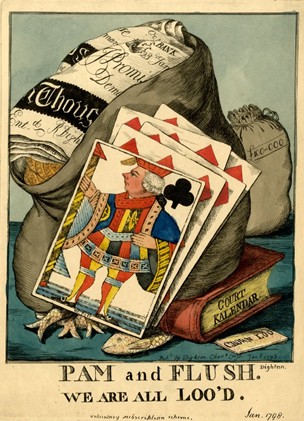
The name "Pam", denoting the in its full capacity as permanent top trump in five-card loo, represents an old medieval comic-erotic character called Pamphilus (Latin for a Greek word, meaning "beloved of all") or "Pamphile", in French, described as "an old bawd" by the New Zealand-born English lexicographer Eric Partridge.
In the North German game of Bester Bube, older rules also specify the Knave of Spades as the top trump, but by the mid-19th century, the commanding card is the trump Knave and the second highest trump is the Knave of the same colour, the Under-Knave.
The game is played by 3 to 8 players using a 52-card pack. The players play for tricks, and in each round they may pass or play. The main forms of the game are three-card loo, Irish loo and five-card loo. The turn to deal and play passes always to the left.
The pool is formed by dealer's contribution of five chips or counters. Each player is dealt five cards and the next turned for trump. Cards rank as at Whist, except that the knave of clubs, which is called Pam, is the highest trump. Each player's aim is to win at least one trick, under penalty of increasing the pool.
Hub AI
Lanterloo AI simulator
(@Lanterloo_simulator)
Lanterloo
Lanterloo or loo is a 17th-century trick taking game of the trump family of which many varieties are recorded. It belongs to a line of card games including Nap and rams.
Under various spellings, like the French forms Lenterne, Lenturlu, Looterlu (meaning "fiddlesticks", a meaningless word equivalent to "Lullay", or "Lulloo", used in Lullabies), the game is supposed to have reached England from France most probably with the restoration of the monarchy in 1660. In France it was originally called Mouche ("Fly"), which was also the name of the five-card flush in that game and came to refer to the four-card flush in Lanterloo. Also called Langtrillo in its prime form and later simply Loo (also termed Lant in the north of England by 1860), most possibly for having evolved into a more elaborate form of play by the addition of new rules, it may also have been brought to England from Holland, where it was known as Lanterlu, Lanturlu or Lenterlui, or North Germany, where it was known as Lenter or Bester Bube. In 1678 a Dutch periodical records a list of games including Verquere, Karnöffel, Poch, Krimpen, Lansquenet, Triomphe, Piquet, La Bête "and that miserable Lanterlu which is in fashion."
Whichever way it was introduced to Britain, by the turn of the eighteenth century it was England's most popular card game. The rules of Lanterloo are listed by Charles Cotton in 1674 and subsequent editions of The Compleat Gamester, while a late 18th century description is given in Covent Garden Magazine. Loo was considered a great pastime by the idle rich of that time, but it acquired a very bad reputation as a potentially vicious "tavern" gambling game during the nineteenth century.
The Oxford English Dictionary quotes a 1685 reference to "Pam at Lanterloo", and William Chatto quotes a Dutch political pamphlet of about 1648 entitled Het herstelde Verkeer-bert verbetert in een Lanterluy-spel, containing a dialogue equating the game "Labate" (hence French Triomphe became La Bête, "The Beast", in Cotton's Complete Gamester, see also Labet) with "Lanterluy". This was the very first mention of the game. Chatto also cites a 1777 Cumberland ballad which recounts that "at lanter the caird-lakers sat i' the loft." Lanter or lant was three-card loo.
The name "Pam", denoting the in its full capacity as permanent top trump in five-card loo, represents an old medieval comic-erotic character called Pamphilus (Latin for a Greek word, meaning "beloved of all") or "Pamphile", in French, described as "an old bawd" by the New Zealand-born English lexicographer Eric Partridge.
In the North German game of Bester Bube, older rules also specify the Knave of Spades as the top trump, but by the mid-19th century, the commanding card is the trump Knave and the second highest trump is the Knave of the same colour, the Under-Knave.
The game is played by 3 to 8 players using a 52-card pack. The players play for tricks, and in each round they may pass or play. The main forms of the game are three-card loo, Irish loo and five-card loo. The turn to deal and play passes always to the left.
The pool is formed by dealer's contribution of five chips or counters. Each player is dealt five cards and the next turned for trump. Cards rank as at Whist, except that the knave of clubs, which is called Pam, is the highest trump. Each player's aim is to win at least one trick, under penalty of increasing the pool.
Recent media