Hubbry Logo
PochPochMain
Open search
Poch
Community hub
Poch
logo
8 pages, 0 posts
0 subscribers
Be the first to start a discussion here.
Poch
Poch
from Wikipedia
Poch
Pochen, Pochspiel
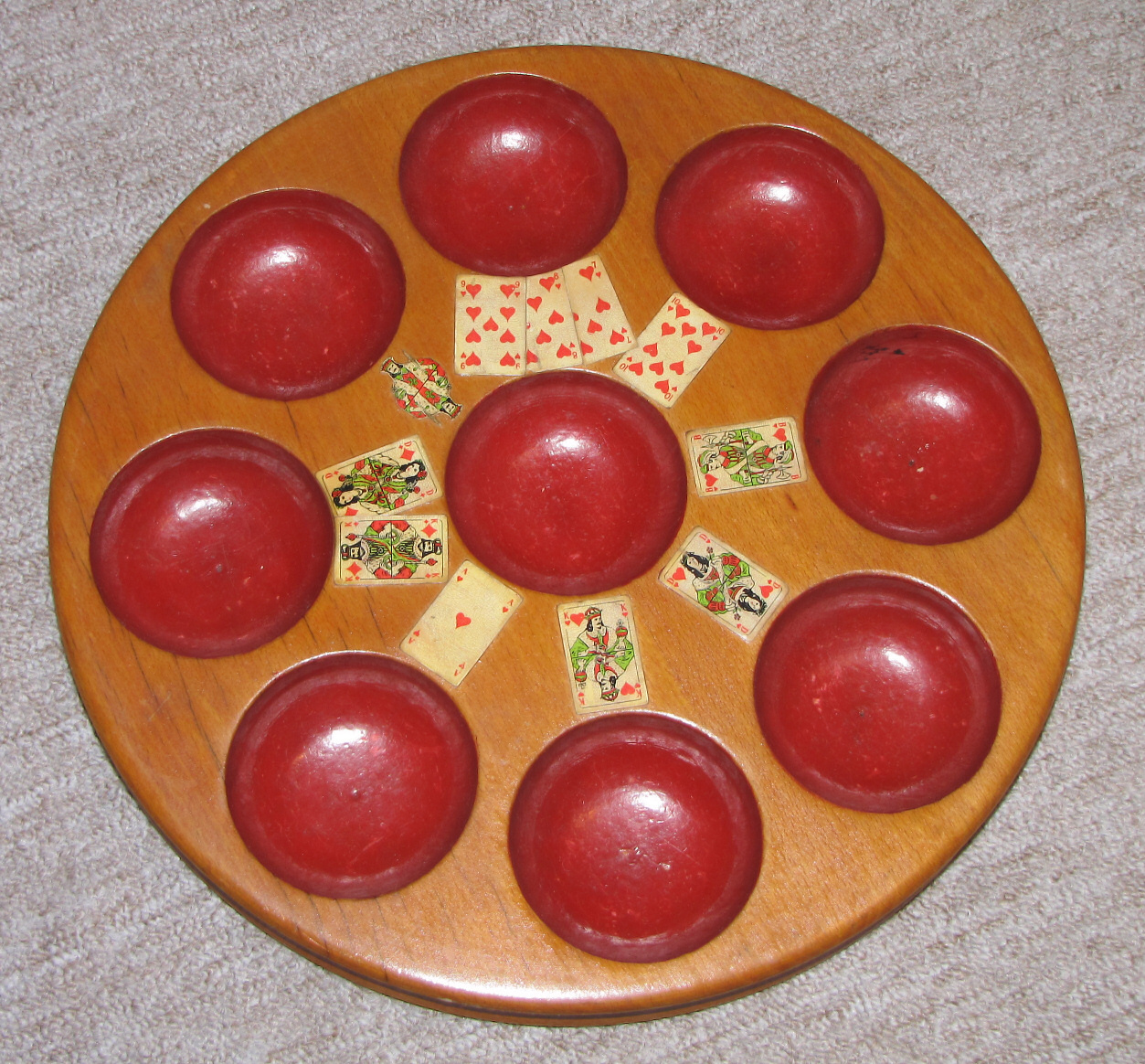
20th century Poch board (Pochbrett)
OriginGermany
Release dateBefore 1441
TypeMelding, vying and shedding
FamilyStops group
Players3–8
Skillscombinations, chance
Age range10+
Cards32 or 52
DeckFrench or German-suited pack
Rank (high→low)A K Q J 10 – 7 or 2
PlayAnticlockwise
Playing time10 min
Related games
Nain Jaune • Pope Joan

Poch, Pochen or Pochspiel (French: Poque) is a very old card game that is considered one of the forerunners of poker, a game that developed in America in the 19th century. An etymological relationship between the game names is also assumed.[1] Games related to Poch are the French Glic and Nain Jaune and the English Pope Joan.[2] Other forerunners of poker and possible relatives of the game are the English game, Brag, from the 16th century and the French Brelan (later Bouillotte) and Belle, Flux et Trente-et-Un. Poch is recorded as early as 1441 in Strasbourg.[3] In north Germany it was called by the Low German name of Puchen or Puchspill, and the board was a Puchbrett.[4]

Pochen is also another name for the card game Tippen or Dreiblatt.[5]

History

[edit]

A game called boeckels is attested as early as 1441 in a Strasbourg ordinance and surfaces periodically during the 15th century as bocken, usually in the context of being banned. It was mainly played in the south German states as well as Alsace and the Rhineland. By the 16th century the game had become well known enough to be featured in a 1519 satirical print of Emperor Charles V playing Bockspyl with an unnamed Turk and King Francis of France and for an anti-Luther pamphlet to be published called Bockspil. No detailed rules are known, but it is evidently a pure gambling game for any number of players.[6]

The oldest known board or Pochbrett is in the collections of the Bavarian National Museum and dates to the early 16th century. It is square in shape and has 7 rows of 6 cells each, marked out by white lines. The top row displays German-suited playing cards, probably of the Ansbach pattern. These cards, all in the suit of hearts, are the Deuce, King, Ober, Unter and Ten ("X") and there is also a column for Bock (Poch) depicted by a billy goat.[a] Other boards of that period were rectangular, often columnar, and with additional compartments for Sequenz (sequence), Braut (marriage) and Trio (run of 6-7-8).[6]

In 1619, in a letter, Dorothea, Sibylle, Duchess of Liegnitz and Brieg described how the young noblemen (Junkers) passed their time "riding, travelling, fighting, fencing and playing pranks... at night it's time to play Puchen and roll the dice until the day breaks." She adds that some women also played dice and Puchen "in secret". Koch explains that "Puchen" was a popular card game at that time, but no longer common [in the early 1800s]. The trumps were numbered as in Tarock and were called Puch. The one who led a Puch or trumped another card with one, knocked on the table. This may account for the custom among "common people today" of hitting the table during card games.[7]

The game of Poch went through its 'dark ages' from around 1620 to 1710 when neither references nor boards are recorded, but re-emerges in the early 18th century. This is also when the first octagonal boards appear. These were joined and eventually superseded by round boards in the 19th century. Over the centuries the number of compartments rose from the original six to the nine that are used today.

Pochen was not only popular in the German-speaking area of central Europe, but also appears to have spread to France.

Rules

[edit]

Poch was and is played in many variations with different details; its rules have changed over time and even the modern rules are not universal or binding like the rules of chess.

Pochen (19th century)

[edit]
19th-century Poch board layout (von Alvensleben)

The rules reproduced below are based on the description in Von Alvensleben (1853).[8] The board illustrated is of the earlier, rectangular type that date to at least the early 16th century.[9]

Overview

[edit]

The aim is to win counters by melding, vying (pochen) and shedding. Three to eight may play, but the game is best for three to six. Deal, vying and play are clockwise. Players required a 52-card French-suited pack and a staking board with eight pools.[8]

Preliminaries

[edit]

Each player antes 1 counter (Marke) to each of the following 7 rows or pools on the board: Ace, King, Queen, Jack, Ten, Marriage (K+Q) and Sequence (7-8-9). The eighth row, Poch, is used in stage 2. The player who draws the first Ace deals first. He has the cards cut by the player to the right, deals 5 cards each (3+2) and turns the next for trump.[8]

Part 1 – Melding

[edit]

Players show cards or combinations in the trump suit matching those on the board and collect the counters from the corresponding row. A player with the trump K+Q wins Marriage; the player with the highest run wins Sequence; if they are the same, a trump sequence wins; if they are the same and neither is in the trump suit, the player in forehand wins. A player with a Marriage or Sequence collects the counters for the individual cards as well as the combination. Counters not won are carried forward, added to in later deals until a player has that meld and clears the pool.[8]

Part 2 – Pochen

[edit]

Part 2 is a vying (pochen) stage where players may vie if they have a set of 2 or more cards of the same rank; otherwise must pass. Forehand begins and may pass or "knock!" (ich poche!) and place 1 or more counters in the Poch row. In turn players (a) pass, or (b) "hold" (ich halte!), placing a stake equal to that of the knocker, or (c) "knock higher" (ich poche nach!), i.e. raise, and add a higher stake. A player not willing to hold a raise, folds and forfeits his or her stake. Once no-one wants to raise further, those who held the last raise reveal the cards they are vying with and the player with the highest set wins.[8]

Part 3 – Shedding

[edit]

Forehand leads. Cards rank in natural order and players must follow suit, otherwise cannot play a card at all. The player who plays the highest card wins the trick and leads to the next trick. The first player to shed all cards is the winner and the game stops as soon as the winner plays his or her last card, even if the others can follow suit. The winner receives as many counters from each other player as they have cards in their hand.[8]

Poch (modern)

[edit]
Modern Poch board

The modern rules reproduced below are based on the description at pagat.com which, in turn, reflects the typical rules supplied with the game and in books. The board used is of the modern circular type with eight 'scoops' around the outside and one in the centre.[10]

Overview

[edit]

Poch is a family game for 3 to 6 people using a pack of 32 French or German-suited playing cards. If 5 or 6 play, a pack of 52 playing cards is recommended. Also needed is a Poch board (Pochbrett) with 9 compartments or pools into which are placed stakes for the Ace, King, Queen, Jack, Ten, Mariage (King + Queen), Sequence (7 + 8 + 9), Poch (Joker) and Pinke (centre pot, pronounced "pinker"). Deal, vying and play are clockwise.

Preliminaries

[edit]

Before the start of the game, the board is dressed in that each player antes one chip to each of the nine. The Pochen receives additional stakes during the 2nd phase and the Pinke is won in the 3rd phase along with any direct payments for cards left in the losing players' hands. The dealer shuffles the cards, offers to the right for cutting, deals out all the cards bar the last one which belongs to no-one but is turned face up to determine the trump suit.

Part 1 – Melding

[edit]

After the cards are dealt, the players move to the first stage of the game, melding,[b] where they declare their 'figures' or combinations. For example, if a player has the Ace of trumps, he reveals it and collects the amount in the relevant pool of the board. Players with the King of trumps, Queen of trumps, Jack of trumps, and Ten of trumps do the same.

If a player holds the combination of King and Queen in trumps, he receives the stake for Marriage as well as the stakes in the two individual pools for the King and Queen.

The stake on the Sequence pool goes to the player who has the 7, 8 and 9 of the trump suit and is not often won.

If a pool is not cleared in the course of melding, its stakes remain in place and, at the start of the next deal, new stakes will be added to it. A player who wins a figure or combination takes all the stakes in the relevant pool, including any left over from previous deals.

Part 2 – Pochen

[edit]

The next stage is Pochen, a vying round which resembles a simple poker game.

The dealer asks "Who's knocking?"[c] Beginning with forehand, the first player with has a set (Kunststück), i.e. two or more cards of the same rank, may knock on the table or say "I'll knock!"[d] and place a number of chips in the Poch compartment. Or forehand may name the stake by saying e.g. "I'll knock one!"[e] and staking one chip or "I'll knock three!" and staking three chips. Any player who thinks he can beat the 'knocker' (Pocher) with a better set says "Hold!"[f] and places the same number of chips in the pool as the knocker did. Alternatively a player may take over as knocker by saying "I'll knock higher!"[g] or "I'll knock two!"[h], thus raising the stake. However, a player who thinks he or she has little chance of winning, may fold by saying "pass" and drop out of this stage of the game, losing any stake placed to that point. Bidding continues around the table until the amounts bet by all those left in are equal or until all bar one have folded.

If at least two players are left in, they reveal their sets and the highest wins both the contents of the Poch pool. Sets must be either four of a kind (Gevierte), three of a kind (Gedritte) or pairs (Paare). Any four of a kind beats any three of a kind and any three of a kind beats a pair. If the sets are of the same type, the higher ranking set wins; if two players have sets of the same rank, the player with the trump card wins. If all but one pass, the player left in wins and does not need to show any cards. Thus bluffing is possible.[i]

Part 3 – Shedding

[edit]

The last stage of the game is the 'playing out' (Ausspielen) or shedding phase. The winner of part 2 leads and may play any card onto the centre pot of the board. Whoever has the next higher card in suit sequence plays it and this continues until no-one has the next card. The person who played the last and highest card starts a new ascending sequence. This continues until a player runs out of cards and becomes the winner of part 3, collecting from each player 1 chip per card still held in the hand.

Variations

[edit]

Domino

[edit]

Pierer (1844) describes a domino-like version of part 3 where the first player (presumably forehand) plays any card, but typically the lowest card of the longest suit held by the player. The player with the next higher card in the same suit (which could be the same player), places it on the card played, etc. until the run ends because it is either completed with the Ace or the next higher card is in the talon. The player who played the last card may now start a new run with any card. The game continues in this way until a player can discard his or her last card. This player now receives as many chips from each player as they each have cards in their hand.[11]

Additional rules

[edit]

According to Meyer, Sequence is generally defined as a sequence of at least three consecutive cards of a suit, e.g. J - 10 - 9. Sometimes it is also played in such a way that the player who has the highest ranking sequence (according to Meyer) may collect the stakes from the Sequence pool. Here, a longer sequence beats a shorter sequence, a higher sequence beats a lower sequence, if both sequences are of equal length and ran, Trumps beat the other suit; if that does not make a difference, then the player closer to the left of the dealer wins.[12]

[edit]

Footnotes

[edit]

References

[edit]

Literature

[edit]
  • Depaulis, Thierry (1990). "Pochspiel: an 'International' Card Game of the 15th Century – Part I" in The Playing-Card, Vol. 19, No. 2 (November 1990), pp. 52–67.
  • Depaulis, Thierry (1991a). "Pochspiel: an 'International' Card Game of the 15th Century – Part II (The Puzzle of Glic)" in The Playing-Card, Vol. 19, No. 3 (February 1991), pp. 77–87.
  • Depaulis, Thierry (1991a). "Pochspiel: an 'International' Card Game of the 15th Century – Part III" in The Playing-Card, Vol. 19, No. 4 (May 1991), pp. 109–117.
  • Hoffmann, Paul F (1874). "Der" Meister in allen Kartenspielen. Vienna: Reimann.
  • Meyer (1908). Meyers Großes Konversations-Lexikon. Vol. 16. Leipzig.{{cite book}}: CS1 maint: location missing publisher (link)
  • Parlett, David (1996) [1992]. The Oxford Dictionary of Card Games. Oxford, New York: Oxford University Press.
  • Parlett, David (1990). The Oxford Guide to Card Games. Oxford, New York: Oxford University Press.
  • Pierer, H.A. (1844). Universal-Lexicon der Gegenwart und Vergangenheit. Vol. 23 (3 ed.). Altenburg: Pierer.
  • von Alvensleben, Ludwig (1853). Encyklopädie der Spiele (in German). Leipzig: O. Wigand.
  • Biester, Johann Erich (1809). Neue Berlinische Monatsschrift. Vol. 22. p. 259.
  • Schütze, Johann Friedrich (1800). Holsteinisches Idiotikon. Hamburg: Heinrich Ludwig Villaume.
  • Koch, Syndikus. (1830). Denkwürdigkeiten aus dem Leben der Herzogin Dorothea Sibylla von Liegnitz und Brieg. Brieg: E. Falch.
[edit]
Revisions and contributorsEdit on WikipediaRead on Wikipedia
from Grokipedia
Poch, also known as Pochspiel or Pochen, is a historical European that combines trick-taking, betting, and set collection, originating in the and widely regarded as a key precursor to modern poker due to its vying and bluffing mechanics. Typically accommodating 3 to 6 players, it employs a 32-card deck (aces high to sevens low) and a specialized game board called a Pochbrett, which features nine pools for staking on card combinations such as aces, marriages, sequences, and the central pot. The game emphasizes strategic betting on hand strength—ranking from pairs to four-of-a-kind—alongside a "stops" phase where players aim to shed cards first, reflecting early traditions in a structured yet competitive format. The origins of Poch trace to German-speaking regions in the mid-, with the earliest documented references appearing in city ordinances from 1441 (as "boeckels") and 1448 in nearby Balgau, , where it was regulated amid concerns over . By the late , the game had spread internationally, gaining popularity among European nobility; records note its play by the dukes of in 1457 and by in 1492, often on ornate Pochbretts that underscored its cultural significance. It evolved into regional variants, such as the French Poque (a direct linguistic and mechanical ancestor of poker, first recorded in New Orleans around 1829) and English Gleek, influencing broader card-playing traditions across the continent through the 16th and 17th centuries, as depicted in satirical literature and art like ' works from 1532–1564. Gameplay unfolds in three distinct phases after dealing the cards (typically 5-6 per player unevenly) face down and revealing a "pay card" to determine the pay suit. First, after antes are placed into the pools, players collect chips from pools corresponding to cards they hold in the pay suit, such as the ace or a king-queen marriage. The second phase involves "pochen," a betting round where players vie with their hands for the best combination (e.g., triples outrank pairs), allowing raises and folds akin to poker, with the winner claiming the pocher pool. Finally, a shedding "stops" phase follows, where players play ascending sequences in suit to the center, and the first to empty their hand collects the central pot plus penalties from opponents' remaining cards. Though rare in its traditional form today, Poch persists in German-speaking areas and has inspired North American adaptations like Tripoli and Michigan Rummy, preserving its legacy as a foundational gambling game.

Overview

Description and Objective

Poch is a historical betting card game originating in 15th-century Germany, derived from the term "Pochen," meaning to knock or bet, and typically played by 3 to 6 players using a reduced deck of 32 cards. The game combines elements of melding combinations, wagering on hand strength, and trick-taking, making it a precursor to modern poker variants. The primary objective of Poch is for players to accumulate chips or winnings from a central pot, known as the Poch pot, by excelling in three distinct phases: melding valuable card combinations, successfully betting during the Pochen phase, and shedding cards in the stops phase to empty one's hand first. Players pay into the pot at the start and during phases, with the pot awarded to those who hold superior holdings or win key confrontations, emphasizing strategy in bluffing and . The game proceeds in one full cycle per deal, rotating the dealer after each round, where the phases unfold sequentially to determine pot contributions and winners. In the pochen phase, hand rankings consist of pairs, three-of-a-kind, and four-of-a-kind, with higher ranks prevailing. These elements highlight Poch's focus on combination values and betting dynamics central to its gameplay.

Equipment and Setup

Poch is traditionally played using a 32-card , comprising the ranks 7 through ace in each of the four suits, which excludes lower cards to accelerate . A variant employs a 36-card deck that includes the 6s alongside the standard ranks, particularly in games with more than four players. This shortened deck format, derived from the German Pochen , supports 3 to 6 players seated around a central table. The game requires a specialized Poch board (Pochbrett), typically constructed of wood or cloth, positioned at the table's center to organize stakes. The board features distinct compartments or bowls for contributions related to court cards (ace, king, queen, jack, ten), specific combinations such as (king-queen of the same suit) and (7-8-9), and a central Poch pot for the game's primary wagers. Betting tokens, coins, or chips serve as the currency, with players typically starting with an equal supply provided by a banker or dealer. Minimum stakes are set at one unit per compartment, anteed by each player before the deal to seed the pools. To initiate play, the first dealer is selected randomly or by cut, with the position rotating counterclockwise after each hand. The dealer shuffles the deck and deals one card at a time to each player, beginning with the player to the dealer's left, continuing until only one card remains in the deck. This remaining card is revealed face up to establish the pay , which determines the suit relevant for the melding pools. Any unused cards are set aside as a draw pile for variants that incorporate drawing during later phases, though traditional setups may leave them dormant. House rules are agreed upon in advance to govern stake sizes and penalties, such as requiring challengers to double their contribution if a pass on a pochen declaration goes unchallenged, ensuring fair pot management across rounds.

History

Origins in the 15th Century

The earliest documented reference to Poch, known then as "boeckels" or similar variants, appears in the 1441 ordinances of , where local regulations addressed activities including this . This mention, preserved in municipal records, indicates Poch's establishment as a recognizable form of play by the mid-15th century in German-speaking regions. Additional attestations followed in 1448 from Balgau in and persisted in documents through 1475, highlighting its rapid integration into local customs despite regulatory scrutiny. Poch likely originated in , particularly the region around , a hub for trade and cultural exchange in medieval . From there, it spread along commercial routes, reaching by the late under the name Poque and appearing in Italian contexts as well, reflecting its early international appeal. The game's name derives from the German verb "pochen," meaning to bluff or announce boldly, underscoring its emphasis on wagering and even in proto-forms. Initial rules centered on a specialized board called the Pochbrett, featuring compartments for staking on specific card combinations such as court cards (kings, , jacks) or matched pairs. Players contributed to a central pot and received payments for holding superior holdings, with simple betting rounds determining claims to stakes; historical descriptions indicate the game involved three phases, including a stops-style play after melding and vying, though early details are sparse. The game used a shortened deck, typically 32 cards ranking from high to sevens low, with trumps determined by a turned card. Socially, Poch was played in taverns, inns, and noble gatherings, bridging commoners and amid the burgeoning popularity of card games in . Its association with betting led to frequent prohibitions, as seen in Strasbourg's ordinances, which decried it as a promoting idleness and financial ruin, yet such bans only attest to its widespread allure. This context positioned Poch as emblematic of 15th-century gambling culture, where cards facilitated both entertainment and economic risk.

Evolution and Spread (16th–18th Centuries)

During the , Poch underwent significant refinements in , where early treatises and manuscripts documented the introduction of combination payments for hands such as pairs and sequences, enhancing the game's beyond simple melds. Surviving Pochbrett boards from this period, often painted with standardized compartments for stakes like marriages (king-queen pairs) and runs, indicate a move toward more organized play, as seen in examples dated to the 1520s and 1530s in German collections. These developments built on 15th-century foundations, with prohibitions in places like Beihingen (1543) and Esslingen (1590) reflecting the game's growing popularity amid concerns over . By this time, the deck had standardized to 32 cards. By the early , Poch had spread across , evolving into "Poque" in , where bluffing elements were emphasized, and players bet on five-card hands using a shortened 32-card deck. French adaptations formalized betting rounds with "poque" calls to challenge opponents, and the top hand, known as "Suprema," emerged as an ace-high , distinguishing it from earlier German variants. French sources from the period documented the game's three-phase structure—melding, betting, and stops play—solidifying Poque's role in aristocratic circles. In , by the 1700s, variants like "Poke" incorporated similar combination rankings and vying mechanics. Poch's cultural significance grew during this era, appearing in 17th-century literature and plays as a symbol of wit and risk, including Dutch theatrical works that satirized gambling scenes. The game reached courts, taverns, and even colonial outposts, adapting to local card suits like the Spanish baraja in overseas territories, though it faced regional bans in the 1700s amid scandals involving excessive wagering in German states and French salons. These restrictions, such as those in Württemberg (1621, extended into the 18th century), highlighted Poch's dual role as entertainment and vice, yet did not halt its proliferation.

19th-Century Developments and Decline

In the early , Pochen saw its rules formalized in German-language gaming literature, with detailed descriptions appearing in works such as the 1808 edition of Das neue königliche L'Hombre-Spiel, which outlined the game's structure including the three-phase play and use of a specialized Pochbrett board for stakes. Subsequent publications, like Heinrich Hoffmann's Der Meister in allen Kartenspielen (first edition 1810, revised 1873), codified the hand rankings—prioritizing Poch (four of a kind) over (flush) and Prime (five cards of different suits)—along with betting mechanics where players announce "Ich poche" to initiate wagers on their hands. These texts locked in the game's core elements, adapting earlier variants for 3–6 players using a 32- or 52-card deck, and emphasized bluffing derived from the term "pochen" meaning "to knock" or "to brag." Pochen's popularity peaked in mid-19th-century , particularly in German-speaking regions, where it remained a staple in social and circles, and spread to America through French immigrants introducing the variant Poque following the 1803 . In the United States, it gained traction among riverboat gamblers on the in the , blending with local customs to foster communal play in saloons and steamboats. This era marked a surge in cross-Atlantic adoption, with Poque documented in New Orleans scenes by 1829, contributing to its role as a precursor to emerging American card games. The game's influence on Poker was profound, providing foundational concepts of betting rounds and hand hierarchies, though Poker independently innovated with a full 52-card deck, the flush ranking, and draw mechanics by the . Early Poker, emerging around 1810–1825 in French-influenced New Orleans, directly echoed Poque's vying phase but simplified it into a single betting structure without the melding or shedding elements. By the late 19th century, Pochen began to decline in favor of more streamlined games like Poker and Écarté, as Poker's rapid evolution—accelerated by the and westward expansion—captured broader appeal with its draw feature and scalability for larger groups. Anti-gambling legislation in the 1890s further marginalized vying games like Poque, restricting public play and pushing Pochen toward private, family-oriented variants in Europe. Its last significant codifications appeared in European guides through the 1870s, after which it faded from mainstream publications amid the rise of trick-taking alternatives like Bridge.

Traditional Rules (Pochen)

Preliminaries

Traditional Poch is played with 3 to 6 players using a 32-card deck consisting of aces high down to sevens in the four suits. A specialized game board known as the Pochbrett features nine pools or compartments: one each for the ace, king, queen, jack, and ten (of the pay suit), plus pools for marriage, sequence, pocher, and the central pot. Before the deal, each player contributes one chip to each of the nine pools. The dealer then distributes four cards to each player in clockwise order, one at a time, and turns up the next card as the pay card, which determines both the pay suit (for melding claims) and the trump suit. The dealer position rotates clockwise after each round. The game is typically played for an agreed number of chips or rounds, with no fixed scoring total specified in historical rules.

Phase 1: Melding

The melding phase begins after the pay card is revealed, with play starting to the dealer's left and proceeding clockwise. Each player in turn may claim the contents of any pools for which they hold the corresponding cards or combinations in the pay suit, laying them face up to verify. Eligible claims include the ace, king, queen, jack, or ten pool if the player holds that card of the pay suit; the marriage pool for holding the king and queen of the pay suit; and the sequence pool for three consecutive cards of the pay suit (such as 7-8-9, 8-9-10, up to queen-king-ace). A player may claim multiple pools if qualified, but only one player can claim each (with priority to the holder). Claimed cards remain face up but are not discarded. Unclaimed pools remain on the board and their chips carry over to the central pot.

Phase 2: Pochen

Following melding, the pochen phase involves betting on the strength of players' remaining 3- or 4-card hands (after any melded cards are set aside but still part of the hand for vying). Play starts with the player to the dealer's left, who may pass or open the betting by placing at least two chips into the pocher pool and announcing their hand type. Subsequent players clockwise may pass, match the bet to stay in, raise (by adding more chips), or fold. Betting continues until all remaining players have matched the current bet or folded. If all pass initially, no pochen occurs. The last bettor or challenger wins the pocher pool plus all bets if unchallenged; if challenged, hands are revealed, and the better hand takes the pool and bets (loser pays no additional). Hand rankings are four of a kind (poch, highest), three of a kind (dreier), then pair (paar, lowest), compared by rank (aces highest); ties are broken by the highest cards and advantage to the player holding the pay suit card.

Phase 3: Shedding

The shedding phase begins immediately after pochen, led by the pochen winner (or the player to the dealer's left if no pochen occurred). The leader plays any card from their hand face up. Each subsequent player clockwise must play the next higher card of the same suit if they hold it; if unable, they play any card. Play continues around the table in this manner, with no trump usage in this phase beyond the pay suit's earlier role. The first player to empty their hand wins the central pot, plus one chip from each opponent for every card remaining in their hands. Any unclaimed peripheral pool chips are added to the central pot beforehand. Melded cards from phase 1 are included in the hand for shedding but cannot be played until all non-melded cards are gone in some variants; however, standard rules allow full hand play.

Modern Rules

Preliminaries

Modern Poch is played by 3 to 6 players, preferably 3 to 4, using a 32-card deck consisting of high down to sevens in four suits. For 5 or 6 players, a full 52-card deck may be used. The game requires a Poch board with nine pools: one each for , King, Queen, Jack, Ten, , , , and Pinke (the last starting empty). Each player antes one chip to each of the first eight pools before the deal. The dealer shuffles and deals five cards to each player clockwise, one at a time, turning up the next card to determine the trump suit (or, in some variants, the top card of the remaining deck after dealing four cards each). The dealer position rotates clockwise after each round. Play proceeds clockwise throughout. The game continues until one player exhausts their chips or a predetermined number of rounds is completed.

Phase 1: Melding

The melding phase begins with the player to the dealer's left and proceeds clockwise. Players announce and claim chips from the pools if they hold the corresponding combination in the trump suit: the , , Queen, Jack, or Ten claims their respective pool; a (King and Queen of trumps) claims the Marriage pool; and the highest (three consecutive cards in trumps, such as 7-8-9) claims the Sequence pool. Multiple claims are allowed if a hand supports them. Unclaimed pools remain for later phases.

Phase 2: Pochen

After melding, the pochen phase involves vying for the best set using 2 to 4 cards from the remaining hand (pairs, three-of-a-kind, or four-of-a-kind). Play starts with the player to the dealer's left, who may pass or bet by staking chips to the Poch pool. Subsequent players may pass, match the bet, , or clockwise. The highest-ranking set wins the Poch pool plus all stakes; rankings prioritize set size (four-of-a-kind highest, then three-of-a-kind, then pairs), then card rank (A high), with trumps breaking suit ties. If all pass, the phase is skipped. The winner of pochen (or the player to the dealer's left if none) leads the shedding phase.

Phase 3: Shedding

In the shedding phase, the leader plays any card from their hand. Subsequent players must play the next higher card in the same if possible; if unable, they play any card, breaking the sequence, and the next player leads. The first player to empty their hand wins (Pinke) pot plus one chip per card remaining in each opponent's hand. Any unclaimed melding pools may also go to the winner.

Variations

Regional and Additional Rules

The French variant known as Poque, popular from the late 1700s to the 1800s, utilized a 36-card deck (including 6s through ) for games with more than four players or a 32-card deck for three to four players. This version featured six pools for payouts on specific cards (, , , jack, ten, and poque hand) but omitted marriages or sequences, with betting occurring before pool collections to heighten bluffing opportunities. In the shedding phase, there was no central pot; instead, the winner received chips equivalent to the number of cards remaining in opponents' hands, while the player with the most cards paid each opponent, adding a layer of strategic . American influences on Poch appeared in the early through saloon adaptations that hybridized elements with emerging poker rules, such as in Tripoli (also called Three in One or Michigan Rummy), which integrated a dedicated poker betting stage using five-card hands alongside the traditional meld and stops-based shedding. These versions, often played on specialized boards with chip stakes for hearts-suited cards and sequences, avoided cards but emphasized pot-building through folds and raises; they became rare after , surviving mainly in branded sets for family play. Some documented variations include the dealer collecting the pools for cards or combinations that no player holds, such as the , , or . In the pochen phase, certain rules allow betting even without a pair or better hand, with players simply vying based on their highest card. These adjustments appear in various traditional play circles to adapt the game's flow.
Add your contribution
Related Hubs
User Avatar
No comments yet.